
 Regardless of industry, conferences and seminars can be a significant waste of time, money and opportunity. But the conference sponsor is typically not at fault for the lack of return on this marketing investment. It’s often the result of poor planning, lack of creativity, outright laziness or unrealistic expectations by the companies that participate in them.
Here are three issues marketers should address, in advance of investing in a conference of any kind:
Do I understand the inherent marketing value of conferences? Before it became a “pay to play” world, there was some brand stature and inherent 3rd party endorsement associated with participation as a keynote speaker or panelist on a conference agenda. Nowadays, however, even if you’re invited to speak, attendees will likely assume that you’ve paid for the privilege, so the brand cachet is diminished.
The real marketing value of participation in any conference agenda is not based on what you say to the 100 attendees during your 15 minutes on the podium. Instead, it’s based on what you do, both before and after the conference, to reach, influence and engage the 1,000+ or 2,000+ decision-makers who were either too busy or too important to attend the event. In many respects, a conference simply provides a legitimate reason to communicate with those individuals who are most important you.
Do I have the internal discipline to make conferences a worthwhile investment? Because conferences are expensive, inefficient, haphazard and often difficult to evaluate, you must establish an internal discipline and specific strategies to harness their marketing value. For starters, you need access to a robust, accurate database of your clients, prospects and referral sources. Possessing a list of conference attendees, either before or after the conference, is helpful, but of lesser importance.
You also need to create a detailed communications strategy – tailored for each event – that addresses how you intend to:
- Share intellectual capital associated with the event (either generated by you or someone else), and how to…
- Leverage that intellectual capital to drive engagement with your target audiences either before and / or after the conference.
For example, if you’ve given a conference presentation, you can send highlights of your remarks to your database shortly after the event, and offer to send them your complete remarks or PowerPoint slides. Or you can convert your presentation into a bylined article for publication in an appropriate business or trade journal, and then send target audiences the published piece along with a personalized cover note.
If you’re not on the podium, you’ll need to be more creative. For example, you might send your target audiences a “Sorry I missed you…” communication that provides your insights on the conference’s highlights, or expresses a contrarian viewpoint related to its underlying theme. Or you might even consider hi-jacking the conference agenda, by inviting high-value targets to a roundtable discussion / reception at a very exclusive venue near the event. (Conference sponsors do their best to prevent this type of guerilla marketing.)
In all cases, the strategic goal is to amortize the time and money you’ve invested in the conference, in order to reach a wider and often times more appropriate audience. By using the conference credibility (or its related topic / theme) to showcase your intellectual capital, drive top-of-mind awareness and foster direct engagement, you’ll have a much greater likelihood of yielding a connection between the event and tangible business metrics, including new client engagements and revenue growth.
Are my expectations for this conference realistic? Sometimes lightning actually does strike: you’ll make a connection at a conference that eventually leads to new business. But most of the time, putting your company’s logo on a lanyard, participating in a panel discussion, or sponsoring a mid-morning coffee break will lead to absolutely nothing. If there were a consistent direct connection between conference participation and business growth, there would be a very long waiting list for sponsorships.
If you understand that conferences will always be a low percentage marketing strategy, then you have a clear choice. You can either:
- Avoid conferences altogether, by hosting your own private events or programs.
- Leverage your participation to showcase intellectual capital with a wider audience.
- Simply enjoy the camaraderie, the golf / tennis / beach, and the nightlife…and hope for the best.
In short, conference participation is similar to all other marketing-related tactics. Smart, focused and strategic behavior will always produce better outcomes than “one-size-fits-all” solutions.
 Regardless of how well a company communicates with the press, it stands a good chance of being “burned” on occasion. From minor misquote to major hatchet-job, these real and perceived offenses occupy the attention of senior managers and their advisors, whose polite clarifications and outraged denials fill the “Letters to the Editor” section of every business and trade publication.
 The most enduring injustice in the world of B2B marketing is that, very often, a firm with strong brand perceptions will be selected over a more qualified, but lesser-known firm. The old adage, “No one was ever fired for hiring IBM,” still rings true in every industry. And firms that understand this market dynamic, and work to build a marketing strategy to address the underlying human issues, can gain market acceptance and compete effectively against larger and better-known competitors.
 Over the past 20 years, most of my firm’s new business has been generated by unsolicited pitch letters sent to targeted prospects. These brief, tailored messages – sent either by email or snail mail – have not only enabled us to maintain a consistent pipeline of clients; but more importantly, we’ve built a practice consisting of high-value companies and people that we wanted to work for. And we’ve never resorted to advertising, sponsorships or other expensive, low-yielding tactics to promote our brand or services.
 For certain industries, such as financial services, that aggregate performance-related data – for example, in annual “league tables” ranking investment banks by the number or size of M&A transactions they’ve underwritten – there is some logic, as well as an objective basis, on which firms can claim to have outperformed their competitors.
 The first question we ask prospective clients is, “Do you have a Marketing Plan?”
 Institutional pedigree always matters, regardless of the type of professional service you’re selling. But to leverage pedigree as a marketing asset, you first need to understand why it’s important to your target audience, and decide what type(s) of pedigree will have the greatest influence on them. The professional credentials your firm possesses (or creates) are a major consideration in determining which doors to knock on, and which doors to ignore.
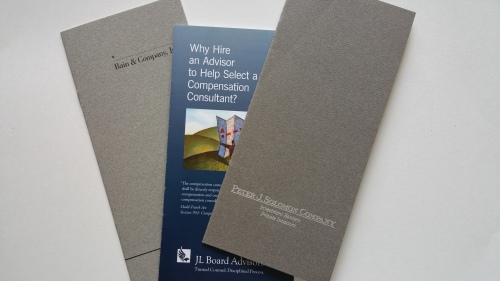 In the dark ages of B2B marketing communications, circa 1980, the goal was to get your snail-mailed communications past the office gatekeepers (a/k/a “executive assistants”), and onto the desks of your targeted decision-makers.





 Marketing Craftsmanship