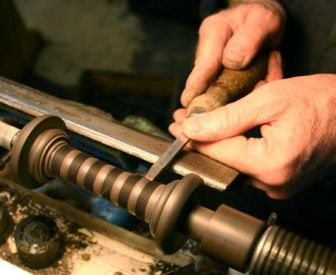
 On a trip to Scotland in the 1980s, from my rented car on a road outside of Glasgow, I spotted a crude hand-painted sign nailed to a tree that read, “Ian McTavish Bagpipe Maker.” I slammed on the brakes and took a sharp left turn up a narrow, dirt road. I had long wanted to play the bagpipes, and in a heartbeat decided that bringing home an authentic set of Scottish bagpipes might help to cross that item off my bucket list.
At the end of the dirt road there were two simple stucco structures, each one about the size of a detached two-car garage. One structure appeared to be a home, with a front door sandwiched between two small windows, and a raised porch. Although it had no signage, the other building had a single, large dirty window, and appeared more likely to be the bagpipe maker’s showroom. There was no vehicle, no barking dog, or any sign of human life. But the showroom door was wide open.
I knocked on the open door and called out as I stepped into the main room, which contained a workbench, some tools hanging from hooks, and a pile of wood scraps. I had imagined a display of bagpipes in various stages of completion, but saw nothing resembling the instrument, in whole or part. Just a dirty room with no apparent purpose. I spent a minute looking at the tools and wondering if I had turned down the wrong road, and just as I decided to leave, a gruff voice from a back room barked, “Whadya want?”
As I jumped to attention, a large, bearded man appeared from a back room, wearing a kilt, black tee shirt and work boots. His boots, knees and hands were covered with mud. He repeated his question, louder. Flustered, and still unsure I was in the right place, I asked politely, “Are you the bagpipe maker?” “Whadya want?” he asked again, providing some comfort that I had a reason to be standing uninvited inside this cranky Scotsman’s workshop.
Finally answering his question, I stammered: “I’m interested in buying a set of bagpipes. Do you have any that I can look at?”
“No,” he said.
After a long pause, he added, “I make pipes to order. There’s none to show ye here.”
“OK then,” I said, searching to create a conversation, “How long does it take you to make a set of pipes?”
“It depends…” he growled, growing impatient with my questions.
I persistent, “What does it depend on?”
“It depends on the weather,” he snapped.
Attempting to decipher his answer and to carry the conversation, I asked, “Does the weather affect the aging of the wood that you use for the pipes?”
He gave me a look of disgust and said, “No. If the weather is nice, I’ll be in my garden, and I won’t be in here makin pipes.”
At this point, having groveled sufficiently, I prepared for my exit with one last shot. “My ancestors are from Scotland, Mr. McTavish, and I’m here visiting some of the places where they lived. I’ve always wanted to learn to play the bagpipes, and was hoping you might be able to help me. But I can see that I’ve disturbed you and I apologize for wasting your time. So good day.”
As I turned toward the door, his said, “Hold on, young man.” His voice softened a bit and he took a step toward me. “I’m the 7th generation of bagpipe makers in me clan, and I make the best pipes in Scotland. You Americans come over here and try to buy me bagpipes so that they can hang em as a decoration over their hearth. But I only make me pipes to be played.”
When he paused, I said, “I’m not going to hang them on the wall. I’m going to learn how to play them.”
He moved even closer, and poked me in the chest, “OK then, lad. Here’s what I’ll do fer ye. Go back to America, find yerself a tutor, and learn to play the practice chanter.”
“I can do that,” I said.
“Good,” he continued. “Then when ye learn how to play the chanter, make a tape of yerself so I can hear what ye sound like. Then, if I think ye play the chanter good enough…ye tell me how much money ye want to spend, and I’ll make ye the best set of bagpipes that yer money can buy anywhere.”
“OK,” I agreed. “I’ll do that.”
He scrawled his address on a piece of paper, and handed it to me. We shook hands and I drove off.
Over the years, life got in the way, and I never got around to sending Ian McTavish an audio tape of my skills on the practice chanter, and as a result, I never had the privilege of owning a set of his bagpipes.
But Ian McTavish, the 7th generation Scottish bagpipe maker, taught me an important marketing lesson I’ve never forgotten:
If you create a product or service of high quality, then you’re entitled to set the bar as high as you like, with respect to those seeking to buy it. It’s difficult to be selective about who your customers are…but this “less is more” discipline makes for happier, longer-term relationships between buyers and sellers…and it never hurts to step away from your business to spend time tending your garden.
 Regardless of industry, conferences and seminars can be a significant waste of time, money and opportunity. But the conference sponsor is typically not at fault for the lack of return on this marketing investment. It’s often the result of poor planning, lack of creativity, outright laziness or unrealistic expectations by the companies that participate in them.
 Regardless of how well a company communicates with the press, it stands a good chance of being “burned” on occasion. From minor misquote to major hatchet-job, these real and perceived offenses occupy the attention of senior managers and their advisors, whose polite clarifications and outraged denials fill the “Letters to the Editor” section of every business and trade publication.
 The most enduring injustice in the world of B2B marketing is that, very often, a firm with strong brand perceptions will be selected over a more qualified, but lesser-known firm. The old adage, “No one was ever fired for hiring IBM,” still rings true in every industry. And firms that understand this market dynamic, and work to build a marketing strategy to address the underlying human issues, can gain market acceptance and compete effectively against larger and better-known competitors.
 Over the past 20 years, most of my firm’s new business has been generated by unsolicited pitch letters sent to targeted prospects. These brief, tailored messages – sent either by email or snail mail – have not only enabled us to maintain a consistent pipeline of clients; but more importantly, we’ve built a practice consisting of high-value companies and people that we wanted to work for. And we’ve never resorted to advertising, sponsorships or other expensive, low-yielding tactics to promote our brand or services.
 For certain industries, such as financial services, that aggregate performance-related data – for example, in annual “league tables” ranking investment banks by the number or size of M&A transactions they’ve underwritten – there is some logic, as well as an objective basis, on which firms can claim to have outperformed their competitors.
 The first question we ask prospective clients is, “Do you have a Marketing Plan?”
 Institutional pedigree always matters, regardless of the type of professional service you’re selling. But to leverage pedigree as a marketing asset, you first need to understand why it’s important to your target audience, and decide what type(s) of pedigree will have the greatest influence on them. The professional credentials your firm possesses (or creates) are a major consideration in determining which doors to knock on, and which doors to ignore.