Tag Archives: #content marketing

Making the Short List: Get into the B2B Game or Go Home

Struggling to make ends meet as a young teacher, I pursued a part-time job as a waiter at a popular local restaurant, where I was told there were no positions available. I completed an employment application…just in case…and handed it to the restaurant manager, who thanked me, and placed my application on top of a very tall stack of papers on his desk.

As I left his office, I asked the manager about my chances of getting a waiter’s job there. “You see this big pile of applications?” he chuckled.

Not satisfied with his answer, I asked, “When a waiter position becomes available, how will you select which candidates to interview?”

The manager replied, “That’s easy. I just pick 3 applications from the top of my pile.”

So I made him an offer. “I really need this job. I’ll come back here every few days to complete a new application, so that mine stays at the top of your pile. Or you can hire me as a busboy right now, and I’ll clear tables and wash dishes for as long as it’s necessary, if you promise to give me the first waiter position that becomes available.”

I served as a busboy for two months before I earned a job as a waiter, which helped to pay my bills. More importantly, the experience provided some valuable insights about “making the short list” that continue to have direct application to our B2B marketing business.

“Making the short list” in B2B marketing means that your firm has been chosen by a prospective client as a candidate for an assignment. At least 3 candidates, and as many as 5 or 6, are typically included on a potential client’s short list.

For a B2B firm, making the short list is always a priority, and here’s what my restaurant experience taught me on the subject:

Provide Good Reasons to be on the Short List

The restaurant manager had a few good reasons to put me on his short list. He knew I was motivated, and different from those applicants who were willing to participate in his selection process.  More importantly, I positioned myself as a safe choice by giving him an opportunity to evaluate my potential as a waiter, based on my actual performance as a busboy.

Your B2B firm must find meaningful ways to differentiate itself and showcase tangible assets. Claiming your firm “has 80 years of combined professional experience,” for example, is not a strong value proposition. Having a blue chip client explain, in a short video, her selection criteria and experience with your firm, is far more likely to earn you a spot on a prospect’s short list. Third-party validation also addresses career risk: the prospect’s fear that hiring the wrong outside resource will affect their own reputation, bonus or employment status.

There are many ways to differentiate yourself in a competitive marketplace, but most often they require some original thought, clever packaging and elbow grease.

Put Your Firm into a Position to Make the Short List

Unlike my tenure as a busboy, you won’t be able to demonstrate value directly to a potential client in advance of an actual engagement. But for starters, your B2B firm must maintain a consistent presence on all the radar screens that your prospects monitor. “Fist-call capability” is how well your firm puts itself in a position to be noticed by target audiences, and it’s the key factor affecting your chances of making the short list.

What’s surprising in our current B2B world – where at least 70% of the short list selection process in made online, in advance of any direct contact – is that so many B2B firms have ineffective or outdated websites; provide no catalysts to drive traffic to their website; generate no content to validate their intellectual capital; and fail to properly leverage social media tools, such as LinkedIn, that prospective clients use to discover candidates for their short list.

Many B2B firms believe that simply doing great work for existing clients will drive all the referrals and word-of-mouth recommendations necessary to put them on short lists, or allow them to avoid having to compete at all.  Their lunch is often eaten by competitors who not only do great work for clients, but also don’t rely on others to put them on the short list.

Increase Your Odds of Making the Short List over the Long Haul

The most difficult aspect of marketing for B2B firms involves transparency: never knowing when your prospects are ready to buy. I was prepared to re-apply for the restaurant’s waiter position every week if necessary; but that level of persistence is more likely to eliminate a B2B firm from short list consideration. A more sophisticated, strategic, nuanced approach is required.

To drive consistent top-of-mind awareness with target audiences, you’ll need to do far more than simply show up all the right radar screens. Over the long haul, your B2B firm must communicate directly, consistently and effectively with its clients, prospects, referral sources and employees.  This is an easy concept to understand, but it’s the exception rather than the rule in B2B marketing. We are more likely to see B2B firms with great thought leadership that’s not appreciated by their target audiences, for lack of an effective CRM system; B2B firms that religiously push out canned newsletters and curated content that diminishes their brand stature; and B2B firms that fail to appreciate how their employees can serve as either brand ambassadors or terrorists.

There’s a profoundly simple, Yogi Berra-esque message here: you first need to get into the game, if you’re hoping to win it. In a business world increasingly driven by RFPs and RFIs, and where gaining and maintaining visibility with decision-makers is essential, B2B firms need to add “Short List Participation Rate” as a key performance indicator for their marketing investment.

Leave a comment

Filed under B2B Marketing, Marketing Strategy

B2B Conferences: Essential Marketing Tactic…or Waste of Time and Money?

Regardless of industry, B2B conferences and seminars can be a significant waste of time, money and opportunity. But the conference sponsor is typically not at fault for the lack of return on this marketing investment. It’s often the result of poor planning, lack of creativity, laziness or unrealistic expectations by the companies that participate in them.

Here are three issues you should address, in advance of investing in a conference of any kind:

Do I understand the inherent marketing value of conferences? Before it became a “pay to play” world, there was some brand stature and inherent 3rd party endorsement associated with participation as a keynote speaker or panelist on a conference agenda. Nowadays, however, even if you’re invited to speak, attendees will likely assume that you’ve paid for the privilege, so the brand cachet is diminished.

The real marketing value of participation in any conference agenda is not based on what you say to the 100 attendees during your 15 minutes on the podium. Instead, it’s based on what you do, both before and after the conference, to reach, influence and engage the 1,000+ or 2,000+ decision-makers who were either too busy or too important to attend the event. In many respects, a conference simply provides a legitimate reason to communicate with those individuals who are most important you.

Do I have the internal discipline to make conferences a worthwhile investment? Because conferences are expensive, inefficient, haphazard and difficult to evaluate, you must establish an internal discipline and specific strategies to harness their marketing value. For starters, you need access to a robust, accurate database of your clients, prospects and referral sources. Possessing a list of conference attendees, either before or after the conference, is of lesser importance.

You also need to create a detailed communications strategy – tailored for each event – that addresses how you intend to:

  • Share intellectual capital associated with the event (either generated by you or someone else), and how to
  • Leverage that intellectual capital to drive engagement with your target audiences either before and / or after the conference.

For example, if you’ve given a conference presentation, you can send highlights of your remarks to your database shortly after the event, and offer to send them your complete remarks or PowerPoint slides. Or you can convert your presentation into a bylined article for publication in an appropriate business or trade journal, and then send target audiences the published piece along with a personalized cover note.

If you’re not on the podium, you’ll need to be more creative. For example, you might send your target audiences a “Sorry I missed you…” communication that provides your insights on the conference’s highlights, or expresses a contrarian viewpoint related to its underlying theme. Or you might even consider hi-jacking the conference agenda, by inviting high-value targets to a roundtable discussion / reception at a very exclusive venue near the event. (Conference sponsors do their best to prevent this type of guerilla marketing.)

In all cases, the strategic goal is to amortize the time and money you’ve invested in the conference, in order to reach a wider and sometimes more appropriate audience. By using the conference credibility (or its related topic / theme) to showcase your intellectual capital, drive top-of-mind awareness and foster direct engagement, you’ll have a much greater likelihood of yielding a connection between the event and tangible business metrics, including new client engagements and revenue growth.

Are my expectations for this conference realistic? Sometimes lightning actually does strike: you’ll make a connection at a conference that eventually leads to new business. But most of the time, putting your company’s logo on a lanyard, participating in a panel discussion, or sponsoring a mid-morning coffee break will lead to absolutely nothing. If there were a consistent direct connection between conference participation and business growth, there would be a very long waiting list for sponsorships.

If you understand that conferences will always be a low percentage marketing strategy, then you have a clear choice. You can either:

  1. Avoid conferences altogether, by hosting your own private events or programs.
  2. Leverage your participation to showcase intellectual capital with a wider audience.
  3. Simply enjoy the camaraderie, the golf / tennis / beach, and the nightlife…and hope for the best. In short, conference participation is similar to all other marketing-related tactics. Smart, focused and strategic will always produce better outcomes than “one-size-fits-all” solutions.

In short, conference participation is similar to all other marketing-related tactics. Smart, focused and strategic will always produce better outcomes than “one-size-fits-all” solutions.

Leave a comment

Filed under Uncategorized

Why Your B2B Marketing Isn’t Working

Inconsistency Kills Most B2B Marketing Strategies

Inconsistency Kills Most B2B Marketing Strategies

There are two major reasons why marketing is ineffective at B2B firms, regardless of size or industry:

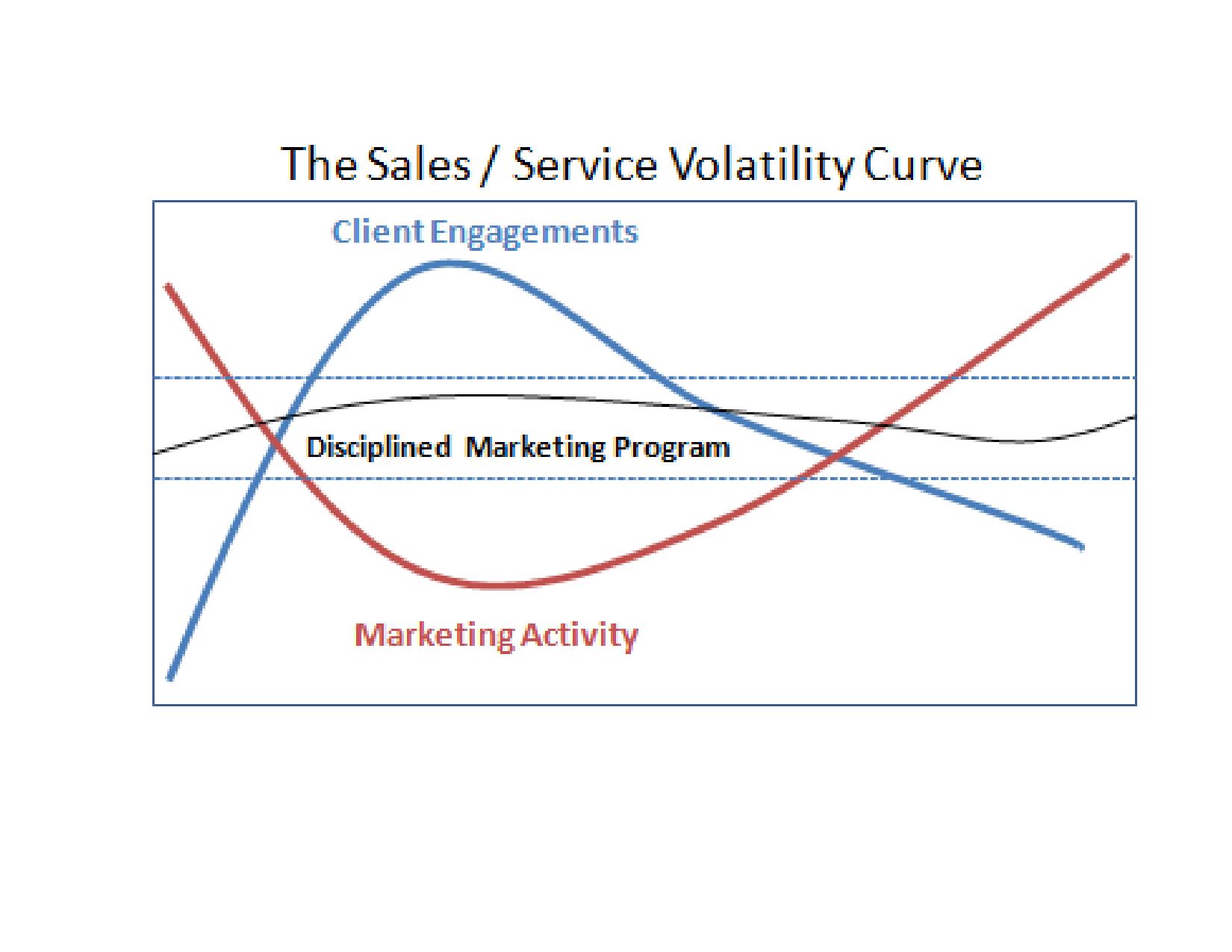
  1. Marketing is viewed as triage. The company applies a collection of tactics (often labeled as a “marketing campaign”) only in response to a problem; typically involving the loss of a key client, or decline in revenue. When business is good, little or no time is invested in marketing. When business (inevitably) takes a dip, marketing becomes a priority. This classic behavior is depicted in the “Sales / Service Volatility Curve” chart above.
  2. Marketing is expected to deliver immediate results. Either because the company views marketing on a cause & effect tactical basis, or because marketing triage must quickly revive an ailing company, the marketing function is given little time to produce tangible results. It’s no surprise that Chief Marketing Officers have the shortest tenure of any corporate function.

Individually or collectively, both of these circumstances drive the #1 reason why B2B marketing does not work:

INCONSISTENCY

The sad truth is that very few B2B firms either understand the marketing function, or have the discipline to design, implement, measure and stick with a marketing approach that builds brand equity and market engagement on a consistent basis.

As an alternative to changing careers, and to establish the infrastructure and internal culture necessary for the discipline to succeed, we offer marketers (and B2B business owners) the following simple path:

  • Create a Written Marketing Plan. Include goals, strategies, responsibilities, timelines, budgets and ways to measure results. Without a Marketing Plan you will not succeed. And unless it’s a written document, you do not have a Marketing Plan.
  • Gain Senior Level Commitment. The corner office must understand, endorse and support the Marketing Plan. The Plan must also be properly staffed and funded upfront.
  • Do a Few Things Very Well. Marketing’s success will be based on the quality and effectiveness of a limited number of strategies / tactics. Less is usually more.
  • Build and Nurture your Database. Direct and easy access to your company’s clients, prospects, referral sources and opinion leaders is essential. Without this pipeline, the marketing value of the content you create is close to zero.
  • Create Meaningful Content. Self-serving white papers and client case studies have very limited appeal. Generate content that validates your company’s intellectual capital, on topics that target audiences have a genuine interest in.
  • Drive Top-of-Mind Awareness. Leverage your thought leadership content by sharing it directly with target audiences on at least a quarterly basis. More importantly, use content to initiate two-way conversations that build relationships in advance of sales.
  • Connect with the Sales Force. There’s no better way to find if and how well your marketing strategies are working, or to gain an understanding of the marketplace.

Most importantly – with apologies to Glengarry Glen Ross – B2B firms must:

A…..Always

B…..Be

M…..Marketing

…for the discipline to be effective. Otherwise, the traditional short-term, hair-on-fire approach to marketing will keep your B2B firm from ever reaching its full potential.

Leave a comment

Filed under Uncategorized

Research Integrity: The Achilles Heel of Content Marketing

The marketing profession has a reputation for sometimes using less than reliable market research to promote a point of view. And this marketer has been guilty of that sin.

Years ago, our insurance company client was introducing a new Directors & Officers liability insurance policy, and asked us to raise market awareness. With good intentions, but given no budget or time to perform proper market research, we interviewed a total of 6 corporate CEOs and board members to provide some validation to the underlying premise of our press release. The headline read: “Most Corporate Directors & Officers Believe They Are Not Protected Properly from Legal Risk.”

With very little expectation that a premise based on such shoddy research would qualify for exposure in the financial press, and dreading inquiries from journalists asking about our research methodology, the release went out. To our great surprise, we received no calls from reporters checking the facts, and the story was immediately picked up by two major wire services, and appeared as a news squib on the front page of the Wall Street Journal, followed by coverage in several business insurance trade publications.

Our client was overjoyed with the media exposure, but we felt less than honorable, and resolved that we would never use market research to promote a client’s product or service unless we believed the supporting methodology had sufficient rigor. And over the years we’ve lost work as a result.

Research integrity was an issue long before the internet became the platform for content marketing. Most often, your research-based news items would not be covered by respected media sources unless you ran the credibility gauntlet. Editors demanded your research methods and data, and had to be convinced that your study was objective and legitimate. Our very thin D&O liability research was a rare and risky exception…and perhaps a sign of things to come.

For well understood reasons, the “legitimate press” now has neither the manpower nor the time to dig deeply for validation of market research that supports content generated by organizations. The loss of this important filter, coupled with the explosion of online content, has created a marketing world in which sloppy, incomplete (and sometimes blatantly false) research generates news items that can go viral and become accepted wisdom. Pumping out content in volume has become far more important than creating high quality content that could withstand the scrutiny of a hard-nosed editor.

What this new world of content marketing means for individuals is simple: assume that all “research-based” information requires close scrutiny. Believe nothing at face value. If it’s important to your business strategy, or you intend to adopt the research to support your own point of view (or upcoming PowerPoint presentation), then you’ll need to become the hard-nosed editor who scrutinizes the original source; who looks at the sample size, respondents, questions asked, etc.; and who determines whether the research results legitimately support the conclusions.

What this new world of content integrity means to companies is more complex: assume that the “research-based” content that you produce is a reflection of your brand’s integrity. For the Marketing Department, this involves educating the corner office regarding the rigor, time and costs involved in market studies, surveys, research necessary to yield content worthy of customer-facing applications. For the corner office, this involves calculating whether the intended marketplace outcome is worth the necessary investment, and avoiding shortcuts.

Without the 4th Estate as the content gatekeeper, there is now far greater opportunity for companies to benefit from content marketing. And by not adopting the market research integrity standards that journalists long upheld, there are far more ways for companies to damage their brand through content marketing.

Leave a comment

Filed under Uncategorized

The Real Price We All Pay for “Brand Journalism”

propaganda babyThe historical roots of journalism, now encompassing all mass media, were nurtured by its role as The Fourth Estate; the independent public watchdog that keeps in check the three major democratic “estates” of power (in Britain the houses of Parliament, in America the three branches of government). So in spite of the great amount of attention it pays to murder trials, royal weddings and the lives of celebrities, the media plays a critical role in a democratic society; and to function properly it must be objective, unbiased, transparent and independent.

One current challenge to journalism’s mandate is that the line between news and entertainment continues to erode. All media sources compete for the same eyeballs, so speed has become more important than accuracy in reporting, and there are no rules regarding how the news is gathered. The journalist’s role has shifted from fact-based reporting to opinion-based commentary. Journalism has morphed into “communitainment.” And Edward R. Murrow is not pleased.

Erosion of journalism’s mandate has accelerated with the growth of “brand journalism,” which is content specifically created to promote commercial interests, very often in a non-transparent manner. Promotional messaging that for decades had been identified and quarantined by the media as ADVERTORIAL content – now safely re-branded as “sponsored” or “native” content – has gained legitimacy as bona fide editorial information worthy of placement in the New York Times or the CBS Evening News.

We live in a world where our knowledge, perceptions and culture are shaped by Google searches, Facebook posts and YouTube videos, and where technology and economic forces have created the perfect Petri dish for commercial agendas to overwhelm the volume and attention given to objective editorial interests. So is there a price to be paid for the loss of a free and independent press?

A few years ago, veteran journalist Bill Moyers explained what’s happened to journalism this way: “Our dominant media are ultimately accountable only to corporate boards whose mission is not life, liberty and the pursuit of happiness for the whole body of our republic, but the aggrandizement of corporate executives and shareholders…These organizations’ self-styled mandate is not to hold public and private power accountable, but to aggregate their interlocking interests. Their reward is not to help fulfill the social compact embodied in the notion of “We, the people,” but to manufacture news and information as profitable consumer commodities.” [Read Bill Moyers “Is the Fourth Estate a Fifth Column?: Corporate media colludes with democracy’s demise” in its entirety.]

As we continue to feast on mind-numbing, easily digested communitainment, and as we readily accept well-disguised commercialized propaganda as objective news and information…let’s keep in mind what we’re really giving up.

Leave a comment

Filed under Uncategorized

Re-Thinking the “Best B2B Advertisement of the 20th Century”

the-man-in-the-chair-mcgraw-hill-885x1024In 1958, Gilbert Morris – an account executive at the Fuller Smith & Ross ad agency – created the, “I don’t know who you are,” business-to-business advertisement for McGraw-Hill Publishing Co. that 41 years later, in 1999, was named the “Best Business-to-Business Ad of the 20th Century” by Advertising Age’s Business Marketing magazine. Quite an achievement.

The iconic print display ad featured an executive in a bow tie hunched forward in a swivel chair, scowling into the camera. (In fact, Gilbert Morris himself was depicted as the executive in the ad.) To promote the practical value of corporate advertising, the ad’s body copy read:

“I don’t know you.

I don’t know your company.

I don’t know your company’s product.

I don’t know what your company stands for.

I don’t know your company’s customers.

I don’t know your company’s record.

I don’t know your company’s reputation.

Now, what was it you wanted to sell me?”

The 56 year-old McGraw-Hill ad concluded with this:

“Moral: Sales start before your salesman calls – with business publication advertising.”

What may have been a revolutionary B2B marketing concept in 1958 is now well understood by B2B marketers. Market awareness, brand impressions and 3rd party endorsements all matter. Sales and marketing must be integrated. We’ve got all that.

But if Gilbert Morris were writing ad copy in 2014, his advertisement would likely reflect very different marketing obstacles for B2B companies. Perhaps something like this:

Leave a comment

Filed under Uncategorized

Confucius Say: Your Case Studies are Worthless

confuciusThe most noteworthy article on B2B selling was published in a 1966 Harvard Business Review article (#66213). In “How to Buy /Sell Professional Services,” author Warren J. Wittreich explains the differences between extrinsic and intrinsic selling.

Extrinsic selling occurs, according to Wittreich, when a B2B seller relies on successful work that’s been performed for other customers, as a means to validate the seller’s capabilities and potential ability to perform for a prospective customer.

The weakness of extrinsic selling is that it requires a prospective customer to make a leap of faith: to believe the service provider will provide a level of success that matches or exceeds the work performed for the seller’s past or current clients. Extrinsic selling is a “trust me” approach, employed by a great number of B2B product and service providers.

Conversely, intrinsic selling does not require a prospective client to base its selection of a seller based on work done for others. No leap of faith required. Instead, it engages the prospect in a meaningful dialogue that (1) addresses their specific situation; (2) demonstrates — on an immediate, first-hand basis — the seller’s understanding of the situation; and (3) validates the seller’s ability to help the potential buyer. Intrinsic selling provides buyers with a significantly higher level of confidence in the seller’s capabilities, and leads to an engagement or sale far more frequently and rapidly than extrinsic selling.

The B2B marketer’s task is to equip the sales force with methodologies and tools that help initiate and facilitate intrinsic selling. This goal is rarely accomplished through anonymous or identified client / customer “case studies,” which are widely used, that prospective clients rarely read, and often carry the same level of credibility as references on a job applicant’s resume. (Would a company ever publish examples of its past work that were not portrayed as highly successful?)

Create Tools to Engage Prospects

One example of effective B2B intrinsic selling involved Phibro Energy’s introduction of energy derivatives…which enabled large companies to manage price risk related to gasoline, jet fuel and heating oil. To capture the attention of CFOs of those companies, and to convince them that energy derivatives were a viable risk management strategy, Phibro’s sales force needed more than brochureware. A prospective client needed to understand exactly how energy derivatives would benefit his company.

To establish an intrinsic sales dynamic, Phibro equipped its sales reps with a worksheet that calculated the range and depth of the prospect’s energy price exposure. Then, by applying a sophisticated algorithm, the sales rep was able to show exactly how energy risk management could improve the CFO’s company’s balance sheet.

Phibro’s energy exposure worksheet not only enabled their sales reps to establish an intrinsic sales dynamic, it cast the sales rep in a consultative role, and positioned Phibro Energy as a resource that could help reduce economic risk and lower operating costs.

Marketers at most B2B businesses, as well as many B2C firms, have similar opportunities to build interactive disciplines and tools — both online and offline — that can empower their sales reps to leverage the power of intrinsic selling. In taking this approach, they also benefit from the wisdom of the marketing master, Confucius, who purportedly wrote:

 I hear…and I forget.

I see…and I remember.

I do…and I understand.

Leave a comment

Filed under Uncategorized

How WebMD Has Changed B2B Marketing Forever

webmd2Many B2B companies, and professional services firms in particular, do not succeed at marketing for two major reasons:

  • Failure to understand that the vendor selection process has fundamentally changed.

Prospective customers now turn to their personal networks and publicly available information — via digital and social media channels—to self-diagnose their problems and to self-prescribe their own solutions. In this new WebMD World of B2B Marketing, making the short list of potential vendors relies heavily on being visible and appearing smart in appropriate online channels on a consistent basis.

To appreciate the magnitude of this shift in how customers select outside resources, consider 2012 market research conducted by the Corporate Executive Board’s Marketing Leadership Council, which surveyed more than 1,500 customer contacts (decision makers and influencers in a recent major business purchase) for 22 large B2B organizations spanning all major NAICS categories and 10 industries. As depicted below, the survey revealed that the average customer had completed nearly 60% of the purchase decision-making process prior to engaging a supplier sales rep directly.  At the upper limit, the responses ran as high as 70%.

57

The implications of this research are clear: B2B companies that fail to “show up strong” in the online world are missing engagement opportunities with potential as well as existing clients.

  • Failure to respond properly to the new vendor selection process.

Unfortunately, many B2B companies that understand the new dynamics of vendor selection have responded in knee-jerk fashion, by saturating every possible online / digital channel and social media platform with content that neither reaches nor resonates with decision makers in their target audiences. Although buyer selection habits have changed, when it comes to brand awareness and positioning of a company’s value proposition, less is still more. And this chart explains why:

Attention Web

The online world makes it easy to obtain information, but extremely difficult to gain attention over all the noise. Increasingly, B2B firms are learning that simply having all the online visibility tools – company blog, Twitter account, Facebook page, LinkedIn profile, etc. – does not guarantee marketplace attention. They’re also learning that tactics designed to feed those online beasts – most often “currated content” from 3rd parties – can be akin to the “throw some shit on the wall and hope something sticks” marketing approach.

The firms benefitting most from the new WebMD World of B2B Marketing apply traditional marketing disciplines: they stake out intellectual territory that supports their brand with insights that are relevant and interesting to clients, prospects and referrals sources; they drive top-of-mind awareness (and new business inquiries) by ensuring that those target audiences receive their insights on a consistent basis; they create opportunities to engage, rather than talk at, decision makers; and they use online tools to enhance, rather than replace, direct communication with existing and prospective customers.


1 Comment

Filed under Uncategorized

The Attention Web: What B2B Marketers Need to Know

For B2B marketers who are too busy to keep up-to-date on every marketing trend and buzzword, here are a few thoughts on all the current noise about the Attention Web:

  • Attention as a marketing asset is not a new concept: Top-of-mind awareness has always served as a cornerstone of effective B2B marketing.  In their 2001 book, The Attention Economy, social scholars Thomas Davenport and John Beck proposed that in today’s information-flooded world, the most scarce resource does not involve ideas, money or talent. They argued that unless companies learn to effectively capture, manage and maintain attention – both internally and in the marketplace – they will fail. Here’s one way to understand what’s happening:

Attention Web

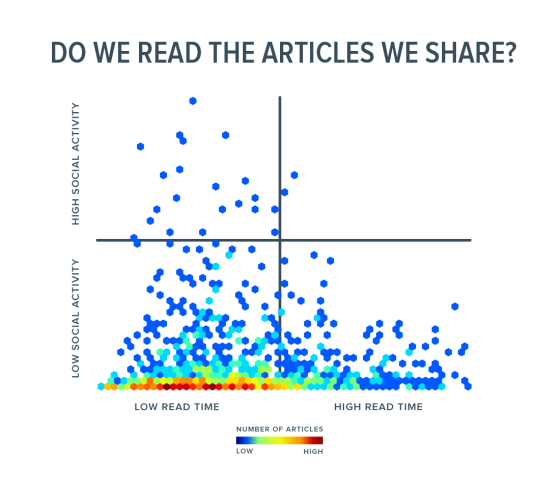
  • Pageviews, Likes, Clicks, Shares and Downloads do not measure engagement: Now that the advertising industry is using actual data to evaluate online behavior, smart B2B marketers can validate what they’ve always suspected about the metrics that are used to measure the effectiveness of the content they produce. There is now hard evidence that shows the number of clicks, comments, and shares are not indicative of how much time people spend engaged with the actual content. One recent study, reflected below – produced by Chartbeat and based on a boatload of data – demonstrates that there is no relationship between how often a piece of content is shared and the amount of attention the average reader will give that content. The good news for B2B marketers is that there are now editorial analytic tools that can provide attention and engagement metrics and insights.

article sharing

  • Attention, engagement and business relationships are driven by quality content: Beyond whatever products or services they sell, all B2B companies must establish credibility and trust with clients, prospects and referral sources. Initial inquiries and longstanding relationships are not nurtured by bombarding target audiences with aggregated content from 3rd parties. The most successful B2B firms only associate their brand with highly relevant content, most often home-grown, that supports their value proposition, stakes out intellectual territory, avoids self-serving claims and truly differentiates their company from competitors. Less can be more, when it comes to B2B content.


  • Don’t rely on the internet exclusively to generate market attention. For B2B firms, direct communication (email, snail mail, face-to-face, etc.) with target audiences remains the most effective means of gaining and maintaining engagement. If you’ve created high quality content, ensure that it earns an adequate marketing ROI by consistently putting it in front of the right people; don’t expect them to find your content by themselves on your company website or blog, on LinkedIn or through Twitter. Those online channels should be considered a secondary, rather than the primary means, of generating attention and engagement through content.

Leave a comment

Filed under Uncategorized

Peter Drucker on “The Four Roles of the CFO”

Dr. Peter F. Drucker, Management Thought Leader

In the early 1990s, Highlander Consulting was engaged by Phibro Energy to help introduce energy derivatives to Chief Financial Officers at corporations with substantial exposure to fluctuations in oil, gasoline and jet fuel prices.

As part of an integrated marketing strategy, management legend Dr. Peter F. Drucker, then serving as a professor at Claremont Graduate School, was engaged to serve as keynote speaker at the Phibro Energy Risk Management Forum, held at The Metropolitan Club in New York City.

Dr. Drucker, who passed away at age 95 in 2005, chose to speak on what he called, “The Four Roles of the CFO.” His remarks before more than 200 CFOs appear to be as relevant now as when he spoke to them nearly 25 years ago.

Here are some highlights from Peter Drucker’s presentation, which can not be found in any one of his 39 books:

The CFO as Information Officer:

“The original role of the CFO was to be the information officer of the business…Accounting, which is information, is changing today more than it has changed in the last hundred years…CFOs will have to make an important decision for their companies not very far down the line, on how to get rid of the pernicious rift between information that is concept-focused, which is accounting, and information that is transaction-focused, which is computerized information…

“The notion that you should split these two universes of information between the Chief Financial Officer, who is responsible for financial information, and the Chief Information Officer, who is responsible for non-financial information is not a good idea…

“The only reliable information we have available to us basically is “inside” information, mostly in our accounting systems. And yet, the events that really determine the success of business do not happen on the inside…So CFOs have a big job ahead: bringing together information channels, and learning an accounting system that’s going to be very different. It will require an ability to get “inside” information by manipulating figures quickly, and combining it with “outside” information, which is largely anecdotal today.”

The CFO as Financial Advisor:

“The Chief Financial Officer must think about the financial consequences of projected policies and actions, not only in terms of costs but in terms of the allocation of scarce resources…So the chief financial adviser’s job is to think about opportunity costs, and most CFOs don’t do this…As a CFO, you must think about what a policy or project is likely to return. Also think about the consequences if it doesn’t work…So the chief financial adviser basically is a conscience, a financial conscience.”

The CFO as Productivity Manager:

“There is a third CFO function, which is managing money for the business. I’m not talking of the treasury function; that is only a small part of it. The biggest part of this involves managing the productivity of capital…It’s my view that you can increase the productivity of capital in any organization three percent a year compounded, by just plain hard work, provided it’s allocated properly. And this is a function which is not, bluntly, on your professional agenda today…

“Top management doesn’t think financially. They think in terms of next quarter’s dividend, and that’s not thinking financially. They don’t think in terms of the financial impact of business decisions and the business impact of financial decisions. And that, I think, is your biggest educational job ahead.”

The CFO as Asset Protector:

“The fourth dimension of the CFO’s role is the preservation and protection of assets. This is a duty of a company that benefits not only the shareholders, but also society…The stupidest thing you can do is attempt to predict the future. Brilliant people have seen that those who predict eventually come to grief. Truly brilliant people understand that they must make external fluctuations irrelevant to their business…

“The protection of assets involves making sure that the risks over which you have no control are managed, and do not interfere with the conduct of the business. Losses based on fluctuations of commodities are no longer permissible, any more than it is permitted to have a factory burn down without insurance coverage. These are manageable risks.”

If you’d like to receive a copy of Peter Drucker’s complete remarks at the Phibro Energy Risk Management Forum in 1991, just shoot me a note.

10 Comments

Filed under Uncategorized