Tag Archives: #marketing

The Road to Hedge Fund Transparency: Marketing Essentials and Potential Pitfalls

To survive and prosper in a marketplace where transparency and trust are now valued by investors and promoted by regulators, hedge funds will be increasingly required to build a rational and risk-averse approach to external communication. Ideally, those plans will also avoid many of the non-productive tactics that marketers are known to promote.

Here’s a marketing roadmap designed to achieve that objective:

Build your brand strategy first. This internal discipline yields a unified view and clear expression of what your firm seeks to achieve for investors, how it addresses that goal, what makes it uniquely qualified for consideration, and why investors should select and trust your firm. An upfront articulation of the firm’s value proposition serves as the cornerstone of a written marketing plan that should include: tangible business goals, appropriate marketing strategies and tactics, calendarized activity, budgets and accountabilities. Any firm that operates without a formal plan (which should be simple, and not take months to create), eventually becomes a victim of “trust me it’s working” marketing. No plan = lots of wheel-spinning + no tangible business outcomes.

Create a bona fide website, not a proxy. In an online world, websites are the mother ship of market transparency. If a hedge fund is unwilling to provide on its website essential information related to its capabilities and credibility, then the firm is not really serious about market communication. Ideally, your website should express institutional values, explain investment processes, showcase human capital, provide examples of thought leadership and include inherent 3rd party endorsements. It’s not a sales pitch or report card. Your website will generate investor interest by allowing visitors to draw their own conclusions about the firm and its potential to help them achieve their goals.

Leverage your firm’s intellectual capital. Thought leadership – which is overused marketing jargon – is a strategy that leverages knowledge and ideas to engage target audiences. Effective thought leadership can involve a broad range of marketing tactics, but should always be designed to achieve measurable goals; not to simply have people think you’re smart. A hedge fund’s intellectual capital represents its most powerful market differentiator, and can be showcased without giving away any proprietary information or methodologies.

Harness the market reach of LinkedIn. LinkedIn has become an important due diligence tool for investors, intermediaries and the financial press. Most hedge funds understand this, and either provide a very basic firm profile, and / or allow its employees to post their personal profiles on LinkedIn. But to harness LinkedIn’s enormous market reach and professional clientele, hedge funds must establish a buttoned-up institutional persona that’s consistent with the firm’s (bona fide) website; ensure that its employees’ profiles enhance the firm’s brand positioning; and take full advantage of appropriate user groups on LinkedIn to raise brand visibility and display its thought leadership. 

Hold off on Twitter and other social media sites. Twitter can be a great information source, and most hedge funds should use it exclusively for that purpose: to listen rather than to speak. Few hedge funds have the time or social media sophistication to engage safely and consistently on Twitter, and the compliance risks are significant. Facebook is simply not an appropriate channel for hedge funds, and posting comments on independent blogs or online publications will not yield meaningful results.

Manage press exposure selectively. Beneficial media exposure can provide valuable brand credibility. But this is a high-risk tactic because reporters have agendas, can make mistakes, and are not in business to make your firm look good. However, hedge funds should proactively seek media exposure through participation in targeted editorial opportunities – such as bylined articles, OpEd pieces and certain types of feature articles – if they provide total or nearly complete control over what’s published. Although guest spots on financial news channels such as CNBC can fuel the ego, these are high-risk opportunities that most hedge funds should avoid.

Unfortunately, most media coverage yields no marketing value, because it’s simply hung like a hunting trophy on a firm’s website. To benefit from the implied 3rd party endorsement, beneficial coverage must be properly integrated into the firm’s direct communication strategy with clients, prospects and referral sources.

Merchandise conference participation. Investor conferences are high-cost tactics that can be effective for hedge funds. But these events also yield low results because firms fail to properly re-purpose the related thought leadership they’ve produced; which can serve as raw material to influence target audiences that are much larger, and sometimes of higher value, than those in attendance at the conference. Doing all the heavy lifting (in terms of content preparation, travel, time away from office and home), but failing to benefit from that investment – both before or after the event itself – represents a tangible opportunity loss.

Forget advertising for now, and perhaps forever. Regulators have not made it easy for hedge funds to understand the rules of the new advertising game, so the industry is better off encouraging the very large players – with deep compliance muscle – to be the first ones on the field. But there are more significant reasons why most hedge funds should never include advertising in their marketing plans. Notably, institutional advertising is expensive, requires a long-term commitment to be effective, and is very difficult to measure or generate a market response. More importantly, at most hedge funds there is an extensive list of marketing strategies and tactics (for example, building an effective website) that should be addressed first, and that will provide a more meaningful return than advertising.

As market dynamics of the investment world drag hedge funds, however reluctantly, into the new era of transparency, there is some good news for those firms. Hedge funds have long demonstrated their ability to sustain a successful business enterprise without traditional marketing tactics. So any benefits that effective market communication might provide for them are very likely to result in incremental asset growth.

Additionally, because hedge funds do not currently depend on marketing for survival, they can act in a deliberate, strategic manner. Hedge funds have the luxury of being able to design and implement their marketing programs incrementally, and to focus on doing a limited number of things very well.

In that regard, other vertical industries may eventually point to hedge funds as examples of best practices in branding and marketing. But at the current rate of change, that’s unlikely to occur in our lifetimes.


Leave a comment

Filed under Uncategorized

Research Integrity: The Achilles Heel of Content Marketing

The marketing profession has a reputation for sometimes using less than reliable market research to promote a point of view. And this marketer has been guilty of that sin.

Years ago, our insurance company client was introducing a new Directors & Officers liability insurance policy, and asked us to raise market awareness. With good intentions, but given no budget or time to perform proper market research, we interviewed a total of 6 corporate CEOs and board members to provide some validation to the underlying premise of our press release. The headline read: “Most Corporate Directors & Officers Believe They Are Not Protected Properly from Legal Risk.”

With very little expectation that a premise based on such shoddy research would qualify for exposure in the financial press, and dreading inquiries from journalists asking about our research methodology, the release went out. To our great surprise, we received no calls from reporters checking the facts, and the story was immediately picked up by two major wire services, and appeared as a news squib on the front page of the Wall Street Journal, followed by coverage in several business insurance trade publications.

Our client was overjoyed with the media exposure, but we felt less than honorable, and resolved that we would never use market research to promote a client’s product or service unless we believed the supporting methodology had sufficient rigor. And over the years we’ve lost work as a result.

Research integrity was an issue long before the internet became the platform for content marketing. Most often, your research-based news items would not be covered by respected media sources unless you ran the credibility gauntlet. Editors demanded your research methods and data, and had to be convinced that your study was objective and legitimate. Our very thin D&O liability research was a rare and risky exception…and perhaps a sign of things to come.

For well understood reasons, the “legitimate press” now has neither the manpower nor the time to dig deeply for validation of market research that supports content generated by organizations. The loss of this important filter, coupled with the explosion of online content, has created a marketing world in which sloppy, incomplete (and sometimes blatantly false) research generates news items that can go viral and become accepted wisdom. Pumping out content in volume has become far more important than creating high quality content that could withstand the scrutiny of a hard-nosed editor.

What this new world of content marketing means for individuals is simple: assume that all “research-based” information requires close scrutiny. Believe nothing at face value. If it’s important to your business strategy, or you intend to adopt the research to support your own point of view (or upcoming PowerPoint presentation), then you’ll need to become the hard-nosed editor who scrutinizes the original source; who looks at the sample size, respondents, questions asked, etc.; and who determines whether the research results legitimately support the conclusions.

What this new world of content integrity means to companies is more complex: assume that the “research-based” content that you produce is a reflection of your brand’s integrity. For the Marketing Department, this involves educating the corner office regarding the rigor, time and costs involved in market studies, surveys, research necessary to yield content worthy of customer-facing applications. For the corner office, this involves calculating whether the intended marketplace outcome is worth the necessary investment, and avoiding shortcuts.

Without the 4th Estate as the content gatekeeper, there is now far greater opportunity for companies to benefit from content marketing. And by not adopting the market research integrity standards that journalists long upheld, there are far more ways for companies to damage their brand through content marketing.

Leave a comment

Filed under Uncategorized

Hedge Fund Marketing: From Oxymoron to Best Practices

HFJ_logo

Published in January 2015 Edition

This past September, the well-respected marketing firm, Peppercom, conducted in-depth research involving nearly 300 of the hedge fund industry’s largest firms, to measure how those funds are currently applying standard marketing tools & tactics including websites, social media, the financial press and advertising, one year after the JOBS Act.

Peppercom’s research paper begins with the statement that, “The private world of hedge funds is looking more like Madison Avenue.” But a close examination of the study’s findings suggests that this observation may be wishful thinking.

In terms of marketing sophistication, the hedge fund industry lags far behind all other financial and professional services, across every sub-category. Peppercom’s research shows that:

  • Nearly all of the largest funds have a website, but most of those websites have no marketing value, and consist of little more than a logo and contact information.
  • Two-thirds of the largest hedge funds have a LinkedIn presence, but only 10 of those funds post any meaningful content on that social media site. Very few funds have Twitter accounts.
  • Hedge funds continue to be a hot topic covered by the financial media, but most funds refuse to talk to the press.
  • The anticipated JOBS Act-related groundswell of advertising by hedge funds “seems more like a trickle than a deluge.” Despite the research study’s sugar-coating (for example, “…mid-sized funds…are beginning to understand the importance of a website.”), hedge fund resistance to marketing is unlikely to abate anytime soon.

And there are both good and bad reasons why these sophisticated, deep-pocketed companies refuse to communicate externally in an effective, transparent manner:

Bad Reason: Misguided Mystique: Many hedge funds embrace the notion that an opaque brand image creates a mystique that’s appealing to sophisticated and well-heeled investors and intermediaries. They believe common marketing practices will diminish their “private club” exclusivity. An OpEd piece published recently on the Hedge Fund Marketing Alliance website sums up the prevailing attitude: “Online universities and community colleges advertise—Harvard and Yale do not.”

Good & Bad Reason: Fear of Visibility: Many funds believe marketing makes them more of a target for regulators. In a business where an S.E.C. inquiry can send investors running for the exits, “out of sight / out of mind” appears to be a prudent risk management strategy. Many funds prefer to restrict market visibility, and even sacrifice potential asset growth, rather than to put the firm’s reputation and entire business in jeopardy by raising its public profile.

Although their trepidation regarding visibility may be well-founded, funds can gain some level of comfort knowing that regulators now publicly encourage market transparency. In October 2013, S.E.C. Chairwoman Mary Jo White stated that, “…hedge fund managers feel they have a new freedom to communicate with the public, to advertise, to talk to reporters, to speak at conferences and, most importantly, communicate with investors openly and frankly. And, you can do these things without the fear of securities regulators knocking on your door, or your outside counsel screaming at you.”

My mother’s advice given decades ago to my two younger sisters regarding teen-aged boys may also apply here. She warned them, “It’s always the quiet ones that you need to keep your eye on.” Based on a similar rationale, regulators may also be more likely to focus attention on funds that have very little to say about the nature of their business.

Good Reason: Marketing Confusion: Regulators and marketers share equal responsibility for the widespread misunderstanding about what’s considered permissible and effective marketing for hedge funds. Regulators create incomprehensible rules of engagement, and marketers offer strategies and tactics that often have no connection with tangible business results, and that sometimes put funds at greater risk of violating fuzzy regulations.

Because of this confusion regarding the definition of a risk-averse and effective marketing strategy, many well-intentioned hedge funds that otherwise support the underlying notion of market transparency will pursue the path of least resistance. Most often, that means doing nothing.

Marketing Essentials and Potential Pitfalls on the Road to Transparency

Changing their existing culture, addressing regulatory concerns and deciphering marketing propaganda are not easy tasks for hedge funds of any size. But to survive and prosper in a marketplace where transparency and trust are now valued by investors and promoted by regulators, hedge funds will be increasingly required to build a rational, risk-averse approach to external communication.Here is a roadmap designed to address that marketing challenge:

Build your brand strategy first. This internal discipline yields a unified view and clear expression of what your firm seeks to achieve for investors, how it addresses that goal, what makes it uniquely qualified to achieve that goal, and why investors should select and trust your firm. This articulation of the firm’s value proposition serves as the cornerstone of a written marketing plan that should includes: tangible business goals, appropriate marketing strategies and tactics, calendarized activity, budgets and accountabilities. Any firm that operates without a formal plan (which should be simple, and not require a lengthy process to create), eventually becomes a victim of “trust me it’s working” marketing.

Create a bona fide website, not a proxy. In an online world, websites are the mother ship of market transparency. If a hedge fund is unwilling to provide on its website essential information related to its capabilities and credibility, then the firm is not really serious about market communication. Ideally, your website should express institutional values, explain processes, showcase human capital, provide examples of thought leadership and include inherent 3rd party endorsements. It’s not a sales pitch or report card. Your website will generate investor interest by allowing visitors to draw their own conclusions about the firm and its potential to help them achieve their goals.

But increasingly, investors are demanding transparency. An Opalesque survey showed that 98% of more than 100 institutional investors, family offices and UHNW investors had declined to put money with at least one hedge fund manager because of transparency concerns. And a growing body of market research confirms the weak correlation between fund performance and investor contributions. So understanding of a firm’s investment process, rather than brand mystique, is at least as important as its track record as a driver of asset flows.

Leverage your firm’s intellectual capital. Thought leadership – which is overused marketing jargon – is a strategy that leverages knowledge and ideas to engage target audiences. Effective thought leadership can involve a broad range of marketing tactics, but should always be designed to achieve measurable business goals; not to simply have people think you’re smart. A hedge fund’s intellectual capital represents its most powerful market differentiator, and can be showcased without giving away any proprietary information or methodologies.

Harness the market reach of LinkedIn. LinkedIn has become an important due diligence tool for investors, intermediaries and the press. Most hedge funds understand this, and either provide a very basic firm profile, and / or allow its employees to post their personal profiles on LinkedIn. But to harness LinkedIn’s enormous market reach and professional clientele, hedge funds need to establish a buttoned-up institutional LinkedIn presence that’s consistent with the firm’s (bona fide) website; ensure that its employees’ profiles enhance the firm’s brand positioning; and take full advantage of appropriate user groups on LinkedIn to raise brand visibility and display its thought leadership.

Hold off on Twitter and other social media sites. Twitter can be a great information source, and most hedge funds should use it exclusively for that purpose: to listen rather than to speak. Twitter is a content beast that demands constant feeding, but few hedge funds have the time or social media sophistication to engage safely and consistently. Facebook is not an appropriate channel for hedge funds, and posting comments on independent blogs or online publications will not yield meaningful results.

Manage press exposure selectively. Beneficial media exposure can provide valuable brand credibility. But this is a high-risk tactic because reporters have agendas, can make mistakes, and are not in business to make your firm look good. However, hedge funds should proactively seek media exposure through participation in targeted editorial opportunities – such as bylined articles, OpEd pieces and certain types of feature articles – that provide total or nearly complete control over what’s published. Although guest spots on financial news channels such as CNBC can fuel the ego, these are high-risk opportunities that most hedge funds should avoid.

Merchandise conference participation. Investor conferences are high-cost tactics that can be effective for hedge funds. But these events often yield low results because firms fail to properly re-purpose the related thought leadership they’ve produced; which can serve as raw material to influence target audiences that are much larger, and sometimes of higher value, than those in attendance at the conference. Doing all the heavy lifting (in terms of content preparation, travel, time away from office and home), but failing to benefit from that investment either before or after the event itself, represents a tangible opportunity loss.

Forget advertising for now, and perhaps forever. Regulators have not made it easy for hedge funds to understand the rules of the new advertising game, so the industry is better off encouraging the very large players – with deep compliance muscle – to be the first ones on the field. But there are more significant reasons why most hedge funds should never include advertising in their marketing plans. Notably, institutional advertising is expensive, requires a long-term commitment, and is very difficult to measure or generate a market response. More importantly, at most hedge funds there is an extensive list of marketing strategies and tactics (for example, building an effective website) that should be addressed first, and that will provide a more meaningful return than advertising.

As market dynamics of the investment world drag hedge funds, however reluctantly, into the new era of transparency, there is some good news for those firms. Hedge funds have long demonstrated their ability to sustain a successful business enterprise without traditional marketing tactics. So any benefits that effective market communication might provide for them are very likely to result in incremental asset growth.

Additionally, because hedge funds do not currently depend on marketing for survival, they can act in a deliberate, strategic manner. Hedge funds have the luxury of being able to design and implement their marketing programs incrementally, and to focus on doing a limited number of things very well. In that regard, other vertical industries may eventually point to hedge funds as examples of best practices in branding and marketing.

So perhaps hedge funds are not marketing Neanderthals. They are simply late bloomers.

Leave a comment

Filed under Uncategorized

Confucius Say: Your Case Studies are Worthless

confuciusThe most noteworthy article on B2B selling was published in a 1966 Harvard Business Review article (#66213). In “How to Buy /Sell Professional Services,” author Warren J. Wittreich explains the differences between extrinsic and intrinsic selling.

Extrinsic selling occurs, according to Wittreich, when a B2B seller relies on successful work that’s been performed for other customers, as a means to validate the seller’s capabilities and potential ability to perform for a prospective customer.

The weakness of extrinsic selling is that it requires a prospective customer to make a leap of faith: to believe the service provider will provide a level of success that matches or exceeds the work performed for the seller’s past or current clients. Extrinsic selling is a “trust me” approach, employed by a great number of B2B product and service providers.

Conversely, intrinsic selling does not require a prospective client to base its selection of a seller based on work done for others. No leap of faith required. Instead, it engages the prospect in a meaningful dialogue that (1) addresses their specific situation; (2) demonstrates — on an immediate, first-hand basis — the seller’s understanding of the situation; and (3) validates the seller’s ability to help the potential buyer. Intrinsic selling provides buyers with a significantly higher level of confidence in the seller’s capabilities, and leads to an engagement or sale far more frequently and rapidly than extrinsic selling.

The B2B marketer’s task is to equip the sales force with methodologies and tools that help initiate and facilitate intrinsic selling. This goal is rarely accomplished through anonymous or identified client / customer “case studies,” which are widely used, that prospective clients rarely read, and often carry the same level of credibility as references on a job applicant’s resume. (Would a company ever publish examples of its past work that were not portrayed as highly successful?)

Create Tools to Engage Prospects

One example of effective B2B intrinsic selling involved Phibro Energy’s introduction of energy derivatives…which enabled large companies to manage price risk related to gasoline, jet fuel and heating oil. To capture the attention of CFOs of those companies, and to convince them that energy derivatives were a viable risk management strategy, Phibro’s sales force needed more than brochureware. A prospective client needed to understand exactly how energy derivatives would benefit his company.

To establish an intrinsic sales dynamic, Phibro equipped its sales reps with a worksheet that calculated the range and depth of the prospect’s energy price exposure. Then, by applying a sophisticated algorithm, the sales rep was able to show exactly how energy risk management could improve the CFO’s company’s balance sheet.

Phibro’s energy exposure worksheet not only enabled their sales reps to establish an intrinsic sales dynamic, it cast the sales rep in a consultative role, and positioned Phibro Energy as a resource that could help reduce economic risk and lower operating costs.

Marketers at most B2B businesses, as well as many B2C firms, have similar opportunities to build interactive disciplines and tools — both online and offline — that can empower their sales reps to leverage the power of intrinsic selling. In taking this approach, they also benefit from the wisdom of the marketing master, Confucius, who purportedly wrote:

 I hear…and I forget.

I see…and I remember.

I do…and I understand.

Leave a comment

Filed under Uncategorized

How WebMD Has Changed B2B Marketing Forever

webmd2Many B2B companies, and professional services firms in particular, do not succeed at marketing for two major reasons:

  • Failure to understand that the vendor selection process has fundamentally changed.

Prospective customers now turn to their personal networks and publicly available information — via digital and social media channels—to self-diagnose their problems and to self-prescribe their own solutions. In this new WebMD World of B2B Marketing, making the short list of potential vendors relies heavily on being visible and appearing smart in appropriate online channels on a consistent basis.

To appreciate the magnitude of this shift in how customers select outside resources, consider 2012 market research conducted by the Corporate Executive Board’s Marketing Leadership Council, which surveyed more than 1,500 customer contacts (decision makers and influencers in a recent major business purchase) for 22 large B2B organizations spanning all major NAICS categories and 10 industries. As depicted below, the survey revealed that the average customer had completed nearly 60% of the purchase decision-making process prior to engaging a supplier sales rep directly.  At the upper limit, the responses ran as high as 70%.

57

The implications of this research are clear: B2B companies that fail to “show up strong” in the online world are missing engagement opportunities with potential as well as existing clients.

  • Failure to respond properly to the new vendor selection process.

Unfortunately, many B2B companies that understand the new dynamics of vendor selection have responded in knee-jerk fashion, by saturating every possible online / digital channel and social media platform with content that neither reaches nor resonates with decision makers in their target audiences. Although buyer selection habits have changed, when it comes to brand awareness and positioning of a company’s value proposition, less is still more. And this chart explains why:

Attention Web

The online world makes it easy to obtain information, but extremely difficult to gain attention over all the noise. Increasingly, B2B firms are learning that simply having all the online visibility tools – company blog, Twitter account, Facebook page, LinkedIn profile, etc. – does not guarantee marketplace attention. They’re also learning that tactics designed to feed those online beasts – most often “currated content” from 3rd parties – can be akin to the “throw some shit on the wall and hope something sticks” marketing approach.

The firms benefitting most from the new WebMD World of B2B Marketing apply traditional marketing disciplines: they stake out intellectual territory that supports their brand with insights that are relevant and interesting to clients, prospects and referrals sources; they drive top-of-mind awareness (and new business inquiries) by ensuring that those target audiences receive their insights on a consistent basis; they create opportunities to engage, rather than talk at, decision makers; and they use online tools to enhance, rather than replace, direct communication with existing and prospective customers.


1 Comment

Filed under Uncategorized

The Attention Web: What B2B Marketers Need to Know

For B2B marketers who are too busy to keep up-to-date on every marketing trend and buzzword, here are a few thoughts on all the current noise about the Attention Web:

  • Attention as a marketing asset is not a new concept: Top-of-mind awareness has always served as a cornerstone of effective B2B marketing.  In their 2001 book, The Attention Economy, social scholars Thomas Davenport and John Beck proposed that in today’s information-flooded world, the most scarce resource does not involve ideas, money or talent. They argued that unless companies learn to effectively capture, manage and maintain attention – both internally and in the marketplace – they will fail. Here’s one way to understand what’s happening:

Attention Web

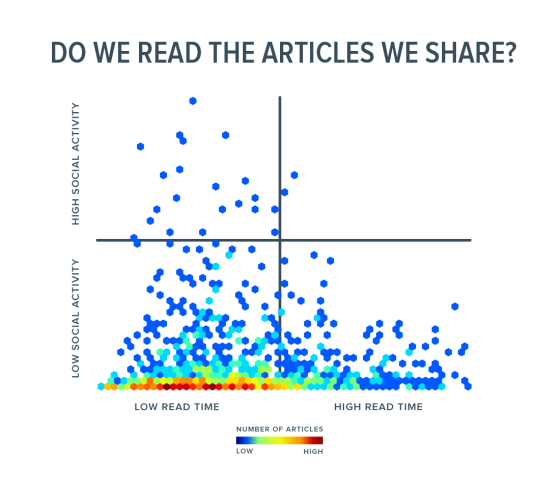
  • Pageviews, Likes, Clicks, Shares and Downloads do not measure engagement: Now that the advertising industry is using actual data to evaluate online behavior, smart B2B marketers can validate what they’ve always suspected about the metrics that are used to measure the effectiveness of the content they produce. There is now hard evidence that shows the number of clicks, comments, and shares are not indicative of how much time people spend engaged with the actual content. One recent study, reflected below – produced by Chartbeat and based on a boatload of data – demonstrates that there is no relationship between how often a piece of content is shared and the amount of attention the average reader will give that content. The good news for B2B marketers is that there are now editorial analytic tools that can provide attention and engagement metrics and insights.

article sharing

  • Attention, engagement and business relationships are driven by quality content: Beyond whatever products or services they sell, all B2B companies must establish credibility and trust with clients, prospects and referral sources. Initial inquiries and longstanding relationships are not nurtured by bombarding target audiences with aggregated content from 3rd parties. The most successful B2B firms only associate their brand with highly relevant content, most often home-grown, that supports their value proposition, stakes out intellectual territory, avoids self-serving claims and truly differentiates their company from competitors. Less can be more, when it comes to B2B content.


  • Don’t rely on the internet exclusively to generate market attention. For B2B firms, direct communication (email, snail mail, face-to-face, etc.) with target audiences remains the most effective means of gaining and maintaining engagement. If you’ve created high quality content, ensure that it earns an adequate marketing ROI by consistently putting it in front of the right people; don’t expect them to find your content by themselves on your company website or blog, on LinkedIn or through Twitter. Those online channels should be considered a secondary, rather than the primary means, of generating attention and engagement through content.

Leave a comment

Filed under Uncategorized

Client Newsletters: Empty Suit of the B2B Marketing Mix

Most Client Newsletters Deliver No Tangible Value

Most Client Newsletters Deliver No Tangible Business Value

Client newsletters are the most widely used, often abused and hotly debated B2B marketing tactic for professional services firms of any size. Here are three highly subjective myths and realities to help your firm determine whether it’s a worthwhile tool, or how to improve your current newsletter.

MYTH #1:        Your Firm Needs a Client Newsletter

Marketers want you to believe that your firm needs a client newsletter. But traditional newsletters – containing commentary ranging from tax legislation to new technology, or who’s joined the firm – are not a marketing necessity. In fact, at many firms their client newsletter is a marketing albatross. Each issue involves a frustrating hunt for timely information of genuine interest that has not already been provided to clients by another news source. Some firms avoid this pain by slapping their logo on boilerplate content purchased from a 3rd party, but those firms can pay a bigger price, in terms of brand damage. Canned content says to target audiences, “We value our relationship, but we don’t really care enough (or know enough) to produce our own newsletter.”

REALITY #1:     Your Firm Needs to Drive Top-of-Mind Awareness

The intrinsic purpose of tactics that communicate with clients, prospects and referral sources is to reinforce the perception that your firm is smart, trustworthy and prepared to help. Beyond keeping and growing existing clients, your primary marketing goal is to drive top-of-mind awareness with target audiences. That way, when a prospect is seeking assistance, there’s a greater likelihood your firm will be selected, or at least will be put on the “short list” of candidates. If that’s the goal, then consistency and quality of the contact are critical; neither of which necessarily require a newsletter format to accomplish.

___________

MYTH #2:        People Want to Learn About Your Firm’s Success

It’s nice to think that clients and prospects really care about your firm’s growth and accomplishments. The sad truth is that your success is more important to your competitors, and to current and prospective employees than it is to clients who generate revenue for the firm. Blowing your own horn can also backfire. When your firm touts that a senior partner has just published a book and was a guest on CNBC, your target audiences may wonder why that partner isn’t focused on client matters rather than self-promotion, or whether the cost of his book’s publicity tour will result in higher hourly rates.

REALITY #2:     Your Clients, Prospects and Referral Sources Care about Themselves

Understanding that all people are self-interested can make you a better marketer. Rather than creating newsletter content that’s based on what you know, on what you’ve done or on what you can do, focus instead on the ideas, talents and accomplishments of your target audiences, regardless of whether your firm played any role in their success. This is a very tough concept for many B2B firms to understand and embrace: that the most powerful form of thought leadership does not involve pushing out your own ideas. Instead, it involves deciding what ideas merit the attention of your target audiences, as well as what voices are worth listening to. True thought leaders seek to manage the conversation, not to control it.

_________

MYTH #3:        A Newsletter is a Cost-Effective Marketing Tactic

The old saw, “Cheap is dear” rings true when it comes to newsletters. If it’s created in-house, few firms actually track the hours required to write, edit, approve and publish their newsletter. If it consists of cut & paste content, few firms consider the cost of producing a newsletter that very few people will read or respect. Regardless of content, only a small number of professional service firms proactively work to expand their newsletter’s reach, to maintain an adequate CRM capability, or to properly leverage readership analytics from open and click-thru rates, if their newsletter is delivered online.

REALITY #3:     Your Marketing Requires More than a One-Way Conversation

Newsletters are one-way conversations. A fundamental marketing objective is to engage clients and prospects in a conversation regarding their specific needs and opportunities. Despite the buzz regarding social media, that channel can also fall short in terms of engagement. If your firm’s traditional and social media marketing tactics do not serve as catalysts to drive Face-to-Face discussions and Word-of-Mouth referrals, then their “cost-effectiveness” can never be measured on a meaningful basis.

2 Comments

Filed under Uncategorized

Did Reader’s Digest Flunk Its Own Trust Test?

It Pays to Get a Second Opinion

…and I have a highly rated TV show.

In an effort to goose newsstand sales, the June issue of Reader’s Digest features a cover story entitled, “The 100 Most Trusted People in America Today.” Although the article’s “most trusted” claim is far from trustworthy (in fact, 1,000 people voted on 200 American “opinion shapers and headline makers” that Reader’s Digest had pre-selected), there are some quirky results worth noting.

According to the survey:

  • Americans trust doctors, especially if they’re on TV. For example, Dr. Oz (#16) and Sanjay Gupta (#17) outscored respected medical authors Andrew Weil (#75) and Deepak Chopra (#92).
  • Americans also trust TV judges, such as Judge Judy (#28) and Judge Joe Brown (#39), more than they do real-life Supreme Court judges, including Sam Alito (#60) and Elena Kagan (#62).
  • Some strange relative rankings include: Johnny Depp (#35) who outscored Oprah Winfrey (#59), Billy Graham #67) and Condoleezza Rice (#68);  and Adam Sandler (#64) who edged out Barack Obama (#65), but both were far behind Michelle Obama (#19).
  • The top four people on the list are all actors: Tom Hanks, Sandra Bullock, Denzel Washington and Meryl Streep. At the bottom of the 200 candidates were celebrities with damaged brands, including Lance Armstrong and Kim Kardashian.
  • In addition to its untrustworthy headline, Reader’s Digest fesses up in the article that its editors had removed the three highest scorers from its Top 100 list, which were “your own doctor” (77%), “your own spiritual advisor” (71%) and “your own child’s current teacher” (66%).
  • Given 15 categories, the most trusted professions were 1. Doctors, 2. Teachers, 3. Movie Stars, 4. Philanthropists, and 5. Spiritual Leaders. Not surprisingly, Business Leaders and Financial Experts were ranked 11th  and 12th, respectively, just ahead of Politicians and Political Pundits.
  • Only 6 active business leaders made the Top 100 list, and all near the tail end, led by Warren Buffett (#71), Amazon’s Jeff Bezos (#78), Alex Gorsky of J&J (#86), Ken Powell of General Mills (#93), Steve Balmer of Microsoft (#94) and Steve Forbes of Forbes Media (#97).

Celebrity publicists will likely use these ranking to justify image overhauls for their low-scoring clients. But Reader’s Digest’s “Top 100 Most Trusted People” ranking really only validates America’s low-brow pop culture, and does not fairly reflect the integrity or character of any one of the 200 people on its arbitrary list.

In addition to “integrity and character,” Reader’s Digest asked its poll takers to rank the trust levels of its 200 candidates in terms of “exceptional talent and drive, internal moral compass, message, honesty and leadership.” But it’s an impossible task to rank someone on any of those criteria, unless you have first-hand experience with that individual over a long period of time.

Here are some the criteria this writer uses to measure trustworthiness of people, regardless of their profession or position of authority:

  1. DO THEY WALK THE TALK? I trust people who make good on their promises. And if they can’t deliver, they’re pro-active about explaining why they failed to meet your expectations.
  2. ARE THEY TRANSPARENT? Trustworthy people have no hidden agendas. Yes means yes, and no means no…which translates into no unpleasant surprises.
  3. DO THEY FOLLOW THE GOLDEN RULE? I trust people who treat a waiter in a restaurant, or the person cutting their lawn, with the same level of courtesy and respect they would display with their boss, or a prospective client.
  4. ARE THEY FAIR? Trustworthy people always explain the rules of the game, don’t play favorites, and base recognition and rewards on a meritocracy.

What are some of the criteria you apply to determine if an individual (or an organization) is worthy of your trust?

Leave a comment

Filed under Uncategorized

Three Myths and Realities of Client Newsletters

Client newsletters are the most widely used, often abused and hotly debated marketing tactic for professional services firms of any size. Here are three highly subjective myths and realities to help your firm determine whether it’s a worthwhile tool, or how to improve your current newsletter.

MYTH #1:        Your B2B Firm Needs a Client Newsletter

Marketers want you to believe that your firm needs a newsletter. But traditional newsletters – containing commentary ranging from tax legislation to new technology, or who’s joined the firm – are not a marketing necessity. In fact, at many firms their client newsletter is a marketing albatross. Each issue involves a frustrating hunt for timely information of genuine interest. Some firms avoid this pain by slapping their logo on boilerplate content purchased from a 3rd party, but those firms can pay a bigger price, in terms of brand damage. It says to target audiences, “We value our relationship, but we don’t really care enough (or know enough) to produce our own newsletter.”

REALITY #1:     Your Firm Needs to Drive Top-of-Mind Awareness

The intrinsic purpose of tactics that communicate with clients, prospects and referral sources is to reinforce the perception that your firm is smart, trustworthy and prepared to help. Beyond keeping and growing existing clients, your primary marketing goal is to drive top-of-mind awareness with target audiences. That way, when a prospect is seeking assistance, there’s a greater likelihood your firm will be selected, or at least will be put on the “short list” of candidates. If that’s the goal, then consistency and quality of the contact are critical; neither of which necessarily require a newsletter format to accomplish.

___________

MYTH #2:        People Want to Learn About Your Firm’s Success

It’s nice to think that clients and prospects really care about your firm’s growth and accomplishments. The sad truth is that your success is more important to your competitors, and to current and prospective employees than it is to people who generate revenue for the firm. Blowing your own horn can also backfire. When your firm touts that a senior partner has just published a book and was a guest on CNBC, your target audiences may wonder why that partner isn’t focused on client matters, or whether the cost of his book’s publicity tour will result in higher hourly rates.

REALITY #2:     Your Clients, Prospects and Referral Sources Care about Themselves

Understanding that all people are self-interested can make you a better marketer. Rather than creating newsletter content that’s based on what you know, on what you’ve done or on what you can do, focus instead on the ideas, talents and accomplishments of your target audiences, regardless of whether your firm played any role in their success. This is a very tough concept for many B2B firms to understand and embrace: that the most powerful form of thought leadership does not involve pushing out your own ideas. Instead, it involves deciding what ideas merit the attention of your target audiences, as well as what voices are worth listening to. True thought leaders seek to manage the conversation, not to control it.

_________

MYTH #3:        A Newsletter is a Cost-Effective Marketing Tactic

The old saw, “Cheap is dear” rings true when it comes to newsletters. If it’s created in-house, few firms actually track the hours required to write, edit, approve and publish their newsletter. If it consists of cut & paste content, few firms consider the cost of producing a newsletter that very few people will read or respect. Regardless of content, only a small number of professional service firms proactively work to expand their newsletter’s reach, to maintain an adequate CRM capability, or to properly leverage readership analytics from open and click-thru rates, if their newsletter is delivered online.

REALITY #3:     Your Marketing Requires More than a One-Way Conversation

Newsletters often are one-way conversations. A fundamental marketing objective is to engage clients and prospects in a conversation regarding their specific needs and opportunities. Despite the buzz regarding social media, that channel also falls short in terms of engagement. If your firm’s traditional and social media marketing tactics do not serve as catalysts to drive Face-to-Face discussions and Word-of-Mouth referrals, then their “cost-effectiveness” can never be measured on a meaningful basis.

4 Comments

Filed under Uncategorized

White Papers are Not Dead. They’re on Life Support.

Have Marketers Killed This B2B Golden Goose?

Have Marketers Killed This B2B Golden Goose?

The original purpose of white papers as a B2B marketing tactic was to produce objective information, packaged as quasi-academic research, that might validate a company’s or product’s value proposition. White paper sponsors sought to educate, inform, raise comfort levels and eventually initiate sales conversations with prospective customers.

White papers gained significant adoption as a content marketing tool concurrent with the rapid growth of new technologies that often required explanation or context for non-technical buyers. Over time, however, the market education function was largely assumed by research firms such as Gartner and Forrester, whose opinions carry greater credibility than self-publishers of white papers.

Unfortunately, what began as a legitimate and sometimes helpful marketing tactic has morphed into poorly disguised sales promotion, packaged in a plain vanilla wrapper. The evolution of white papers from bona fide content into self-serving advertorials has been validated by vertical industry trade publications, in which companies, for a fee, are permitted to “feature” their white papers in a special section. White papers jumped the shark when they became paid content.

The outcome of widespread abuse of white papers – driven by marketers grasping for new ways to put lipstick on a pig, or too lazy to produce rigorous research that might empower customers to draw their own conclusions – is that the tactic has lost its franchise as an effective B2B marketing asset class. Increasingly, prospective customers do not believe white papers will be helpful or credible, and as a result, they no longer play a critical role in their decision-making process for purchasing products or services.

Some B2B publications, marketing consulting firms and other 3rd parties with a vested interest in promoting the use of white papers are capable of citing surveys, focus group results and case studies to support the tactic as an effective lead generation and lead nurturing device. And there are still many companies that produce legitimate white papers containing helpful, objective information.

But despite this quantitative evidence and the best efforts of producers of high quality content, B2B customers are avoiding white papers in greater numbers, not only because they are no longer viewed as credible, but also because marketers have erected too many registration barriers that restrict online access to content. Marketers, in turn, are finding white papers to be far less effective as a demand generation tool. Marketers may not have killed the white paper goose, but the tactic is certainly on life support, and is producing far fewer golden eggs.

So if diminished impact is the new white paper reality, then how do companies leverage whatever B2B marketing benefits this traditional tactic may still be capable of delivering? Here are few suggestions:

Repackage the Content: One of my grandmother’s favorite expressions was, “If you fly with the crows, you’ll be shot at.” If you’ve produced credible content, avoid guilt by association with self-serving white papers by publishing it with a different label. Executive Review? Research Report? Market Analysis? Blue Paper?

Scrap the Traditional Format: Regardless of the credibility issue, people simply have too much to read. Instead, produce a video or slideshare version of your white paper content. There’s a greater likelihood that interested parties will sit still for a 3-minute video production than invest 20 minutes laboring over a written white paper. Or create a visual version to serve as a “highlights” teaser that incents readership of the written version.

Grow a Set: Instead of producing the white paper in-house or hiring a freelance writer, engage a well-known, respected industry source to research and produce your white paper…and (here’s the tough part) give that writer complete editorial control. The report may take some shots that you don’t like, but the conclusions will be highly credible and your brand will gain a reputation as a company that can withstand scrutiny.

Slice and Dice Content: Rather than jamming your white paper content into a single masterpiece, allocate and publish the findings as a series of blog post installments. This method will increase readership and also produce multiple opportunities to communicate with target audiences, versus once-and-done publication of your white paper.

Kill Registration Hurdles: Your competitors will always find a way to get a copy of your white paper. Stop acting as though your white paper contains the formula for cold fusion, and use it to generate appreciation of your company’s intellectual capital by all interested parties, including competitors. As B2B internet protocol has evolved, people are far less inclined to provide contact information in exchange for what may be worthless content. Increasingly, registration barriers lose more leads than they generate.

White paper supporters need only be patient. Similar to other B2B marketing tactics that have fallen out of favor through over-use or abuse, the utility of white papers may eventually be fully restored. Even snail mail, long declared dead as a marketing channel, is now enjoying a resurgence as an effective means to cut through the clutter of email.

18 Comments

Filed under Uncategorized