Tag Archives: #PR

Why Most B2B Companies Don’t Use Earned Media (Public Relations)

Most B2B company websites, across all industries, contain some combination of self-produced “owned media” content, including blog posts, case studies, white papers, podcasts, archived webinars, and event calendars. A significantly smaller number of those websites, however, contain any publicity (earned media) that showcase the company’s intellectual capital, success stories, products and services, or people.

There are 3 reasons why most B2B companies do not pursue earned media:

They fear the lack of editorial control. The intrinsic value, as well as the inherent risks, related to earned media – whether the coverage is solicited by the company, or in response to a media inquiry – is that bona fide journalists from respected media sources are expected to deliver fact-based, objective reporting and / or opinions. Despite the erosion of public trust in “fake news” (mostly related to political and world news reporting), business and industry trade media sources continue to have a high degree of credibility and influence.

Over an after-hours cocktail, most corporate clients will admit to their PR firm flack that one unspoken reason for their engagement is to serve in a risk management capacity. Simply put, if the CEO is looking for a head to roll following negative media coverage, the outside PR rep serves as a convenient scapegoat, and the CMO’s career can remain intact.

Career risk notwithstanding, many companies have legitimate concerns based on fear of being misquoted, or based on dealing with a journalist who either does not understand their business or covers the story with a preconceived agenda.

    [[What these companies fail to understand: There are ways to benefit from the market exposure and inherent 3rd party endorsement of media coverage without losing control over editorial content. For example, bona fide bylined articles (not pay-to-play “native” content), authored by company subject matter experts on relevant topics, written in a non-self-serving manner, provide all the benefits of earned media without the risk of being misquoted or represented in a negative manner.]]

    They don’t know how to generate positive coverage. The most valuable type of media coverage – in terms of having a positive, near- and long-term impact – is written by professional journalists associated with respected media sources. Their job is to present “balanced” coverage, which means it will most always include some information that’s considered to be negative by the company, product, or individual that’s featured in the story.

    In advance of the media target research, selection, and “pitching” logistics involved in seeking a staff-written story, a company first needs to:

    • Be confident that the coverage they’re seeking is of likely interest to the journalist, and based on accurate facts and tangible evidence to support the proposed story;
    • Accept the fact that reporting may include some negative or contrarian information;
    • Identify the most likely or “worst case” details a journalist may want to include in the story, and be prepared to address those issues; and
    • Believe strongly that the net positive aspects of the coverage will far outweigh any potential negative information that’s included.

    [[What these companies fail to understand: When a journalist accepts a story proposal from a company that’s done its homework – both in terms of supporting their story with facts and outcomes, and in assessing the “balanced reporting” risks – there is an extremely high likelihood that the coverage will be positive, and of benefit to the company.]]

    They don’t appreciate the power of earned media. In ways that really matter for companies, notably lead generation, market engagement and revenue generation, no other type of marketing content compares with earned media exposure.

    Here’s a real-life example: The business units of Travelers Group, prior to its combination with Citibank, included Travelers Insurance and Primerica; which represented two very different insurance categories and operating cultures. Travelers Insurance sold whole life coverage through full-time professional insurance agents, while Primerica sold term life insurance through its part-time sales force, consisting of teachers, fire fighters and other “blue collar” workers.

    Historically, the insurance industry looked down upon term life insurance, and had low regard for part-time agents. With two very different products and cultures under its red umbrella, and with the intention to gain market share in the term life insurance market, Travelers Group set out to reposition Primerica as a legitimate insurance carrier that provided a worthwhile product to customers.

    Based on significant improvements in sales practices and compliance it had instituted at Primerica, and with the expectation that any coverage would include Primerica’s prior shortcomings, Travelers Group pitched a “transformation” story to Best’s Review, one of the insurance industry’s most respected publications.

    Their calculated risk paid off. Bigtime. The headline of the Best’s Review cover story read: “Primerica’s Metamorphosis: The “termites” of the life insurance industry have been reborn under the Travelers Group umbrella as financial planners to the underserved middle class.”

    That article not only became the most requested reprint in the history of Best’s Review, and an important part of the sales kit used by Primerica’s part-time agents; the media coverage was also recognized as the catalyst for a significant and sustained increase in term life sales for Primerica, and as an effective tool for recruitment of new part-time agents.

    [[What these companies fail to understandEarned media is more difficult to achieve, and can involve a degree of risk, which can be managed. But in terms of return on marketing investment, and the potential to generate tangible business outcomes, no other marketing tactic comes close.]]

    Leave a comment

    Filed under B2B Marketing

    PR’s “Big Lie” is Alive and Well

    whack a moleNearly 5 years ago, I wrote a LinkedIn blog post (The PR Industry’s Dirty Little Secret) that called out PR practitioners who use their “close relationships” with journalists – along with the implication that those relationships will generate media coverage – to sell their services to prospective clients.

    The “Big Lie” in this sales pitch is that no journalist will ever cover a topic because they know your PR rep.  Further, any PR rep who pitches stories to journalists based relationships is unlikely to have those relationships for very long.

    I had not run into the Big Lie for some time, and believed it had become a remnant of old school PR; that clients had finally caught on, and were showing the door to PR practitioners who claimed their media relationships are for sale.

    But in Whack-a-Mole fashion, the Big Lie popped up again last week in a discussion with a prospective client, which went like this:

    Prospect:        Do you have relationships with influential reporters that can help us get coverage?

    Me:                 I’ve worked with lots of reporters, but I would never pitch them a story simply because they know me.

    Prospect:        What do you mean?

    Me:                 I would only pitch a reporter if I had a story that was worthy of their consideration. That’s my value proposition. I know what journalists want, and I know how to present it to them in a way that increases the likelihood that they will be interested.

    Prospect:        But if they already know you, won’t that help our chances of getting the story published?

    Me:                 Not necessarily. Have you worked with a PR firm before?

    Prospect:        Yes. And I hired them because they had strong media contacts.

    Me:                 How well did they perform?

    Prospect:        I got absolutely nothing from them. That’s why I’m talking to you.

    So apparently…the Big Lie is alive and well in PR Land. And companies are still being played.

    Leave a comment

    Filed under Uncategorized

    Making the Short List: Get into the B2B Game or Go Home

    Struggling to make ends meet as a young teacher, I pursued a part-time job as a waiter at a popular local restaurant, where I was told there were no positions available. I completed an employment application…just in case…and handed it to the restaurant manager, who thanked me, and placed my application on top of a very tall stack of papers on his desk.

    As I left his office, I asked the manager about my chances of getting a waiter’s job there. “You see this big pile of applications?” he chuckled.

    Not satisfied with his answer, I asked, “When a waiter position becomes available, how will you select which candidates to interview?”

    The manager replied, “That’s easy. I just pick 3 applications from the top of my pile.”

    So I made him an offer. “I really need this job. I’ll come back here every few days to complete a new application, so that mine stays at the top of your pile. Or you can hire me as a busboy right now, and I’ll clear tables and wash dishes for as long as it’s necessary, if you promise to give me the first waiter position that becomes available.”

    I served as a busboy for two months before I earned a job as a waiter, which helped to pay my bills. More importantly, the experience provided some valuable insights about “making the short list” that continue to have direct application to our B2B marketing business.

    “Making the short list” in B2B marketing means that your firm has been chosen by a prospective client as a candidate for an assignment. At least 3 candidates, and as many as 5 or 6, are typically included on a potential client’s short list.

    For a B2B firm, making the short list is always a priority, and here’s what my restaurant experience taught me on the subject:

    Provide Good Reasons to be on the Short List

    The restaurant manager had a few good reasons to put me on his short list. He knew I was motivated, and different from those applicants who were willing to participate in his selection process.  More importantly, I positioned myself as a safe choice by giving him an opportunity to evaluate my potential as a waiter, based on my actual performance as a busboy.

    Your B2B firm must find meaningful ways to differentiate itself and showcase tangible assets. Claiming your firm “has 80 years of combined professional experience,” for example, is not a strong value proposition. Having a blue chip client explain, in a short video, her selection criteria and experience with your firm, is far more likely to earn you a spot on a prospect’s short list. Third-party validation also addresses career risk: the prospect’s fear that hiring the wrong outside resource will affect their own reputation, bonus or employment status.

    There are many ways to differentiate yourself in a competitive marketplace, but most often they require some original thought, clever packaging and elbow grease.

    Put Your Firm into a Position to Make the Short List

    Unlike my tenure as a busboy, you won’t be able to demonstrate value directly to a potential client in advance of an actual engagement. But for starters, your B2B firm must maintain a consistent presence on all the radar screens that your prospects monitor. “Fist-call capability” is how well your firm puts itself in a position to be noticed by target audiences, and it’s the key factor affecting your chances of making the short list.

    What’s surprising in our current B2B world – where at least 70% of the short list selection process in made online, in advance of any direct contact – is that so many B2B firms have ineffective or outdated websites; provide no catalysts to drive traffic to their website; generate no content to validate their intellectual capital; and fail to properly leverage social media tools, such as LinkedIn, that prospective clients use to discover candidates for their short list.

    Many B2B firms believe that simply doing great work for existing clients will drive all the referrals and word-of-mouth recommendations necessary to put them on short lists, or allow them to avoid having to compete at all.  Their lunch is often eaten by competitors who not only do great work for clients, but also don’t rely on others to put them on the short list.

    Increase Your Odds of Making the Short List over the Long Haul

    The most difficult aspect of marketing for B2B firms involves transparency: never knowing when your prospects are ready to buy. I was prepared to re-apply for the restaurant’s waiter position every week if necessary; but that level of persistence is more likely to eliminate a B2B firm from short list consideration. A more sophisticated, strategic, nuanced approach is required.

    To drive consistent top-of-mind awareness with target audiences, you’ll need to do far more than simply show up all the right radar screens. Over the long haul, your B2B firm must communicate directly, consistently and effectively with its clients, prospects, referral sources and employees.  This is an easy concept to understand, but it’s the exception rather than the rule in B2B marketing. We are more likely to see B2B firms with great thought leadership that’s not appreciated by their target audiences, for lack of an effective CRM system; B2B firms that religiously push out canned newsletters and curated content that diminishes their brand stature; and B2B firms that fail to appreciate how their employees can serve as either brand ambassadors or terrorists.

    There’s a profoundly simple, Yogi Berra-esque message here: you first need to get into the game, if you’re hoping to win it. In a business world increasingly driven by RFPs and RFIs, and where gaining and maintaining visibility with decision-makers is essential, B2B firms need to add “Short List Participation Rate” as a key performance indicator for their marketing investment.

    Leave a comment

    Filed under B2B Marketing, Marketing Strategy

    Investment-Related Publicity: How Clueless is Your Fund?

    According to BNY Mellon’s most recent survey of Investor Relations (IR) practices worldwide, fewer than half of the nearly 700 respondents are using media relations to support their IR goals. More significantly, only 6% of that group included media exposure as a top IR goal.

    Whether its reluctance to proactively pursue publicity (also called “earned media”) is based on cost, control, or misunderstanding of the function, the investment industry is failing to take advantage of one of the most powerful means to build investor awareness, third-party endorsement, and assets under management.

    Here are some thoughts on how your fund can effectively leverage publicity:

    More Publicity is Not Better: The term “media mentions” is broadly used by the investment industry to describe publicity, which implies that the sheer volume of exposure is beneficial. Even if your fund generates piles of press clippings, however, there are too many distractions within print, broadcast, and digital media channels to ensure that target audiences will ever notice, or be influenced by, any of those mentions. A media relations strategy driven by volume rather than substance is an expensive, zero-sum game.

    Not All Publicity is Created Equal:  High-value media exposure puts an exclusive spotlight on your fund’s intellectual capital, underlying values or narrative, and typically allows you to control all or most of the content. On that basis, specific types of publicity — such as a firm profile written by a “friendly” journalist, or a one-on-one interview on relevant topics — are far more valuable than simply being mentioned or quoted (often with a competitor or two) in a news story, or providing a sound bite for CNBC.

    Create Credibility Tools: The underlying value of media exposure lies in the inherent third-party endorsement that’s provided by a respected, objective media source. (This is why a Wall Street Journal article is more valuable than paid Wall Street Transcript coverage.)  Your goal is to generate media exposure that serves as ad hoc “credibility tools” for your firm, which can be used in your IR program to assure current investors, prospects and referral sources that you are a safe choice. If your publicity doesn’t make your fund’s marketing materials more believable, then the tactic will never have a connection to asset growth.

    Plan Media Solicitations Last: Most media exposure is pursued in a haphazard, opportunistic manner. But to generate publicity that has inherent business value, you need to work backwards: first define what specific behavior or opinion you’re attempting to influence, and then determine what type(s) of media exposure will accomplish your goal. Only at that point are you prepared to solicit specific media opportunities that have the potential to drive measurable business outcomes.

    Put Your Media Exposure to Work: Too often, media placements are passively hung on a website or a LinkedIn profile like a hunting trophy. But media exposure itself is never the goal; it’s only a means to an end, and must be put to work. Current and prospective investors, referral sources and other key audiences should be consistently reminded – through your positive media exposure – of who you are, what makes you different, and why they should invest with you. This is the tedious but critical step that most firms skip: maintaining a database of important contacts, and nurturing those relationships with those individuals by leveraging their media exposure to drive awareness and engagement.

    Slice & Dice for Incremental ROI: In our digital age, there are online opportunities to gain additional mileage from the publicity you generate. For example, if you’ve scored a bylined article in a respected publication, initiate a discussion on the article’s topic within appropriate LinkedIn user groups, and attach a link to the published piece. Or use Twitter to promote your article’s link, by Tweeting (more than once) a provocative observation or quote from the piece to generate interest.

    Funds that use media exposure effectively also understand the greatest limitation of the tactic: that no amount of publicity can compensate for an enterprise that lacks a strong value proposition, a clear sense of purpose, and underlying integrity. Without those cornerstones of brand reputation, publicity’s potential to expose a fund’s shortcomings will always represent a liability.

    Leave a comment

    Filed under Uncategorized

    PR Playbook: Earning Your Seat at the Senior Management Table

    While waiting for the PR profession-at-large to earn a place at the senior management table, current practitioners should develop their own company-specific strategies that will enable them to rub shoulders on an equal basis with their counterparts in finance, legal, marketing, operations or technology. The timeworn adage, “Think globally, act locally,” applies very well here.

    Here are a few tactics to consider for your personal campaign to gain a seat:

    • Clarify PR’s Role – The most pragmatic answer to “What is PR?” may be: “Whatever your employer (or client) needs it to be.” Exploration of how the PR profession can be applied to achieve tangible benefits for your organization begins with frank and perhaps eye-opening conversations with senior managers to gain a first-hand understanding of their current perceptions and expectations of PR. You may be surprised at the depth of misunderstanding that exists within your organization regarding your activity and its value. This is an opportunity to clarify what PR does or can do for them, to identify their needs and establish expectations.
    • Get Quantitative – The nature of PR tactics can make it difficult to demonstrate a direct correlation between that activity and tangible business outcomes. Most senior executives accept that reality, and do not expect PR to be a profit center. However, PR practitioners who understand the bottom-line orientation of the business world make it a priority to connect the dots internally, by explaining and highlighting what role PR has played in helping to produce results – whether those outcomes are measured in lead generation, search engine page rankings, revenue growth, employee satisfaction or customer experience.
    • Speak Their Language – It’s not necessary to understand all the technicalities, issues or nuances related to various corporate functions, but you need to know what’s important. For example, your CFO does not expect you to be up-to-date on Dodd-Frank compliance, but does expect you to be well-versed regarding the company’s business model (how it makes and spends money), its competitive landscape, key legislation and enterprise priorities such as market share, acquisition or going public. Speaking your company’s language has less to do with knowing balance sheet terminology, and more to do with being tuned into what’s on the priority list of its senior team and your ability to adapt PR strategies to support those goals.
    • Get Strategic – As a staff function, PR is often viewed as corporate overhead, and expendable when times get tough. Making PR an essential element in line function strategies can build internal support as well as career longevity. To make PR indispensible within your organization, focus on activities that are valued by senior management. These are typically tactics that make the phones ring, or move the revenue needle. For example, drive a successful effort to get your company’s whiz-bang technology included in a respected industry benchmark such as the Gartner Magic Quadrant (ideally, without paying Gartner’s hefty subscription fee), and watch the PR department’s stature rise internally.
    • Act Like an Agency – Outside PR firms live or die by the level of service and results they deliver to clients. An agency’s motivation and enthusiasm are driven by an appreciation that if they fail to meet expectations or add value, they will likely be replaced. Corporate PR practitioners who adopt an agency mindset – treating each operational function as an outside PR agency might manage a client – can build internal support across the organization. From a practical standpoint, this means understanding what your internal clients need, developing tailored plans of action, being accountable for agreed-upon deliverables and maintaining a sense of urgency.
    • Be Fearless – You must serve as the PR function’s ambassador within your company. Keep the pom-poms in the file cabinet, but don’t be shy about discussing what’s working, as well as what’s not and why. If you don’t point out PR’s contribution to the top or bottom lines, no one else will. Conversely, if you don’t put shortcomings out on the table, someone else is likely to do that for you. And if you’re in an environment where honest conversations regarding success and failure are not fostered, then it may not be a management table where you want to be seated.
    • Get a Life – A PR practitioner’s internal reputation and stature are also shaped by professional involvement outside of the company. Your public relations skills can be of great value to civic, charitable and cause-related organizations, and regardless of the motivation for contributing your time, these affiliations represent 3rd party validation of your expertise. This experience also broadens your career horizons, sharpens your professional capabilities and can be personally rewarding and fun.

    Best practices established by individual PR professionals – not PRSA lobbying, or PR courses in MBA curricula – represent the profession’s most valuable resource in its effort to move public relations from the management farm team to the big leagues. Over time, as more practitioners gain seats, including PR in the corporate decision-making process is likely to become standard practice, rather than the exception.

    Bill Gates learned the “by invitation only” lesson the hard way when he was denied admission to the prestigious August National Golf Club, because he publicly expressed an interest in becoming a member. Similarly, if you want a seat at your company’s senior management table, you won’t get there by asking for it; so take the steps necessary to earn yourself an invitation.

    Leave a comment

    Filed under Uncategorized

    The Attention Web: What B2B Marketers Need to Know

    For B2B marketers who are too busy to keep up-to-date on every marketing trend and buzzword, here are a few thoughts on all the current noise about the Attention Web:

    • Attention as a marketing asset is not a new concept: Top-of-mind awareness has always served as a cornerstone of effective B2B marketing.  In their 2001 book, The Attention Economy, social scholars Thomas Davenport and John Beck proposed that in today’s information-flooded world, the most scarce resource does not involve ideas, money or talent. They argued that unless companies learn to effectively capture, manage and maintain attention – both internally and in the marketplace – they will fail. Here’s one way to understand what’s happening:

    Attention Web

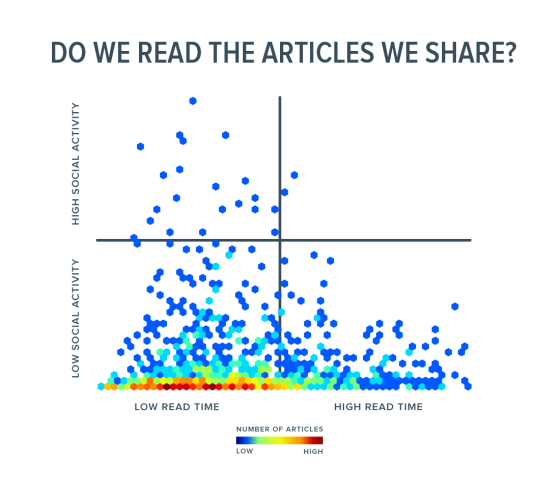
    • Pageviews, Likes, Clicks, Shares and Downloads do not measure engagement: Now that the advertising industry is using actual data to evaluate online behavior, smart B2B marketers can validate what they’ve always suspected about the metrics that are used to measure the effectiveness of the content they produce. There is now hard evidence that shows the number of clicks, comments, and shares are not indicative of how much time people spend engaged with the actual content. One recent study, reflected below – produced by Chartbeat and based on a boatload of data – demonstrates that there is no relationship between how often a piece of content is shared and the amount of attention the average reader will give that content. The good news for B2B marketers is that there are now editorial analytic tools that can provide attention and engagement metrics and insights.

    article sharing

    • Attention, engagement and business relationships are driven by quality content: Beyond whatever products or services they sell, all B2B companies must establish credibility and trust with clients, prospects and referral sources. Initial inquiries and longstanding relationships are not nurtured by bombarding target audiences with aggregated content from 3rd parties. The most successful B2B firms only associate their brand with highly relevant content, most often home-grown, that supports their value proposition, stakes out intellectual territory, avoids self-serving claims and truly differentiates their company from competitors. Less can be more, when it comes to B2B content.


    • Don’t rely on the internet exclusively to generate market attention. For B2B firms, direct communication (email, snail mail, face-to-face, etc.) with target audiences remains the most effective means of gaining and maintaining engagement. If you’ve created high quality content, ensure that it earns an adequate marketing ROI by consistently putting it in front of the right people; don’t expect them to find your content by themselves on your company website or blog, on LinkedIn or through Twitter. Those online channels should be considered a secondary, rather than the primary means, of generating attention and engagement through content.

    Leave a comment

    Filed under Uncategorized

    Stop the Insanity. Fire Your PR Firm in 2014.

    The attribution is unsupported, but Albert Einstein is often credited with the quote: “Insanity is doing the same thing over and over again, and expecting different results.” Its source notwithstanding, the axiom applies perfectly to the great number of companies that retain PR firms, year after year, to generate publicity that will have little or no impact on tangible business outcomes.

    Over the past 5 decades, to rationalize hefty monthly fees, the PR profession has successfully promoted three underlying assumptions:

    • Any publicity is good publicity.
    • The more publicity, the better.
    • Publicity generates revenue.

    Here are just a few reasons why it’s insane for most businesses to base their marketing strategy on any of those assumptions:

    1. Lots of Media Exposure is Worthless. The “worthless media” category can include one-off quotes or mentions in round-up stories that also reference your competitors…if you’ve gained no unique mindshare.  It can include appearances on network and cable TV…if the topics have a short shelf-life, or are unlikely to be of interest to target audiences.  And it always includes exposure in advertorials (regardless of the sponsoring publication’s stature) and feature articles in pay-to-play vanity publications…because you gain no credible 3rd party validation.
    2. Counting Media Clips is a Zero Sum Game. PR firms often justify their value by the sheer volume of media exposure they generate…regardless of whether it stakes out intellectual territory, supports a client’s value proposition, or differentiates them in the marketplace. The goal should be to create an arsenal of effective credibility tools; not simply to generate clippings to hang like hunting trophies in the “Media” section of a website.  This zero sum game is also played in social media, where scorecards of “likes” and “followers” are used as hollow substitutes for meaningful business metrics.
    3. It’s All About Merchandising. Business leaders must address two key questions in advance of seeking any publicity: “1. What type of media exposure will benefit us most?” and “2. If we gain that exposure, what will we DO with it?” Responses to Question #2 must provide clear direction regarding how it will support the firm’s sales and marketing strategy; how it will be used to drive leads; how it will initiate meaningful conversations with clients and prospects; and how it can be leveraged to gain other opportunities for targeted exposure.

    Most PR firms fail to deliver on the potential of their craft because performing it correctly requires really hard work, takes time, and demands accountability for business results. Your role as a responsible client requires that you hold your PR agency’s feet to the fire by expecting results that have a measurable impact on your company’s balance sheet. It also means that you must provide your agency with the time and guidance necessary for them to deliver something more than a pile of useless press clippings.

    If you’re unwilling to make that commitment, or if they’re incapable of delivering on your expectations, then it’s time to stop the insanity. Fire your PR firm in 2014.

    Leave a comment

    Filed under Uncategorized

    Thought Leadership Merchandising: Rising Above the Noise

    kjhkjhk

    Thought Leadership Programs Must be Accountable for Business Outcomes

    Thought Leadership is one of the most widely used terms in B2B marketing.  But there’s a range of opinion regarding what Thought Leadership is, and fuzzy expectations with respect to its tangible benefits.

    Researching the term “Thought Leadership” yields everything from a sterile Wikipedia definition, to blog posts featuring marketing insights similar to this online gem:

    “It doesn’t matter if you’re an entrepreneur, an employee, or a student – your ability to become a thought leader will catapult your success.  A great way to accomplish this, is on LinkedIn.” And we wonder why the marketing discipline is held in such low regard.

    Broadly, if Thought Leadership is a marketing strategy that leverages intellectual capital to engage target audiences, then there are two critical components and issues:

    1. Content — What qualifies as legitimate and effective Thought Leadership?
    2. Application — How should the content be applied to drive tangible business outcomes?

    A coherent and concise description of bona fide Thought Leadership content is contained within a checklist (shown below) developed by Jeff Ernst, VP of Marketing at Forrester Research, who broadly describes the strategy as “expressing a viewpoint that influences others…” as a means to “generate conversations that build trusting relationships over time.”

    It’s important to note that Thought Leadership should not be limited to pushing one’s own viewpoint. True Thought Leaders are those individuals or organizations that define what topics or issues are important, and also provide opinions on those topics (other than their own) that are worth listening to. Thought Leaders seek to manage, rather than control, the conversation.

    For example, rather than featuring a message from your CEO in each issue of the company’s quarterly newsletter, consider publishing guest commentaries (not promotional messages) from clients, prospects, referral sources and recognized opinion leaders in your discipline. In return, you’ll gain higher readership levels, greater credibility and top-of-mind awareness, and the likelihood that the client / prospect will distinguish your brand from competitors.

    Merchandising Strategy Precedes Content Development

    To the consternation of CXOs, some marketers employ Thought Leadership as though it embodied some mystical higher purpose; as a tactic that’s not held accountable for increasing leads, clients or revenue. Apparently through marketing osmosis, a brilliant OpEd piece in the Wall Street Journal or a rousing keynote presentation at an industry conference will somehow bolster a company’s balance sheet. All too often, Thought Leadership’s only benefit involves corporate egos.

    Proper application of Thought Leadership-based content begins with development of a content merchandising strategy, involving two basic questions:

    • What measurable outcomes do we want our Thought Leadership to achieve (other than having people think we’re smart)?
    • How will we apply our Thought Leadership content (other than dropping it on our website) to achieve those measurable outcomes?

    Creating any Thought Leadership content before fully addressing these two questions is akin to building a large sailboat in your basement. It may be a beautiful work of art, but you will never sail it around the lake.

    Ultimately, the most effective merchandising of B2B Thought Leadership content yields credibility tools that:

    –        support your company’s value proposition,

    –        deliver an inherent 3rd party endorsement,

    –        can be presented in a non-self-serving manner,

    –        contain content that has a very long shelf life,

    –        integrate seamlessly into your firm’s sales process,

    –        engage target audiences in conversations that build relationships, and

    –        drive tangible business results.

    In fact, the acid test of effective Thought Leadership should not be based on your CEO’s level of satisfaction in seeing her byline in print. Instead, you’ll know that your Thought Leadership is effective when the head of sales or new business development is nipping at your heels regarding the campaign’s progress.

    2 Comments

    Filed under Uncategorized

    Did Reader’s Digest Flunk Its Own Trust Test?

    It Pays to Get a Second Opinion

    …and I have a highly rated TV show.

    In an effort to goose newsstand sales, the June issue of Reader’s Digest features a cover story entitled, “The 100 Most Trusted People in America Today.” Although the article’s “most trusted” claim is far from trustworthy (in fact, 1,000 people voted on 200 American “opinion shapers and headline makers” that Reader’s Digest had pre-selected), there are some quirky results worth noting.

    According to the survey:

    • Americans trust doctors, especially if they’re on TV. For example, Dr. Oz (#16) and Sanjay Gupta (#17) outscored respected medical authors Andrew Weil (#75) and Deepak Chopra (#92).
    • Americans also trust TV judges, such as Judge Judy (#28) and Judge Joe Brown (#39), more than they do real-life Supreme Court judges, including Sam Alito (#60) and Elena Kagan (#62).
    • Some strange relative rankings include: Johnny Depp (#35) who outscored Oprah Winfrey (#59), Billy Graham #67) and Condoleezza Rice (#68);  and Adam Sandler (#64) who edged out Barack Obama (#65), but both were far behind Michelle Obama (#19).
    • The top four people on the list are all actors: Tom Hanks, Sandra Bullock, Denzel Washington and Meryl Streep. At the bottom of the 200 candidates were celebrities with damaged brands, including Lance Armstrong and Kim Kardashian.
    • In addition to its untrustworthy headline, Reader’s Digest fesses up in the article that its editors had removed the three highest scorers from its Top 100 list, which were “your own doctor” (77%), “your own spiritual advisor” (71%) and “your own child’s current teacher” (66%).
    • Given 15 categories, the most trusted professions were 1. Doctors, 2. Teachers, 3. Movie Stars, 4. Philanthropists, and 5. Spiritual Leaders. Not surprisingly, Business Leaders and Financial Experts were ranked 11th  and 12th, respectively, just ahead of Politicians and Political Pundits.
    • Only 6 active business leaders made the Top 100 list, and all near the tail end, led by Warren Buffett (#71), Amazon’s Jeff Bezos (#78), Alex Gorsky of J&J (#86), Ken Powell of General Mills (#93), Steve Balmer of Microsoft (#94) and Steve Forbes of Forbes Media (#97).

    Celebrity publicists will likely use these ranking to justify image overhauls for their low-scoring clients. But Reader’s Digest’s “Top 100 Most Trusted People” ranking really only validates America’s low-brow pop culture, and does not fairly reflect the integrity or character of any one of the 200 people on its arbitrary list.

    In addition to “integrity and character,” Reader’s Digest asked its poll takers to rank the trust levels of its 200 candidates in terms of “exceptional talent and drive, internal moral compass, message, honesty and leadership.” But it’s an impossible task to rank someone on any of those criteria, unless you have first-hand experience with that individual over a long period of time.

    Here are some the criteria this writer uses to measure trustworthiness of people, regardless of their profession or position of authority:

    1. DO THEY WALK THE TALK? I trust people who make good on their promises. And if they can’t deliver, they’re pro-active about explaining why they failed to meet your expectations.
    2. ARE THEY TRANSPARENT? Trustworthy people have no hidden agendas. Yes means yes, and no means no…which translates into no unpleasant surprises.
    3. DO THEY FOLLOW THE GOLDEN RULE? I trust people who treat a waiter in a restaurant, or the person cutting their lawn, with the same level of courtesy and respect they would display with their boss, or a prospective client.
    4. ARE THEY FAIR? Trustworthy people always explain the rules of the game, don’t play favorites, and base recognition and rewards on a meritocracy.

    What are some of the criteria you apply to determine if an individual (or an organization) is worthy of your trust?

    Leave a comment

    Filed under Uncategorized

    White Papers are Not Dead. They’re on Life Support.

    Have Marketers Killed This B2B Golden Goose?

    Have Marketers Killed This B2B Golden Goose?

    The original purpose of white papers as a B2B marketing tactic was to produce objective information, packaged as quasi-academic research, that might validate a company’s or product’s value proposition. White paper sponsors sought to educate, inform, raise comfort levels and eventually initiate sales conversations with prospective customers.

    White papers gained significant adoption as a content marketing tool concurrent with the rapid growth of new technologies that often required explanation or context for non-technical buyers. Over time, however, the market education function was largely assumed by research firms such as Gartner and Forrester, whose opinions carry greater credibility than self-publishers of white papers.

    Unfortunately, what began as a legitimate and sometimes helpful marketing tactic has morphed into poorly disguised sales promotion, packaged in a plain vanilla wrapper. The evolution of white papers from bona fide content into self-serving advertorials has been validated by vertical industry trade publications, in which companies, for a fee, are permitted to “feature” their white papers in a special section. White papers jumped the shark when they became paid content.

    The outcome of widespread abuse of white papers – driven by marketers grasping for new ways to put lipstick on a pig, or too lazy to produce rigorous research that might empower customers to draw their own conclusions – is that the tactic has lost its franchise as an effective B2B marketing asset class. Increasingly, prospective customers do not believe white papers will be helpful or credible, and as a result, they no longer play a critical role in their decision-making process for purchasing products or services.

    Some B2B publications, marketing consulting firms and other 3rd parties with a vested interest in promoting the use of white papers are capable of citing surveys, focus group results and case studies to support the tactic as an effective lead generation and lead nurturing device. And there are still many companies that produce legitimate white papers containing helpful, objective information.

    But despite this quantitative evidence and the best efforts of producers of high quality content, B2B customers are avoiding white papers in greater numbers, not only because they are no longer viewed as credible, but also because marketers have erected too many registration barriers that restrict online access to content. Marketers, in turn, are finding white papers to be far less effective as a demand generation tool. Marketers may not have killed the white paper goose, but the tactic is certainly on life support, and is producing far fewer golden eggs.

    So if diminished impact is the new white paper reality, then how do companies leverage whatever B2B marketing benefits this traditional tactic may still be capable of delivering? Here are few suggestions:

    Repackage the Content: One of my grandmother’s favorite expressions was, “If you fly with the crows, you’ll be shot at.” If you’ve produced credible content, avoid guilt by association with self-serving white papers by publishing it with a different label. Executive Review? Research Report? Market Analysis? Blue Paper?

    Scrap the Traditional Format: Regardless of the credibility issue, people simply have too much to read. Instead, produce a video or slideshare version of your white paper content. There’s a greater likelihood that interested parties will sit still for a 3-minute video production than invest 20 minutes laboring over a written white paper. Or create a visual version to serve as a “highlights” teaser that incents readership of the written version.

    Grow a Set: Instead of producing the white paper in-house or hiring a freelance writer, engage a well-known, respected industry source to research and produce your white paper…and (here’s the tough part) give that writer complete editorial control. The report may take some shots that you don’t like, but the conclusions will be highly credible and your brand will gain a reputation as a company that can withstand scrutiny.

    Slice and Dice Content: Rather than jamming your white paper content into a single masterpiece, allocate and publish the findings as a series of blog post installments. This method will increase readership and also produce multiple opportunities to communicate with target audiences, versus once-and-done publication of your white paper.

    Kill Registration Hurdles: Your competitors will always find a way to get a copy of your white paper. Stop acting as though your white paper contains the formula for cold fusion, and use it to generate appreciation of your company’s intellectual capital by all interested parties, including competitors. As B2B internet protocol has evolved, people are far less inclined to provide contact information in exchange for what may be worthless content. Increasingly, registration barriers lose more leads than they generate.

    White paper supporters need only be patient. Similar to other B2B marketing tactics that have fallen out of favor through over-use or abuse, the utility of white papers may eventually be fully restored. Even snail mail, long declared dead as a marketing channel, is now enjoying a resurgence as an effective means to cut through the clutter of email.

    18 Comments

    Filed under Uncategorized