Managing Customer Expectations and Being Picked Last

Soccer Can Be More Exciting Than Lawn Bowling

This past weekend, I joined a group of pre-teen relatives and their neighborhood buddies in a friendly game of soccer – a sport that had not yet made its way to America when I was in school, and has never been of any interest to me. Guys in shorts + lots of running = Snore-fest.

Maybe the kids sensed my underlying disregard for their sport. Maybe it was my gray hair. Or my middle-age one-pack abs. Whatever the reason, when they chose up sides, I was picked dead last, and the team that got me acted as though they had just been handed a red card. Humiliated, I took up a defensive position…assigned by a 12 year-old soccer hot shot…to keep the ball from getting near our goalie.

For the next hour, as balls whizzed past my head, through my legs and into our net, ignoring the impolite remarks from my cranky teammates, I nursed my wounded ego and considered the impact of expectations on performance and perception.

Perhaps I was playing poorly only because my teammates expected me to stink. I’ve certainly been a victim of low expectations on the golf course, where fellow hackers accuse you of “sandbagging” if you start playing better than your handicap suggests…so you quickly revert to double bogey performance.

There are a host of related studies on this subject: Students who outperform peers in tests because their teacher convinces them that they are smarter than other kids.  Patients who experience better clinical outcomes because they believe in the effectiveness of the therapy or medication. Factory workers who are more productive because their co-workers are supportive and want them to succeed.

But here’s an interesting twist: attempting to manage customer expectations can backfire.

Exceeding customer expectations may be a key to customer satisfaction, but a Journal of Marketing Research study suggests that seeking to define their expectations in advance can cause consumers to focus on the negative aspects of the purchase or experience, and to view the experience more negatively than customers whose expectations were not solicited.

The lesson here for marketers looking to measure and improve performance: Don’t ask customers to define their expectations before you deliver
the experience. Following the customer experience, ask them if, how and why it met their expectations.

The lesson for middle-aged, aspiring weekend soccer stars: Avoid the humiliation of being picked last. Buy a whistle, make yourself permanent
referee, and call ridiculous fouls on all those pimply neighborhood kids.


Leave a comment

Filed under Uncategorized

Ronald McDonald Makeover: Liposuction Not Required

Too Big To Fail?

Thanks to the well-intentioned corporate activist group, “Corporate Accountability International,” and its egg & ham-fisted attempt last week to coerce Ronald McDonald into retirement, McDonald’s Corporation was handed an unsolicited opportunity (and loads of free air time) to reposition the company as a protector of first amendment rights, and to re-launch its aging spokesclown as “the ambassador of good food.”

Although the grass-roots group gets props for tackling the childhood obesity issue, CAI was ill-advised to point the finger at McDonald’s as a leading obesity culprit; to attempt to dictate corporate policy; and to mess with Ronald.

Why?

Fat kids don’t drive themselves to McDonald’s; their fat parents do. If you want to influence corporate policy, get a seat on the company’s Board of Directors. And the McDonald’s clown is namesake of a charitable organization that helps kids who have cancer.

This was a historic triple-stupid play deserving of special recognition from the Public Relations Society of America. Perhaps they should have hired the PR guy who handles the Facebook account at Burson-Marsteller.

Leave a comment

Filed under Uncategorized

Marketing to Multi-Media Multitaskers?

Death of the Mono-Media Environment?

A new study from Boston College’s Carroll School of Management on the impact of multi-media multitasking has some significant implications for marketers using TV or online channels.

In a forthcoming edition of the journal Cyberpsychology, Behavior, and Social Networking, Professors S. Adam Brasel and James Gips demonstrate that, in a side-by-side challenge for multitasker attention, the computer dominates TV, but neither device holds attention for long periods.

Prior surveys have shown that 59% of Americans use their computer and television at the same time, and for those who do:

  • the computer draws the viewer’s attention nearly 69% of the time
  • neither device holds their length of gaze for long periods (< 2 seconds for TV, < 6 seconds for computer)
  • just 7.5% of all computer gazes, and 2.9% of all TV glances last for longer than 60 seconds

For companies that rely on TV or the Internet to communicate with consumers, these findings regarding the physical behavior of multi-media multitaskers raise questions about the effectiveness of both channels as a means to garner the attention of potential customers.

The researchers noted that the study did not take into account the impact of a multi-media distraction that may eventually push both TV and computers to the side, in terms of multitasker dominance: the mobile phone. According to Professor Brasel, “Assumptions about how people are using media need to be updated. The era of the mono-media environment is over.”

Marshall McLuhan has been dead for 31 years, but I’m confident he would have had something clever to say about the death of the mono-media environment.

Leave a comment

Filed under Uncategorized

Survey of 550 Ferrari-Driving Marketers

Would you please re-paint mine to match my tartan?

According to research released by Unisfair, which calls itself a “leading global provider of virtual events and business environments,” 60 percent of the 550 US marketers who participated in its online survey “plan to increase spending on virtual events and environments this year… and if budgets were not an issue, 67 percent would host 10 or more virtual events in the next 12 months.”

If “budgets were not an issue,” I suspect those 550 marketers would likely all be driving Ferrari Testatrossas. Whatever.

The survey also noted that “42 percent of marketers plan to decrease spending on physical conferences and trade shows over the next year.” Although I don’t dispute the veracity of Unisfair’s survey results, this does not square with the first-hand reports from folks at World Congress and other sponsors of live events, who claim companies are increasing spending on conferences, seminars and trade shows.

Survey results notwithstanding, whether it’s conducted live or virtually, the most significant shortcoming of event sponsorship is the failure of companies to conduct adequate pre- and post-event merchandising of the related content. An event is an opportunity to communicate with target audiences for a legitimate purpose; a way to showcase thought leadership; and (if the forum is prestigious) to leverage the inherent 3rd party endorsement of the program sponsor.

Most importantly, pre- and post-event merchandising is a great way to reach a significantly larger audience than those sitting in seats or listening in over their laptops. In fact, many events can be viewed simply as a necessary excuse to communicate with important decision makers who don’t waste time attending events of any kind.

If you’re looking for business results-driven ROI on event sponsorship, you’ll need to focus more on the content and less on the venue.

Leave a comment

Filed under Uncategorized

Quick Fix for Sales and Marketing Alignment?

Blame the CFO

According to BtoB magazine’s coverage of last week’s SiriusDecisions Summit 2011 held in Scottsdale, sales must be “pulled into the fold” by marketing, to better understand alignment and sales enablement. That was the overriding theme delivered throughout the event and reiterated on its final day.

“It’s not a question of adding systems to fix sales and marketing alignment, but rather a challenge of leadership,” according to John Neeson, SiriusDecisions’ managing director, at a wrapup session Friday. “It’s about two leaders—the heads of marketing and sales—fixing things together.”

Another common thread at this year’s summit was the need to gain C-suite buy-in for these evolving sales-marketing initiatives. Several case studies presented during the week detailed resistance to proactive sales-marketing alignment.

“One major theme here is how CFOs must begin to think about marketing, not so much as an expense but rather as an investment,” Neeson said.

Leave a comment

Filed under Uncategorized

Craftsmanship Is Hard Work

“They who lack talent expect things to happen without effort. They ascribe failure to a lack of inspiration or ability, or to misfortune, rather than to insufficient application. At the core of every true talent there is an awareness of the difficulties inherent in any achievement, and the confidence that by persistence and patience something worthwhile will be realized. Thus talent is a species of vigor.”

– Eric Hoffer

Reflections on the Human Condition (1973)

Leave a comment

Filed under Uncategorized

Are Your Customers Brand Terrorists?

The old marketing adage is that customers can either be brand ambassadors or brand terrorists, depending on how they’re treated.

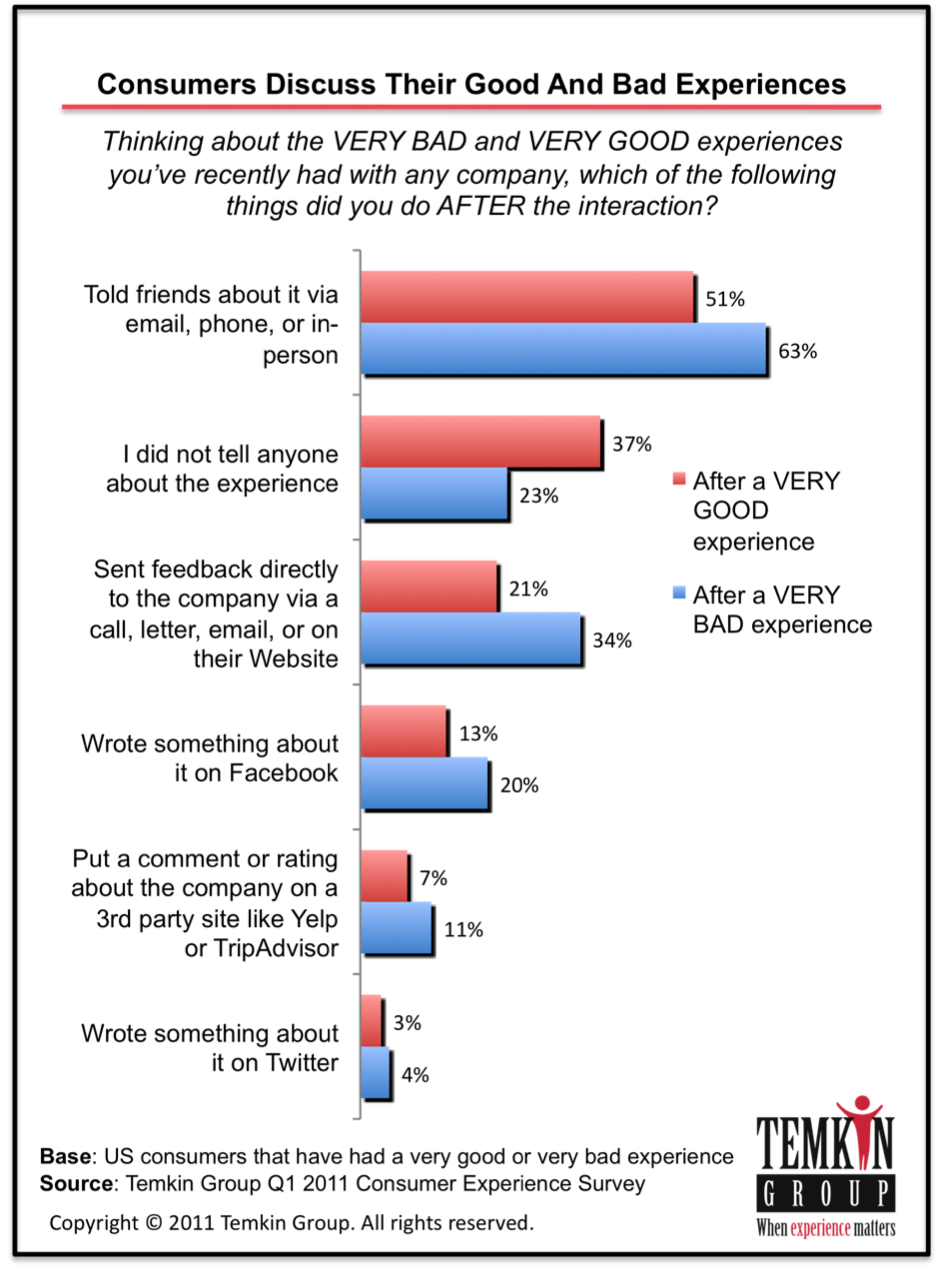
Former Forrester Research analyst Bruce Temkin (now managing partner of Temkin Group) is a guru of the Customer Experience Management (CEM) discipline…and there are some interesting insights for marketers in Temkin Group’s Q1 2011 Customer Experience Survey, including this one:

Are traditional channels the best battleground to fight brand terrorists?

It appears as though customer terrorists are most likely to inflict brand damage in direct conversations with friends; either on the phone, through email or in person (63%), and it’s tough for companies to counter those assaults. In fact, Word-of-Mouth research firm Keller Fay Group estimates that 90% of all customer conversations about brands in the US – both positive and negative – happen offline.

From a defensive standpoint, a company’s greatest opportunity to address customer grievances occurs when they appeal directly to the company through phone calls, email, letters and website comments, which according to Temkin occurs about 34% of the time.

Despite all the buzz about the power of social media as a CEM tool, most customers are not spending much time complaining on Facebook(20%); on 3rd party opinion sites such as Yelp or TripAdvisor (11%); or on the darling of social media, Twitter (4%).

Perhaps all the social media hubbub – at least in part – serves as a convenient distraction for companies that have failed to deliver on the most widely used CEM channels: phone, chat and email?  If you’re looking to convert customer terrorists into brand ambassadors, those channels still appear to be the best places to invest time and money.

Leave a comment

Filed under Uncategorized

Why New Jersey Loves Bad PR

Fly Fishing on the Raritan in Califon, NJ

Before I relocated to New Jersey a few years ago, my impressions of the Garden State were consistent with the stereotypes: Interstate 95 traffic jams, cogeneration plants spewing smoke, Tony Soprano, roadside diners, dangerous cities, people with annoying accents. But it took little time living in New Jersey to see that its range of natural beauty — from coastline, to quaint towns, to farmlands and deep woodlands — can match any state in the union. In spite of MTV’s Nicole “Snooki” Polizzi and Mike “The Situation,” most New Jersey residents have much more on their minds than “Gym, Tan and Laundry,” and the notorious Jersey accent is actually from Staten Island. Sorry New York.

So why doesn’t New Jersey hire a PR firm to set the record straight?

Before I had an opportunity to register my car in New Jersey, a group of teenagers who spotted my Connecticut license plates yelled at me in unison: “Go Home!” In defense, I screamed back: “Hey! I live here!”

So I asked my next door neighbor: “New Jersey’s a beautiful state, and doesn’t do justice to its lousy reputation. Why are people here so content to have outsiders believe all the negative stereotypes?”

“People who live here all know what a great state New Jersey is,” he said. “And we don’t care if other people find out, because then they might move here.”

New Jersey loves its bad PR, and has no interest in improving its reputation. Bad PR means fewer people to discover New Jersey’s prime fly fishing locations, more blanket space on its pristine beaches, and available tee times at its world-class golf courses.

But you didn’t get that information from me.

2 Comments

Filed under Uncategorized

The PR Industry’s Dirty Little Secret

If you’re looking to hire a PR firm, and they suggest their deep relationships with journalists will be of benefit to you, that’s when you should show them the door.

Regardless of the size of their Rolodex, seasoned PR practitioners do not use those media contacts to sell their services. They know those long-term professional relationships are more important to them than the short-term needs of any client. They understand that success in media placement is based on what they know, not on who they know.

And “what they know” is how reporters think, and what they need. This insight enables PR pros to ferret out appropriate news and ideas. To package that information so that it’s not self-serving.  To present story ideas in an appealing manner. To push back or disagree with reporters and editors when it’s called for.  And to NEVER pitch a reporter solely based on their relationship with them.

Conversely, seasoned journalists do not cover news or accept story ideas from flacks simply because they’ve shared a few beers or worked with them previously. A reporter’s reputation is too important to compromise by covering items that don’t meet their editorial standards or address the interests of their readers or viewers. On a personal level, journalists also don’t appreciate the implication that they can be influenced by someone with an agenda.

PR firms that leverage media relationships to pitch substandard content are playing a losing game. Companies led to believe they’ll gain from their PR firm’s media contacts are simply being played.

Leave a comment

Filed under Uncategorized

Can Craftsmanship Go Unrecognized?

The Craft of Teaching

William R. Dill, when he was dean of the Graduate School of Business Administration of New York University, invited me to work with him on a study of students with known addresses that had graduated five or more years before: how are they doing? And what might be characteristics of background for success? One question was this:

Did any teacher here affect your life? If so, what was his / her name?

Responses showed that every student who had taken a course with any one of the six teachers answered yes. Moreover, every one who answered yes remembered the name of the teacher. Almost no one was mentioned aside from the six.

Unfortunately, this recognition came too late. No special effort was made by authorities at the school to hold on to these six men – the kind that make an institution famous – and none of them received from the student body the award “Great Teacher of the Year.”

W. Edwards Deming “Out of the Crisis”

Comments Off on Can Craftsmanship Go Unrecognized?

Filed under Uncategorized