Tag Archives: #craftsmanship

Sales Tips from PR Legend Lee Levitt

Lee Levitt, sans fedora and shoulder bag

Lee Levitt, who passed away in 2010 at the age of 80, continues to be remembered as a PR practitioner who gave much to the profession; as someone who lived up to his characterization as an industry visionary.

Paging through Lee’s “Manual of PR Sales Strategy & Tactics,” the insights he  offers are as relevant today as when he wrote them in 1992, and apply across all professional service disciplines, not just PR. Here are a few Levitt gems:

  • “What most managements want to buy today is the accomplishment of specific substantive corporate / institutional goals… So that is what you must sell. You cannot simply come in and enumerate the skills you have, the technical things you can do. You must explain how applying them will solve some substantive problem or take advantage of some substantive opportunity.”
  • “Telling people that you are going to counsel them can make you seem presumptuous and arrogant. No matter how diplomatically you put it, you seem to be saying that management is dumb and benighted, while you are smart and enlightened.”
  • “What prospects really want to hear about is themselves. They want you to tell them about themselves in exactly the same words they use… And they want you to want their business and be enthusiastic about it.”
  • “Never criticize what the prospect has done in the past. Let the prospect tell you what went wrong and whose fault it was… If asked if you could have done better, say you hope so.”
  • “Most salespeople believe it is their job to talk, and up to a certain point that is true. But once the prospect is primed to talk, it is your job to shut up and listen. Some salespeople never learn this.”

If you can find a copy of Lee’s book, buy it and read it. If you have a copy on your bookshelf, pull it out and re-read it. But don’t ask to borrow my copy, because it’s not going anywhere.

Lee Levitt embodied craftsmanship in public relations, and left a lifetime of wisdom for those who follow in his footsteps.

1 Comment

Filed under Uncategorized

Hot Air Balloon Craftsmanship

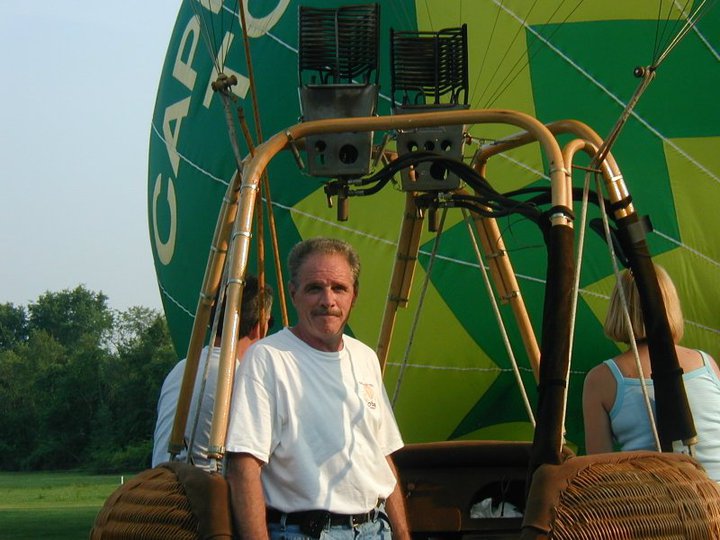
Denny Fleck -- Hot Air Balloon Craftsman

When he was 21 years-old, Denny Fleck took his first hot air balloon ride. He was hooked for life.

Nearly forty years later, on most days from May to October, Denny can be found piloting one of his hot air balloons; ferrying adventurous passengers on an hour-long airborne trek across Northern New Jersey, complete with dogs barking, friendly locals waving and balloon chase vehicle in pursuit below.

Depending on the wind, Denny will purposely brush tree-tops and occasionally pull off a touch-and-go landing in a harvested corn field. Combined with the ear-piercing blast of flame that seems close enough to melt your scalp, sharing a hot air balloon basket with Denny Fleck is guaranteed to get the adrenalin pumping for most first-time riders.

When asked about his ballooning credentials – often timidly presented by a novice rider immediately following initial contact with a tree-top – Denny might disclose with a smile that he was, among other things, the former head of the Forbes Magazine Balloon Ascension Division. He might even tell you that the late Malcolm S. Forbes’ insurance policy stipulated that Fleck serve as his balloon pilot. This information provides some comfort for most nervous riders.

As the story goes, Denny had been serving as the Forbes Magazine publisher’s chauffer in June 1972 when Malcolm instructed him one morning to change their daily route into Manhattan, and head to a small airport in Princeton, New Jersey. That’s where Denny and his boss took their first balloon ride together.

That was also the start of a high-profile and sometimes reckless series of adventures, combining ballooning with motorcycling, that Malcolm sponsored and hosted for nearly 20 years as a means to promote Forbes Magazine and capitalism around the world. And on many of those trips to exotic locations in Egypt, Thailand, France, China and the Soviet Union, Denny Fleck was at Malcolm’s side…on a bike or in a hot air balloon.

Malcolm S. Forbes died in his sleep of a heart attack in 1990.  But Denny Fleck, his soft-spoken, New Jersey sidekick (who knows more than he’s willing to tell regarding Malcolm’s flamboyant private life) is still flying high, running his Tewksbury Balloon Adventures, located about an hour outside of Manhattan.

If you’d like to rub shoulders in a woven cane basket with this local legend – a true hot air balloon craftsman – give Denny a call at (908) 439-3320. He might even bring along his 24 year-old son Jonathon, who earned his balloon pilot license last year. Here’s a video clip of Jonathon piloting a balloon in New Mexico.

Balloon craftsmanship is in the Fleck blood lines.

Ballooning Over New Jersey

3 Comments

Filed under Uncategorized

Is Your Own Work Worthy of Your Signature?

Craftsmanship Requires Accountability

“Artisan” was the term used before the advent of mass manufacturing to describe people who made things or provided services with a distinctive touch and flair in which they took personal pride.

Prior to the Industrial Revolution, this included just about everyone: the shoemaker, the doctor, the dressmaker, the saddler. Artisans gave a personal touch to whatever they did, and they often carved their initials into their work.

It’s a good mind-set to have for whatever job you are doing: Would you want to put your initials on it when it’s done?

That Used to Be Us: How America Fell Behind in the World It Invented and How We Can Come Back

by Thomas L. Friedman and Michael Mandelbaum

Leave a comment

Filed under Uncategorized

Four Lessons From IBM’s Centennial Advertising

Page One of IBM's 4-Page Insert

“Every advertisement should be thought of as a contribution to the
complex symbol which is the brand image.”

– David Ogilvy

In recognition of its founding 100 years ago, last week IBM produced a 2,592-word, four-page advertising insert that ran for just one day in the U.S. issues of the Wall Street Journal, the New York Times and Washington Post.

Although few companies have the resources or courage to produce “old media” advertising on this scale, IBM’s Centennial insert embodies several important lessons for marketers at companies of all sizes and industries. Here are four take-aways:

  1. The message was well-targeted and on point. IBM was speaking primarily to investors, through the nation’s 3 most widely read daily publications. By pointing out that 100 shares of IBM stock purchased in 1915 would be worth $200 million today, the company was entitled to state that “90 day reporting cycles” are not IBM’s end game…a clear message to Wall Street analysts and institutional investors. Lesson for Marketers: Define your target audiences, reach them through appropriate channels and make your point clearly. Sounds like Marketing 101, but many ads are placed for prestige and ego rather than for impact, and it’s often a mystery what most advertisers are trying to accomplish.
  2. The layout accommodated all types of readers. IBM understands that most people are surface readers, focusing only on heads, subheads, graphics and captions. Although the body copy was 1,888 words in length, the ad’s layout accommodated those quick-scan readers with eye-catching and interesting graphics, and also cleverly footnoted each graphic element as a means to draw readers into the main text. Lesson for Marketers: Regardless of the medium, you have a nano-second to catch someone’s interest, and if you’re lucky enough to accomplish that goal, you have even less time to make your point. Don’t make people work to understand your message…because they won’t.
  3. The ad was part of an integrated campaign. This advertising insert served as one small part of a larger IBM strategy to leverage its 100th anniversary as a marketing asset. Other components of this well-structured campaign include a book; short films; colloquia, lectures and thought leadership forums; a dedicated website (www.ibm100.com), and 2.5 million hours of volunteer community service provided by IBM employees around the world. Lesson for Marketers: One-off tactics — even those conducted over periods longer than one day — seldom produce meaningful results. IBM’s marketing budget is larger than total revenue at most companies, but those companies can be just as smart as IBM, in terms of building marketing programs that are integrated and strategic, rather than a collection of tactics.
  4. Their appeal was honest and human. In addition to its longevity, IBM has much to brag about. But this ad was written with humility and sincerity, and did not appear self-serving or overly promotional. In fact, a prominent graphic in the ad featured 3 of the company’s “share of misses,” including IBM PCjr, its OS/2 operating system and its Prodigy online service. Lesson for Marketers: Copywriting style aside, and regardless of the tactic, it’s more powerful to present the evidence that supports your value proposition and let your audience draw its own conclusions, than it is to tell your audience how wonderful you are.

This advertisement is a reflection of IBM’s marketing craftsmanship, and suggests a bright outlook for their second century. In fact, you might consider purchasing 100 shares — currently trading at around $165 per share — for your grandchildren.

Leave a comment

Filed under Uncategorized

The Fine Line Between Craftsmanship and Obsession

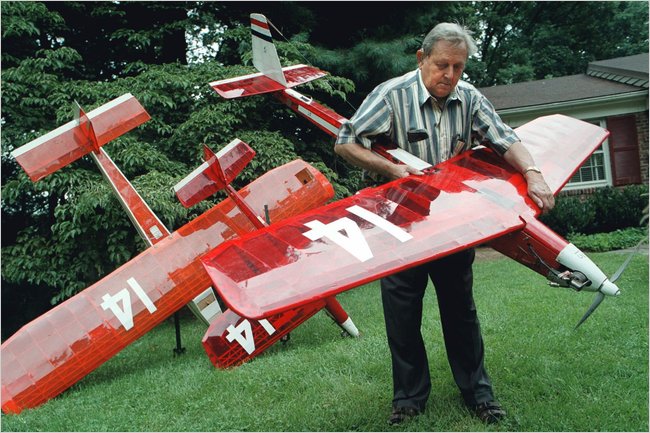
An Obsession With Balsa Wood and Glue

Maynard Luther Hill was born in 1926 – the year before Lindberg’s historic trans-Atlantic flight – and died last week at the age of 85.

For most of Mr. Hill’s life, he was obsessed with model airplanes and with pushing the limits of their capabilities. He set 25 world records for speed, duration and altitude, for both powered flights and gliders.

The culmination of his decades of devotion to the design, construction and flight of model aircraft came at the age of 77.  Nearly blind from macular degeneration and mostly deaf as well, Mr. Hill’s 11-pound model plane, the Spirit of Butts Farm – constructed of balsa wood and mylar, with a 6 foot wingspan – made the 1,900 mile trans-Atlantic crossing from Newfoundland to the west coast of Ireland in just under 39 hours. For this historic flight, as well as his lifelong advancement of the hobby, Mr. Hill will long remain a legend among aeromodeling enthusiasts.

“By age 9,” once Mr. Hill wrote in an essay, “I had acquired a fairly serious addiction to balsa wood and glue.” He even admitted that on the third day of his honeymoon he went to the store to purchase those items.

“Anybody that does something great in his field has to be obsessed to some extent, and he was obsessed,” noted a senior staff member at the Johns Hopkins lab who also worked with Mr. Hill on the trans-Atlantic flight. “Why do people want to jump higher or run faster?” he added. “It’s to excel, and that was Maynard’s big thing. It was to do things no one had ever done in the field of model airplanes.”

So where does craftsmanship end and obsession begin? Do craftsmen simply seek to replicate accepted standards of perfection…building a model airplane that’s flawless in design or performance; compared with those who are determined to “do something great” by re-defining perfection…building a plane that’s faster, lighter, sturdier or more elegant than existing models?

Shakespeare, Beethoven, Emily Dickinson, Albert Einstein, Frank Lloyd Wright, Margaret Mead and even Steve Jobs were all obsessed, and have set the bar higher for those who follow. Like Maynard Hill, these game-changers provide craftsmen with the understanding that perfection can always be improved upon.

Leave a comment

Filed under Uncategorized

Craftsmanship Is Hard Work

“They who lack talent expect things to happen without effort. They ascribe failure to a lack of inspiration or ability, or to misfortune, rather than to insufficient application. At the core of every true talent there is an awareness of the difficulties inherent in any achievement, and the confidence that by persistence and patience something worthwhile will be realized. Thus talent is a species of vigor.”

– Eric Hoffer

Reflections on the Human Condition (1973)

Leave a comment

Filed under Uncategorized

Can Craftsmanship Go Unrecognized?

The Craft of Teaching

William R. Dill, when he was dean of the Graduate School of Business Administration of New York University, invited me to work with him on a study of students with known addresses that had graduated five or more years before: how are they doing? And what might be characteristics of background for success? One question was this:

Did any teacher here affect your life? If so, what was his / her name?

Responses showed that every student who had taken a course with any one of the six teachers answered yes. Moreover, every one who answered yes remembered the name of the teacher. Almost no one was mentioned aside from the six.

Unfortunately, this recognition came too late. No special effort was made by authorities at the school to hold on to these six men – the kind that make an institution famous – and none of them received from the student body the award “Great Teacher of the Year.”

W. Edwards Deming “Out of the Crisis”

Comments Off on Can Craftsmanship Go Unrecognized?

Filed under Uncategorized

Will Internet Transparency Devalue Craftsmanship?

As online access to information and insight into a broad range of professional and technical skills becomes more widely available, will “knowledge worker” craftsmanship become an anachronism?

For decades, medical schools have told students that patients want the Three As: Accessibility, Affability and Ability…in that order. Med students are taught that “patients don’t care how much you know, until they know how much you care.” With the exception of Dr. Gregory House, most physicians understand that bedside manner often trumps a correct diagnosis or successful procedure. And insurance company research shows that physicians who apologize to patients for their errors are sued for malpractice far less often than those physicians who “lawyer up.”

Increasingly, online search and social media transparency will enable us to understand, manipulate, second-guess and validate the counsel of every professional discipline. If motivated, you can learn as much as your CPA knows about arcane tax laws, as much as your lawyer knows about divorce agreements, or as much as your real estate broker knows about mortgage lending.

With this level of virtual transparency, what’s the motivation for any knowledge worker to excel in their profession? If knowing only what’s necessary becomes sufficient – to avoid embarrassment and lawsuits – then why should any professional seek excellence? Rather than studying IRS rulings, is your accountant better served, in terms of business development and retention, by inviting clients and prospects out for a round of golf, dinner and drinks? As the client, would you prefer to be schmoozed by your CPA, or to have him increase your tax refund by $1,500? Would you even know if he’s capable of doing a better job for you? Maybe that’s why you’ve already replaced him withTurboTax.

Google, Twitter and TurboTax notwithstanding, as a knowledge worker, I take some solace in having seen that information and tools are often no substitute for experience. Several years ago, I was asked by a new client to create an integrated marketing strategy to serve as that company’s detailed blueprint to be implemented entirely by the CEO and his young, in-house marketing director. Two months later, the CEO engaged me again, to help his marketing director make the plan actually work.

So keep your former CPA’s phone number, because your TurboTax customer service rep will not be helpful at a tax audit with the IRS.

My guess is that true craftsmen in any profession will leverage online transparency to enhance their skills, rather than to use it as an excuse to join the status quo.

2 Comments

Filed under Uncategorized

Jerry Maguire’s Mission Statement…

…Revisited

“If the tapdancing becomes less constant, less furious, less necessary, what will the result be? The result will be more honesty, more focus, fewer clients, but eventually the revenues will be the same. Because the new day of honesty will create a machine more personalized, more truthful, and the client that wasn’t bullshitted this year, has a greater chance of greatness next year.

The answer is fewer clients. Less dancing. More truth. We must crack open the tightly clenched fist of commerce and give a little back for the greater good. Eventually revenues will be the same, and that goodness will be infectious. We will have taken our number oneness and turned it into something greater. And eventually smaller will become bigger, in every way, and especially in our hearts…

Forget the dance. Focus…Love the job. Be the job.”

Jerry Maguire’s Mission Statement

  • Hikers wait for 3 years, pay $700 and travel to New Hampshire for boots made by Peter Limmer.
  • Musicians wait for 5 years, and pay more than $100,000 for a violin made by Sam Zygmuntowicz in Brooklyn.
  • Hunters and dog lovers wait years, and pay $15,000 to $20,000 for a “finished” Labrador Retriever raised by Mike Stewart in Mississippi.
  • Fly fishermen waited years, and paid up to $2,500 for reels made by Stanley Bogdan, who passed away last month at 92.
  • There’s a wait of more than 5 years for bikes built by Sacha White in Portland, at an average price of $10,000.

Leave a comment

Filed under Uncategorized