
Tag Archives: marketing ROI

An End to B2B Social Media Madness

20070805-humanLemmings

Rapid, lemming-like adoption of social media tools by small and medium-sized B2B firms – fueled by an army of self-proclaimed social media experts – has resulted in wasted dollars, missed opportunities and heightened distrust of the marketing function in the C-suite. As if CMOs needed another cause for termination.

The past decade’s social media debacle is akin to introduction of desktop publishing in the early 1980s, when personal computers arrived in the business world. New software programs enabled companies, for the first time, to design and produce their own graphic materials in-house. Every company needed desktop publishing; corporate bean counters promoted the cost savings; anyone who learned how to use the software claimed to be a graphic designer, and the trend resulted in the most unprofessional and ineffective marketing & sales collateral every produced. Over time, even the bean counters came to understand that misapplied technology can be very costly.

The impact and potential of social media is far more significant than desktop publishing, but this also means that its range of casualties and cost of misapplication are exponentially greater. Simply, there are far too many B2B companies that are either:

–  using inappropriate social media tools,

–  not using appropriate social media tools correctly, or

–  missing opportunities to use appropriate social media tools.

At the risk of generating a firestorm of debate from social marketing gurus armed with clicks, likes, re-tweets and other forms of meaningless ROI validation, and based on the social media casualties we’ve seen or treated first-hand, the following guidelines are suggested for small and medium-sized B2B firms:

  • Focus on Your Website. This is the online mother ship of your brand. Don’t bother with social media tactics unless this tool is all that it can be. If your website has not been refreshed and updated in the last 3 years (which means more than simply sticking press releases in the “News” section), then your company is due for an overhaul.
  • Blog Correctly, or Don’t Have One. A company blog is the most effective way to leverage social media. But if you are unable or unwilling to generate meaningful content on a consistent basis (at least twice a month), or to merchandise your blog content properly (which means taking specific steps to promote the content with target audiences), then do not start a blog. If you already have a blog and you’re not meeting those goals, then shut the blog down. It’s a brand liability.
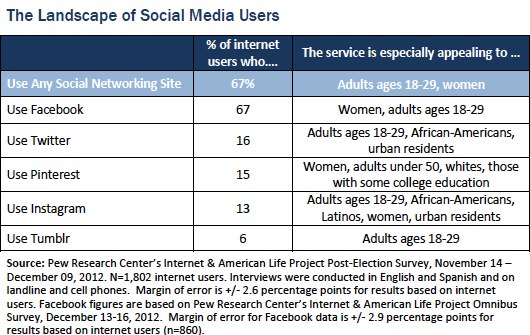
  • Forget Facebook, Twitter and Google+. These are primarily personal and B2C social media platforms, and there are few good reasons why most B2B firms should be investing any time or resources there. In terms of demographics, it’s telling that Twitter’s top 3 profiles belong to Justin Bieber, Lady GaGa and Katy Perry, but if your B2B firm needs quantitative evidence to support dropping these social media platforms, here is some recent research from Pew Research Center:
PRN_landscape_social_media_users

  • Use YouTube Selectively. YouTube can be a very effective social media channel for B2B firms. But your video products must be sophisticated, professionally produced, and no longer than 3 minutes. Resist the temptation to include sloppy, home-made productions, or hour-long webinar presentations. They reflect poorly on your brand, and few people will watch them. Ensure that you develop ways to drive consistent traffic to your YouTube channel.
  • Build Your LinkedIn Presence. LinkedIn is 3x more effective for demand generation than either Facebook or Twitter. LinkedIn has become an essential part of the business world’s due diligence process, and your company is conspicuous by its absence. Unfortunately, few companies take full advantage of LinkedIn’s social media potential. Their corporate profiles often do not contain adequate information, they do not merchandise blog-related and other relevant content, fail to connect through industry user groups, and their employees’ profiles are inconsistent and sometimes unprofessional. Most B2B companies would be well served to invest 100% of their social marketing effort through LinkedIn.

Very often, the root cause of dysfunction and disappointment related to the application of social media tools by B2B firms has less to do with the shortcomings of the various platforms, and more to do with the lack of a coherent and articulated marketing strategy. Chances are, if a B2B firm is spinning its wheels in the morass of social media, they’re having similar challenges with traditional marketing communication channels as well.

1 Comment

Filed under Uncategorized

5 Ways to Merchandise the “Masthead Value” of Publicity

Not to be confused with "The Wall Street Transcript"

Not to be confused with “The Wall Street Transcript”

Many companies will invest considerable effort seeking positive publicity in influential media sources, and then fail to benefit from the masthead value of that exposure.

Originally a seafaring term relating to the brass plate attached to a ship’s mainmast that memorialized its owners and builders, a publication’s masthead lists the members of its current editorial and production staff. The industry term “masthead value” can be defined broadly as the level of stature, credibility and influence associated with a specific media source. The Wall Street Journal, for example, has high masthead value; the Wall Street Transcript…not so much.

Masthead value can be relative. A respected trade or professional publication in a particular industry may have greater masthead value – in terms of its influence with a particular audience – than well known publications such as the Wall Street Journal or New York Times. For example, physicians are likely to assign the New England Journal of Medicine greater masthead value than the Journal or Times on topics relating to clinical care of patients.

Masthead value should drive your publicity strategy. A placement from a single highly respected source can be far more valuable, in terms of influence, than a dozen hits with low masthead value. Because gaining inherent 3rd party endorsement is the end goal, in the publicity game quality always trumps quantity.

Here are 5 ways to leverage media placements with strong masthead value:

  • Put high value placements directly in front of your target audiences – Even if your coverage appears on the front page of the Wall Street Journal or makes the cover of Fortune magazine, don’t assume it will be read by clients, prospects, referral sources…or even by your employees. There’s simply too much offline and online noise to ensure that any media exposure on its own will gain the attention you’re seeking. If you’ve developed an internal CRM-driven discipline to communicate directly and regularly with target audiences, then you’re well prepared to apply that distribution capability to increase the chances that decision makers will notice, remember, and respond to your high value exposure. (Lacking that discipline, your time may be best spent building an effective distribution capability, in advance of seeking additional publicity.)
  • Avoid “Hey, look at me!” self-promotion – Pickup in a media source with high masthead value provides some reason for high-fives internally, but it should not serve as a platform for self-promotion. Extreme examples of this error include companies that issue a press release, or generate Twitter and Facebook postings to announce, for example, that their CEO has been profiled in Inc. magazine. This type of over-reaction to high value publicity suggests to target audiences that you were surprised to receive the media endorsement, and therefore may not have really deserved it. The key is to showcase the media exposure in a relevant context (you may need to create this), to make the media placement secondary to the underlying content (such as the reasons why your CEO was profiled in Inc.) and to pull off these tasks with a matter-of-fact level of self-confidence.
  • Rank graphics over content, in terms of impact – Most people are surface readers. Online visitors are more likely to scan images, heads, subheads and captions, than they are to read body copy. (Long blocks of copy on websites that require scrolling are rarely read.) If you’ve earned a placement with high masthead value, you can increase the likelihood of your company being associated with the “endorsing” publication by displaying its logo with the capsule description and link to the placement. To be clear: the critical element is the logo. If your placement is from the New York Times, for example, you should replicate the logo – as it appears on the front page of that publication. Based on how people gather information, simply typing, “from The New York Times,” or a similar attribution, is about 75% less effective than actually depicting the New York Times logo.
  • Prominently showcase high value placements – If you’ve invested and succeeded in generating media placements with high masthead value, why make it difficult for target audiences to find them on your website? Rather than burying influential publicity in an obscure “In the News” section that requires multiple clicks for visitors to locate, you can amortize your investment in publicity (and perhaps improve your website’s bounce rate in the process) if you create a location for these high value items on your home page. This can be accomplished by applying a design format in which the content either remains fixed or is refreshed regularly. For formats that supply current information, extend the shelf-life of each placement by not including its publication date.
  • Cite a relevant endorsement on your home page – One of the most effective  ways to  merchandise high-value media exposure is to select a very brief, relevant phrase from the coverage, for placement in a prominent position on your home page. Here’s a hypothetical example:

“…a recognized authority in Big Data technology.”

                                                       –Wired Magazine

By limiting your publicity efforts to media placements with high masthead value, and by ensuring that those placements are effectively merchandised through direct communication, social media tools and proper website visibility, PR practitioners will spend far less time worry about the ROI of public relations. The fruits of their labors will be self-evident in tangible business metrics, ranging from lead generation to high search engine page rankings.

Leave a comment

Filed under Uncategorized

What the US Marines Can Teach Your B2B Firm about Marketing and Sales

Every Marine a Rifleman

Every Marine a Rifleman

“Every Marine a Rifleman” is a basic tenet of the US Marine Corps.  At boot camp, every marine receives training in marksmanship, hand-to-hand combat and teamwork. Regardless of how (s)he ends up serving in the Corps – as a mechanic, lawyer, clerk, pilot, dentist or pastry chef – every marine is prepared and expected to apply their combat training whenever it’s required. That rifleman commitment serves as a tactical cornerstone of the Marine Corps’ Semper Fi (“Always Loyal”) motto.

B2B companies – professional service firms in particular – can benefit by creating a culture similar to the Marine Corps; training all employees with basic marketing & sales skills that can help the firm to grow and succeed. “Every Employee a Sales Rep” should be fully ingrained across a company’s work force, from the front desk to the corner office.

Many B2B firms – in legal, accounting, financial services and consulting disciplines – employ at least one rainmaker, typically a founding member, who brings in the lion’s share of new business. But that “outside / inside guy” dynamic puts a company at risk, because rainmakers can depart unexpectedly (by choice or by ambulance), and the firm’s growth rate is always limited by their energy, motivation and availability.  More importantly, this business model fails to leverage a firm’s “inside guys,” whose individual and collective business relationships, skills, experience and credibility should be harnessed to drive consistent revenue growth and to scale the operation.

Regardless of their title, job description or capacity to work the room at a social event, every B2B executive should be given training, tools and ongoing support that empowers them to:

  • Manage Their Personal Brand – Clients hire individuals, rather than a firm, to help them. To showcase their credentials, every account practitioner should maintain a complete and up-to-date biographical profile on the company’s website and on LinkedIn. To expand their visibility, they should also participate in at least one activity unrelated to employment, whether  that’s membership in the local chapter of a professional trade association, their daughter’s soccer team, or a fly fishing club.
  • Articulate the Firm’s Value Proposition – Many employees, even at the senior level, do not have a clear understanding of what makes their firm different from the competition, and are at a loss to provide a compelling      reason why someone should engage them. Like a good marine, every employee should know their firm’s “elevator pitch,” and be prepared to recite it whenever someone asks, “So…who do you work for?”
  • Nurture Their Professional Network – Every practitioner has a network of current and former clients, associates in other disciplines, friends, relatives, neighbors and individuals they’ve met at conferences or social events.  Business contacts are often included in the firm’s CRM system, and may receive quarterly newsletters or other communications issued by the company. But account practitioners should also maintain direct and regular contact with their entire personal network in order to nurture and expand those relationships, because referrals are driven by casting a wide net.
  • Drive Top-of-Mind Awareness – The marketing challenge for most B2B firms is making the short list of candidates called in for an assignment. To increase their odds of getting that call, firms must constantly sow seeds with clients, prospects and referral sources, driving top-of-mind awareness regarding the firm’s capabilities and credentials. Every practitioner should play an active role in that process by generating relevant content – in the form of blog posts, bylined articles, case studies, industry updates, slide presentations, etc. – that can be merchandised by the firm to keep the firm in play.
  • Sell Intrinsically – Because “inside guys” embody the firm’s intellectual capital and deliver its services and solutions, they are best prepared to demonstrate to prospects and clients the firm’s capacity to add value, which is its most powerful sales tactic. Intrinsic (or “consultative”) selling is what converts prospects to clients, and not including account practitioners in the sales presentation process can handicap a firm’s growth potential.
  • Seek Cross-Selling Opportunities – The professional practitioner assigned to an account is the steward of that relationship. As a trusted advisor, the practitioner has an in-depth understanding of each client’s current needs, as well as insight into what additional services might be of value. Based on that 360° perspective, the account practitioner is in the strongest position to recommend new services or an expansion of existing work. But many practitioners fear this solicitation will compromise their professionalism, or put the client relationship at risk. Both of those obstacles to increasing account penetration can be addressed with proper tools and training.
  • Ask for Referrals – This is a tough task for most account practitioners.  However, if they’ve nurtured their network, gained confidence by learning how to cross-sell to existing clients, and have rehearsed the referral request process, then practitioners can make this a painless routine.

“Every Employee a Sales Rep” will not be achieved simply by establishing firm-wide mandates. The program must be driven by internal disciplines – consisting of written guidelines, worksheets and in-house training – that provide employees with proper guidance, support, feedback and motivation. Combined with a senior-level commitment to change the culture, and firm-wide acknowledgement that the transformation will be difficult, your B2B company can greatly enhance its sales and marketing capability. Semper Fi.

1 Comment

Filed under Uncategorized

The Lost Marketing Art of Ink on Paper

Time to temper our love affair with pixels on a screen?

In a pre-pixilated world in the not too distant past, Ink on Paper ruled the world of marketing.

Capabilities brochures, annual reports and other print collateral – complete with blind-embossing, foil-stamping, perfect binding, die-cutting and spot-varnished photos – served to explain, sell and educate. Graphic designers used drafting boards, rulers and glue. They understood the difference between a sheet-fed and web offset printing press, could distinguish between thermography and engraving, and spent hours studying paper stock samples, typefaces and PMS color charts.

In the days of Ink on Paper, marketers reviewed press proofs; they hand-delivered advance copies of newly printed materials to their CEOs, and measured ROI based on Business Reply Card volume. Printed words and images did not move on the page. Content stood on its own, linked to nothing. And the US Postal Service was profitable.

There’s no denying the time and cost efficiencies of our online world. We now communicate more broadly, more precisely, more rapidly and with greater marketing insight than we could ever have imagined 20 years ago.

But we’ve lost a few things in our exodus from Ink on Paper:

Visceral Impact – Pixels on a screen have no weight, no dimension, no texture, no smell. Ink on Paper places something physical into a person’s hands. They open the cover and turn its pages. They can scribble notes in the margin, or rip out a photo. It’s a sensory experience that communicates on human terms, and that cannot be replicated by a PDF downloaded and created on a laser copier.

Personality – The range of creative expression using pixels is limited by the fixed dimensions of a flat glass screen. Ink on Paper lives on a canvas of unlimited graphic possibilities, in terms of size, shape, color and physical features. No scrolling is required to appreciate the design. It provides an opportunity to stand out from the crowd, to express yourself more effectively, and to make an impression that’s likely to be remembered.

Permanence – People scroll through computer screens at hyper-speed. The volume of information is unlimited, and no intellectual commitment is required of viewers. Ink on Paper moves in slow motion, forcing readers to pay closer attention to its content. Print materials possess presence and permanence, suggesting that the people and company who produced them actually exist, have nothing to hide and can be trusted.

Craftsmen in any field are quick to embrace new tools and methods that enhance their results and professional satisfaction. They also understand the importance of sticking with tactics that work well. Seasoned marketers who have thrown the baby out with the bathwater in their rush to digital communications, as well as more recent arrivals to the marketing profession who have always lived in a paperless world, would be well served to reconsider Ink on Paper as a medium.

No marketing communications program is truly integrated without that capability.

27 Comments

Filed under Uncategorized

Should Companies Manage Their Employees’ LinkedIn Profiles?

Everything Counts in Brand Management

LinkedIn has become an important business channel, not only for individuals to showcase their professional credentials, but also for companies seeking to promote their value proposition and to establish or manage brand awareness.

LinkedIn is no longer simply a social media tool that enables corporate executives to put themselves in play for a better job under the guise of “networking.” LinkedIn also is no longer just a digital marketplace for consultants, freelancers and agencies seeking new clients. For better or worse, LinkedIn has become part of the world’s due diligence process: a public resource that enables employers, customers, regulators, competitors, prospective employees, referral sources, vendors, creditors, shareholders, research analysts and journalists to look beneath the covers, and to establish an opinion (or decision) not only regarding individuals, but also the companies they work for.

Although LinkedIn provides companies with an opportunity to present a basic or enhanced (for a hefty fee) corporate profile, what most businesses either fail to recognize – or are reluctant to address – is that the content, quality and consistency of individual and collective descriptions of the company embodied within their employees’ LinkedIn profiles can have a significant impact on brand perceptions. (These brand implications are less significant on Facebook, which is not generally viewed as a business channel.)

To illustrate the point, simply in terms of brand clarity and consistency, here are 5 different ways (grammatical shortcomings and typos included) that High Street Partners – an 80-person Boston-based consulting firm – describes itself through various LinkedIn profiles of its employees:

“High Street Partners is an international business services firm. We simplify the management and control of international operations, empowering our customers to capitalize on their growth opportunities in foreign markets.”

“High Street Partners (HSP) is the leading professional advisory firm in the international expansion space. We offer a range of cross-border finance and administrative services to organizations with new or existing global operations, including entity set-up, payroll, accounting, tax compliance, advisory and HR services.”

“High Street Partners provides international business services to companies operating overseas. These services include international accounting, tax, global cash management, HR and compliance solutions that mitigates a Company’s risk when operating in foreign markets (www.hsp.com.)”

“Our cross-border solutions enable the HQ finance and HR teams to quickly and efficiently implement expansion plans, establish appropriate entities, get overseas employees paid, and navigate unfamiliar overseas tax codes and compliance regulations.”

“Providing financial, tax and compliance services to companies in their international explansion.” (sic)

There are (at least) two fundamental issues involving LinkedIn:

  • The employees’ right to describe themselves any way they see fit on social media sites, and
  • A company’s right to protect its brand reputation through accurate and consistent descriptions of the enterprise that are posted on social media sites by its employees.

Although the underlying issues related to freedom of expression and corporate intrusion frequently serve as catalysts for heated protests and endless debate, there is really no good reason why both employee and corporate interests cannot both be served, if the process is managed in a reasonable, respectful manner.

At the risk of over-simplifying an issue that can quickly escalate to union grievances, CEO town hall meetings, picket lines and national media coverage, perhaps the company’s Chief Marketing Officer can initiate the change process with an internal memo along these lines:

Dear Valued Employee:

We are encouraged to see that so many of our staff members are using LinkedIn to develop professional networks. Increasingly, social media tools like LinkedIn are playing an important role in personal and corporate life.

While we recognize and support your personal right to participate in social media sites, we would like to ensure that the descriptions used in your LinkedIn profile to describe our company are consistent with the guidelines we’ve established to enhance understanding and appreciation of our corporate brand.

Toward that end, we would greatly appreciate your cooperation in using only the approved description of our company for your LinkedIn profile. This company description is located on Page 3 of our Employee Handbook. In fact, we have recently added some additional suggestions regarding LinkedIn profiles, which you may find helpful.

Thanks for your support on this important issue. If you have any questions or concerns on this topic, please let me know.

Your Friendly CMO

An alternative approach regarding brand presentation in employee LinkedIn profiles is to do nothing. Maybe it’s an issue that’s too insignificant or considered not worth the time. But companies with enduring world-class brands understand that everything matters. That’s one reason why you never see a dirty UPS or FedEx delivery truck.

3 Comments

Filed under Uncategorized

Jimmy Webb and the Power of Storytelling for B2B Companies

Music critic Miss Universe on "A Hard Day's Night" movie set

Songwriting legend Jimmy Webb has written some of pop music’s most enduring ballads, including Wichita Lineman, By the Time I Get to Phoenix, Galveston, The Worst That Could Happen and the rock cantata MacArthur Park (simultaneously heralded as a musical masterpiece and the worst song ever written.)

The 66 year-old Oklahoma native now lives in Long Island and performs year-round at small venues in the US, Canada and abroad. Baby boomer fans pack the room to hear Webb strain to hit his own songs’ high notes, to listen to his tales of life on the road, and to get the real stories behind how and why he wrote specific songs.

At a show last weekend in New Jersey, Webb told fans about his first trip to London in 1964, where he fell in love with Miss Universe, who he met on the set of the Beatles movie, A Hard Day’s Night. According to the rambling story, in his attempt to impress the beauty queen – who had been cast as an exotic dancer and appears for 6 seconds in the film – Webb invited her back to his hotel room, where he sat her down next to him on the piano bench and performed his then unrecorded version of MacArthur Park. Unfortunately for Webb, the 7 ½-minute song failed to put her under his spell. She told him it was a silly song and left. Or so Webb’s story goes.

For the 450 people who heard Webb’s London adventure, all of whom have listened to MacArthur Park for decades, their musical experience has been forever re-shaped. When they hear that song in the future, it will provide a different context or a different meaning. Now, instead of cakes left out in the rain, they’re more likely to envision Jimmy Webb serenading Miss Universe in London. That’s the power of storytelling.

Social media and technology provide efficient ways for people to tell stories. But according to Dr. Pamela Rutledge, Director of the Media Psychology Research Center, “The human brain has been on a slower evolutionary trajectory than the technology. Our brains still respond to content by looking for the story to make sense out of the experience.”

Writing in Psychology Today magazine, Dr. Rutledge notes that, “When organizations, causes, brands or individuals identify and develop a core story, they create and display authentic meaning and purpose that others can believe, participate with, and share. This is the basis for cultural and social change. This is a skill worth learning.”

Increasingly, in B2B communication, companies focus on the medium and the technology, rather than the underlying message, its meaning or purpose.  In our world of websites, blast emails, podcasts, webinars, analytics, blogs, Facebook, Twitter, marketing automation, smart phones and mobile apps…it’s easy to forget that the quality of a company’s narrative drives people to notice, participate or care about what’s begin sold – whether that be a product, service or a philosophy.

We’re all familiar with how the big brand companies such as Harley Davidson, Jack Daniels, Levi Strauss, IBM and Ben & Jerry’s have leveraged their corporate narratives to build awareness and market interest. But most small and medium-sized companies, and B2B firms in particular, are at a loss to understand how the power of storytelling can showcase their core values, mission and marketplace differentiation. But this goal can be accomplished…not by cooking up elaborate tales about the company’s founders or its early struggles… but rather, by pulling back the curtain on how and why the company makes decisions, and by using real-life examples and incidents to provide interest and context.

A great example of effective storytelling involves Davidson Trust Company, a Devon, Pennsylvania-based investment manager with around $1 billion in assets under management. In a series of columns published in the Philadelphia Inquirer, Davidson’s CEO Alvin A. Clay III used stories to establish relevance for his thoughts on issues of importance and likely interest to his firm’s current and prospective investors.

In one of his columns, Davidson’s CEO described how his father – a longtime professor at Villanova – had been the beneficiary of kindness as a young man, and had devoted much of his teaching career returning the favor to others. In another, Mr. Clay recounted a heated debate he had experienced with other business leaders, and how that exchange had shaped his decision-making process regarding publication of his company’s ethics statement on its website. In all of Clay’s columns, he used storytelling to deliver insight and to position the Davidson brand in a genuine, credible and memorable manner.

At his concerts, Jimmy Webb spends more time telling stories than he does on singing his songs. And these events typically end with a 10-minute standing ovation.

Earlier this month, Davidson Trust Company received its own standing ovation. Publicly traded Bryn Mawr Bank Corporation (NASDAQ:BMTC) announced plans to acquire Davidson.

Leave a comment

Filed under Uncategorized

No-Cost, Cornball Marketing Can Drive B2B Top-of-Mind Awareness

LtoR: Heather Fuller, Andrew Crisp, Percy, Gary Thompson, Mickie Kennedy. Missing: Nimmi, the acrobatic dog.

eReleases competes with dozens of electronic news distribution services, all seeking to charge companies and PR agencies hefty fees to put their press releases in front of journalists, in hopes of capturing the media’s attention and coverage.

After some polite online badgering by eReleases, Highlander Consulting gave that upstart firm a shot last week; tasking them to distribute a press release for one of its clients, CAP Index Inc. – a leading provider of  crime forecasting data and risk analytics.  eReleases’ results were as good as, or better than, any of its larger, better-known competitors.

But what impressed us more than the quality of their service, was the no-cost, cornball guerilla (included in photo) marketing tactic that eReleases applied to thank us for our business.

A whacky whiteboard “eReleases Welcomes…” photo, personalized by name, sent by editorial director Heather Fuller, was embedded with this note:

“We just wanted to take the opportunity to personally welcome you as a valued eReleases customer and let you know we’re not just a website in some guy’s basement. 🙂

If you ever have any questions or concerns, pick up the phone and call us. All of our editors pick up the phone. No pushy salesperson or operator standing between you and us.”

So….what service provider will Highlander think of FIRST the next time we need to distribute a press release online?

Marketing Lesson: Cheap, clever and memorable can beat costly and sophisticated when it comes to driving top-of-mind awareness with targeted B2B audiences.

Leave a comment

Filed under Uncategorized