Tag Archives: #PR

An End to B2B Social Media Madness

20070805-humanLemmings

Rapid, lemming-like adoption of social media tools by small and medium-sized B2B firms – fueled by an army of self-proclaimed social media experts – has resulted in wasted dollars, missed opportunities and heightened distrust of the marketing function in the C-suite. As if CMOs needed another cause for termination.

The past decade’s social media debacle is akin to introduction of desktop publishing in the early 1980s, when personal computers arrived in the business world. New software programs enabled companies, for the first time, to design and produce their own graphic materials in-house. Every company needed desktop publishing; corporate bean counters promoted the cost savings; anyone who learned how to use the software claimed to be a graphic designer, and the trend resulted in the most unprofessional and ineffective marketing & sales collateral every produced. Over time, even the bean counters came to understand that misapplied technology can be very costly.

The impact and potential of social media is far more significant than desktop publishing, but this also means that its range of casualties and cost of misapplication are exponentially greater. Simply, there are far too many B2B companies that are either:

–  using inappropriate social media tools,

–  not using appropriate social media tools correctly, or

–  missing opportunities to use appropriate social media tools.

At the risk of generating a firestorm of debate from social marketing gurus armed with clicks, likes, re-tweets and other forms of meaningless ROI validation, and based on the social media casualties we’ve seen or treated first-hand, the following guidelines are suggested for small and medium-sized B2B firms:

  • Focus on Your Website. This is the online mother ship of your brand. Don’t bother with social media tactics unless this tool is all that it can be. If your website has not been refreshed and updated in the last 3 years (which means more than simply sticking press releases in the “News” section), then your company is due for an overhaul.
  • Blog Correctly, or Don’t Have One. A company blog is the most effective way to leverage social media. But if you are unable or unwilling to generate meaningful content on a consistent basis (at least twice a month), or to merchandise your blog content properly (which means taking specific steps to promote the content with target audiences), then do not start a blog. If you already have a blog and you’re not meeting those goals, then shut the blog down. It’s a brand liability.
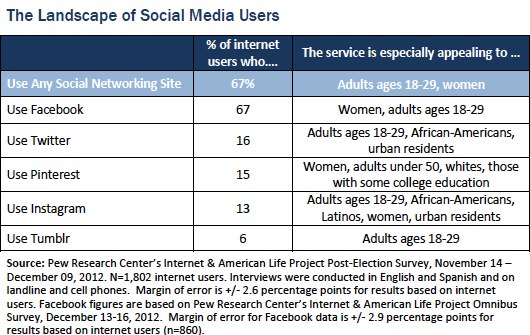
  • Forget Facebook, Twitter and Google+. These are primarily personal and B2C social media platforms, and there are few good reasons why most B2B firms should be investing any time or resources there. In terms of demographics, it’s telling that Twitter’s top 3 profiles belong to Justin Bieber, Lady GaGa and Katy Perry, but if your B2B firm needs quantitative evidence to support dropping these social media platforms, here is some recent research from Pew Research Center:
PRN_landscape_social_media_users

  • Use YouTube Selectively. YouTube can be a very effective social media channel for B2B firms. But your video products must be sophisticated, professionally produced, and no longer than 3 minutes. Resist the temptation to include sloppy, home-made productions, or hour-long webinar presentations. They reflect poorly on your brand, and few people will watch them. Ensure that you develop ways to drive consistent traffic to your YouTube channel.
  • Build Your LinkedIn Presence. LinkedIn is 3x more effective for demand generation than either Facebook or Twitter. LinkedIn has become an essential part of the business world’s due diligence process, and your company is conspicuous by its absence. Unfortunately, few companies take full advantage of LinkedIn’s social media potential. Their corporate profiles often do not contain adequate information, they do not merchandise blog-related and other relevant content, fail to connect through industry user groups, and their employees’ profiles are inconsistent and sometimes unprofessional. Most B2B companies would be well served to invest 100% of their social marketing effort through LinkedIn.

Very often, the root cause of dysfunction and disappointment related to the application of social media tools by B2B firms has less to do with the shortcomings of the various platforms, and more to do with the lack of a coherent and articulated marketing strategy. Chances are, if a B2B firm is spinning its wheels in the morass of social media, they’re having similar challenges with traditional marketing communication channels as well.

1 Comment

Filed under Uncategorized

5 Ways to Merchandise the “Masthead Value” of Publicity

Not to be confused with "The Wall Street Transcript"

Not to be confused with “The Wall Street Transcript”

Many companies will invest considerable effort seeking positive publicity in influential media sources, and then fail to benefit from the masthead value of that exposure.

Originally a seafaring term relating to the brass plate attached to a ship’s mainmast that memorialized its owners and builders, a publication’s masthead lists the members of its current editorial and production staff. The industry term “masthead value” can be defined broadly as the level of stature, credibility and influence associated with a specific media source. The Wall Street Journal, for example, has high masthead value; the Wall Street Transcript…not so much.

Masthead value can be relative. A respected trade or professional publication in a particular industry may have greater masthead value – in terms of its influence with a particular audience – than well known publications such as the Wall Street Journal or New York Times. For example, physicians are likely to assign the New England Journal of Medicine greater masthead value than the Journal or Times on topics relating to clinical care of patients.

Masthead value should drive your publicity strategy. A placement from a single highly respected source can be far more valuable, in terms of influence, than a dozen hits with low masthead value. Because gaining inherent 3rd party endorsement is the end goal, in the publicity game quality always trumps quantity.

Here are 5 ways to leverage media placements with strong masthead value:

  • Put high value placements directly in front of your target audiences – Even if your coverage appears on the front page of the Wall Street Journal or makes the cover of Fortune magazine, don’t assume it will be read by clients, prospects, referral sources…or even by your employees. There’s simply too much offline and online noise to ensure that any media exposure on its own will gain the attention you’re seeking. If you’ve developed an internal CRM-driven discipline to communicate directly and regularly with target audiences, then you’re well prepared to apply that distribution capability to increase the chances that decision makers will notice, remember, and respond to your high value exposure. (Lacking that discipline, your time may be best spent building an effective distribution capability, in advance of seeking additional publicity.)
  • Avoid “Hey, look at me!” self-promotion – Pickup in a media source with high masthead value provides some reason for high-fives internally, but it should not serve as a platform for self-promotion. Extreme examples of this error include companies that issue a press release, or generate Twitter and Facebook postings to announce, for example, that their CEO has been profiled in Inc. magazine. This type of over-reaction to high value publicity suggests to target audiences that you were surprised to receive the media endorsement, and therefore may not have really deserved it. The key is to showcase the media exposure in a relevant context (you may need to create this), to make the media placement secondary to the underlying content (such as the reasons why your CEO was profiled in Inc.) and to pull off these tasks with a matter-of-fact level of self-confidence.
  • Rank graphics over content, in terms of impact – Most people are surface readers. Online visitors are more likely to scan images, heads, subheads and captions, than they are to read body copy. (Long blocks of copy on websites that require scrolling are rarely read.) If you’ve earned a placement with high masthead value, you can increase the likelihood of your company being associated with the “endorsing” publication by displaying its logo with the capsule description and link to the placement. To be clear: the critical element is the logo. If your placement is from the New York Times, for example, you should replicate the logo – as it appears on the front page of that publication. Based on how people gather information, simply typing, “from The New York Times,” or a similar attribution, is about 75% less effective than actually depicting the New York Times logo.
  • Prominently showcase high value placements – If you’ve invested and succeeded in generating media placements with high masthead value, why make it difficult for target audiences to find them on your website? Rather than burying influential publicity in an obscure “In the News” section that requires multiple clicks for visitors to locate, you can amortize your investment in publicity (and perhaps improve your website’s bounce rate in the process) if you create a location for these high value items on your home page. This can be accomplished by applying a design format in which the content either remains fixed or is refreshed regularly. For formats that supply current information, extend the shelf-life of each placement by not including its publication date.
  • Cite a relevant endorsement on your home page – One of the most effective  ways to  merchandise high-value media exposure is to select a very brief, relevant phrase from the coverage, for placement in a prominent position on your home page. Here’s a hypothetical example:

“…a recognized authority in Big Data technology.”

                                                       –Wired Magazine

By limiting your publicity efforts to media placements with high masthead value, and by ensuring that those placements are effectively merchandised through direct communication, social media tools and proper website visibility, PR practitioners will spend far less time worry about the ROI of public relations. The fruits of their labors will be self-evident in tangible business metrics, ranging from lead generation to high search engine page rankings.

Leave a comment

Filed under Uncategorized

Should I Rekindle My Blog Love Affair…Or End It?

Can This Blog Affair Be Saved?

Can This Blog Affair Be Saved?

Here’s a sad letter from the Marketing Craftsmanship mailbag:

Dear Marketing Guy,

I’ve fallen out of love with my Blog and I need your advice. My sad story:

It was love at first sight. A company Blog had everything I was looking for in social media. It would drive SEO. Establish thought leadership. Engage clients and prospects. Create two-way communication. Build long-term relationships.

My competitors all had Blogs, and I needed one. It would complete my marketing.

Falling in love with my Blog was so easy. WordPress.com was the perfect matchmaker, and my Blog didn’t cost me a penny to build. I had big plans for my Blog. Topics we would cover together. Discussions I would moderate. I made a personal commitment to post regularly. My Blog and I would create beautiful leads together.

It was a great love affair…at least for a while.

After a few months, my Blog started demanding more of my time. But my Blog wasn’t living up to expectations. Few people visited, only employees commented on posts, and there were no leads in sight. My disappointment grew, but my Blog demanded even more content. “I need interesting ideas, not sales promotion,” my Blog would scream. We grew further apart. Weeks, and sometimes months, passed between posts.

Now, my blog and I are the office joke. Blog visitors wonder if my company has a pulse. My Blog has become a brand liability. I can’t look at the company’s website anymore, because my Blog is always there, reminding me of our failed relationship.

Does my Blog deserve a second chance? Or should I simply move on? Help!!!

Yours Truly, Blog Gone Wrong

Dear Blog Gone Wrong,

Lots of companies fall out of love with their Blogs. I feel your pain, but you’ll get little sympathy from me. Here are  a few questions to start you thinking about why your Blog relationship fell apart so quickly:

  • Was your Blog part of an integrated marketing strategy…or just a temporary infatuation?
  • Did you create an editorial calendar to provide content focus…or made promises you could never keep?
  • Did you assign sufficient resources to ensure your Blog’s long-term success…or were you just looking for a cheap date?
  • Was there a strategy to promote your Blog and to merchandise its posts…or did you think that would just “happen”?
  • Were there tangible and realistic business metrics to measure your Blog’s ROI…or did you think pre-nuptuals would kill the relationship?

My guess is that you were attracted to your Blog’s many fine features and benefits, but were unwilling to invest the time and resources necessary to build a meaningful, long-term relationship. If that’s the case, you really don’t deserve a Blog.

You might be better suited for a relationship with a Twitter account.

The Marketing Guy

2 Comments

Filed under Uncategorized

4 ½ Reasons To Avoid Using Celebrity Endorsements

With those big guns, can we be sure that Tony's not using HGH?

With those big guns, can we be sure that Tony’s not using HGH?

Here are 4 ½ good reasons to avoid celebrity endorsements:

  1. OJ Simpson
  2. Tiger Woods
  3. Lance Armstrong
  4. Oscar Pistorius

4.5  Elmo the Muppet

The marketing world is littered with celebrity endorsements similar to these train wrecks. Yet companies will continue to dole out lucrative contracts to sports heroes, actors, politicians and other personalities du jour…in hopes of leveraging their popularity or notoriety.

Why do marketers continue to roll the dice with their company’s brand reputation?

One reason: celebrity endorsements require no creativity and very little effort. Nike’s ad agency simply shoots some footage of Tiger bouncing a golf ball 25 times off the face of a pitching wedge, and voila…there’s a 30-second commercial.

Companies rationalize this brand risk by assuming that the public will assign them some sympathy for having been duped by the murdering, philandering or drug abusing ways of their fallen celebrity. Marketers also may believe a celebrity’s fall from grace will provide their company with an opportunity to publicly cancel the contract, express sorrow or indignation, and gain additional time for their brand in the public spotlight.

But in terms of long-term brand management, association with a celebrity who’s fallen from grace is a losing proposition. For starters, it demonstrates poor judgment. So ignore the assurances from your ad agency, even if the celebrity they’re proposing is Mother Teresa.

But if you’re determined to use a celebrity, it may be a safer bet to hire an animal than a human. To my knowledge, RinTinTin never bit anyone, but Orca whales have a very poor track record.

Better yet…create your own celebrity. The Geico Gecko, Kellogg’s Tony the Tiger, and StarKist’s Charlie the Tuna all have clean rap sheets. So far.

Leave a comment

Filed under Uncategorized

Tennyson Delivers Skyfall’s British Bulldog Moment

To strive, to seek, to find, and not to yield.

In her 7th and final role playing “M” in Skyfall – the latest in a series of 23 James Bond movies produced over the past 50 years – Dame Judi Dench appears before Britain’s Intelligence and Security Committee to defend her record as head of MI6 – the government agency which supplies Her Majesty’s Government with foreign intelligence.

Under pressure to explain breaches in MI6’s internal security, the 007 matriarch waxes poetic, quoting a few lines from one of her late husband’s favorite poems:

“…We are not now that strength which in old days
Moved earth and heaven, that which we are, we are;
One equal temper of heroic hearts,
Made weak by time and fate, but strong in will
To strive, to seek, to find, and not to yield.”

Students of the late Professor Arthur R. Reil, Jr.’s English Lit course at Fairfield University – having memorized all 70 lines of that particular poem (as well as several odes and sonnets) – recognized Dench’s reading immediately as Ulysses, written by Lord Alfred Tennyson in 1833.

Some Cliff Notes for Biology majors: Ulysses is the ancient warrior hero of Homer’s Odyssey. British poet Tennyson envisions Ulysses speaking this narrative after having returned from the Trojan War to Ithaca, the kingdom he rules. Before he leaves Ithaca to embark on his final voyage, Ulysses describes his boredom with domestic life and fear of old age, longing for a return to his lifelong quest for adventure and knowledge.

Lord Tennyson was Poet Laureate of the United Kingdom during much of Queen Victoria’s reign and remains one of Great Britain’s most popular poets. But when Tennyson wrote Ulysses, he was living in cramped quarters with his mother and nine of his ten siblings, with little income and in failing health. The poem was written shortly after, and influenced by the death of his close friend, the poet Arthur Henry Hallam (1811–1833), who was engaged to Tennyson’s sister Emily. The parallels between the plight of Ulysses and Tennyson’s personal circumstances continue to be the focus of countless, thoroughly boring Ph.D. dissertations.

Although it has been the subject of sniping since the film’s release, the Skyfall screenwriters’ rationale to interrupt their action movie with a brief poetry reading was very clear, and in my view, displayed noteworthy cinematic craftsmanship by providing the “British Bulldog Moment” that’s an essential element in every James Bond installment.  (For movie-goers who miss the point of the poem, Skyfall’s screenwriters provide a Union-Jacketed, Royal Doulton ceramic bulldog that “M” bequeaths to 007.)

What’s far less clear – some 40 years after Professor Reil forced me to memorize Ulysses – is how I can still remember and recite verbatim at least the first 10 lines of that epic poem (and up to 15 lines, after downing 3 Guinness stouts)…but I can never remember a new name or phone number for more than 30 seconds unless I write it down.

8 Comments

Filed under Uncategorized

Finding Elmer in Hurricane Sandy

This is where I found Elmer, the Volunteer Craftsman.

One week ago today, my wife and I spent most of the night in total darkness lying on a mattress we had dragged into the front hallway: the location we determined to be the safest in the house…other than the basement, which we considered our retreat of last resort. On the other side of our front door, Hurricane Sandy lived up to expectations. Over the howling 80 mile per hour wind and the sound of aluminum siding being ripped away from the house, we could hear the mammoth trees that surrounded our house groan and fall, one at a time…but without the enormous thud one would expect, as their root systems, still clinging to clumps of rocks and dirt, slowed their trajectory.

For nearly two hours, waiting for any one of those trees to fall directly on to our house, we were completely at the mercy of the gods, statistical probability and dumb luck. We felt terror and helplessness, and unlike how we all spend most of our lives – watching others on a screen experience actual or scripted misfortune – this event was happening to us, it was real, and we were directly in harm’s way. Our three dogs, secured in their cages for the evening, were all strangely quiet, as if they understood the seriousness of the situation.

At first light, we surveyed how our property had been re-landscaped by the storm. Nearly a dozen trees, all more than twice the height of our house, were on the ground and all pointing in the same direction, as though they had been knocked down by a giant bowling ball. Our aluminum fence was crushed in several places, our chicken-less chicken coop destroyed, and our yard scarred by huge 3-foot craters at the base of each fallen tree. No tree had hit the house, and we counted our blessings, thankful to be alive.

Since that moment of profound thanks, and over the course of one week (so far) living without electricity, refrigeration, microwave oven, internet service, cable TV, phone service, hot showers or gasoline, a few things came into clearer focus:

  • “Civilized man” appears no longer capable of enduring any prolonged period of discomfort. We are hooked on electricity, plumbing and technology, and have no notion of how we might survive without any of them. We are addicted to physical comfort and entertainment.
  • The line between civilized society and total anarchy appears extremely tenuous. If it takes the local police to manage orderly distribution of gasoline at a filling station when supply is low, what happens when food and water supplies are short? Society scoffs at hard-core survivalists, but there is much truth in what they preach about human behavior.
  • We only really feel or care about misfortunes that happen to us and our families. As I sat in my dark, cold kitchen using limited laptop battery life, it annoyed me to see Facebook friends who had not been affected by the hurricane conduct their usual online banter.
  • We have very short memories. The power will eventually be restored, fences rebuilt, trees replanted and daily routines re-established. We’ll all return to our “normal” lives, and push Hurricane Sandy into that small corner of our brain reserved for things we’d rather forget.

At the “warming shelter” that had been set up at our local fire house for people without electricity, we met Elmer, a retired executive now serving as a full-time Red Cross volunteer, who has been on site at every major national catastrophe across the country over the past decade. Elmer was there simply to talk to people, to put their situation into perspective, to offer support and to provide helpful information if he could.

For me, other than taking cold showers and not having a tree fall on the house, Elmer is what I will remember most about Hurricane Sandy. Because Elmer reminded me that there are plenty of people who do care about others, and who are willing to be uncomfortable in order to help them. Elmer and his fellow practitioners of volunteering craftsmanship are just harder to find.

Leave a comment

Filed under Uncategorized

PR / Media Pros Should Stand Firm on Requiring Quote Approvals

Quote Approvals Lower the Risk of Media Burn

The practice of requiring journalists to submit on-the-record quotes for approval by a source in advance of publication has long been a sore point between the media and the PR profession. A new spotlight has been cast on the issue, with writer Michael Lewis’ acknowledgment that he’d agreed to quote approval for his Vanity Fair profile on Barack Obama, and the new policy issued by the New York Times, which forbids their reporters from agreeing to “after-the-fact quote approval by sources and their press aides.”

Notwithstanding the New York Times’ effort to protect the integrity of the Fourth Estate, there are at least 3 reasons why it makes good sense for companies and organizations to stand firm on stipulating that reporters obtain quote approval as a pre-condition for granting an interview:

  1. Reporters Are Human. They often don’t bring the depth of knowledge that’s required to cover the assignments they’re handed…so they will make mistakes. They also bring their own points of view…so they will be selective in how they quote sources. And sometimes, they don’t always play by the rules. This blogger was told by a New York Times reporter that if I pressed for a correction to an error he had made regarding one of my clients, that he would never feature any of my clients in his column.
  2. The Spoken Word and Written Word are Very Different. A comment or offhand remark that’s expressed during an interview can cast a false or unfair impression when taken out of context, and when it is read rather than heard. Very few individuals have the ability to envision…as they are speaking…how their spoken words will look in print and to know what message those words will convey. Mark Twain recognized that “talk in print” results in “confusion to the reader, not instruction.”
  3. Journalism Is a Cat and Mouse Game. Reporters are frequently looking for a “gotcha” quote that can juice up their coverage, or support a point they’re seeking to make. Their questions can be contrived, or their approach designed to wear down a source. This blogger learned that lesson the hard way, when a Chicago Tribune reporter twisted a fact-based comment in a very long conversation that enabled him to write a story entitled, “Amex Official Admits CBOE Superiority.”

If you’re willing to participate in media interviews without the safety net of quote approval….here are some guidelines that will lower your risk of being burned:

  • You Can Never Be “Media Trained” – Regardless of whatever training, practice sessions or actual interviews you’ve had, believing that you are “media trained” provides a dangerous and false sense of security. Every reporter is different, every interview is a unique opportunity, and you need to be properly prepared every time.
  • Don’t Lead Lambs to Slaughter – For a host of reasons, and regardless of their org chart position or years of experience, some people are media disasters. If your senior manager or client has a track record of interviews that did not go well, avoid putting them in harm’s way. If a heart-to-heart conversation regarding their poor interviewing skills is not an option, at least ensure that they are equipped for interviews with tightly scripted talking points.
  • Tape Record all Interviews – When there’s a recorded version of an interview, a reporter is likely to be more careful in quoting a source, and you have something more credible than written notes, if there is any controversy. It’s good form to let the reporter know upfront that you will be tape recording an interview. If the reporter objects, and you still agree to conduct the interview, then your organization deserves whatever misquotes or misrepresentation may occur.

2 Comments

Filed under Uncategorized

The Harvard Cheating Scandal: Do Administrators Need “Public Relations 101”?

Harvard University announced last week that the school is investigating 125 students for possibly cheating on a take-home final exam for “Government 1310: Introduction to Congress.” After reviewing more than 250 take-home exams turned in last Spring, the Harvard College Administrative Board has opened cases involving nearly half the 279 students enrolled in the class. The school has contacted every student whose work is under review, who now face sanctions that include suspension for up to a year.

In considering whether Harvard may have caused significant long-term damage to its own reputation unnecessarily, let’s ignore some fuzzy facts and conjecture:

  • The course, as measured by the professor’s own words and behavior, did not reflect a level of academic rigor one might associate with a prestigious university.
  • Take home exams, by their very nature, are generally considered a joke by most students.
  • Apparent confusion over at least one of the exam’s questions was exacerbated by the unavailability of the professor during the exam period, causing students to seek clarification from fellow classmates.
  • It’s unlikely that such a large proportion of the class would purposely cheat on what appears to be a gut course.

In examining whether Harvard may have caused significant long-term damage to its own reputation by acting in a hasty and imprudent manner, let’s speculate on a few likely catalysts:

  • After discovering similarities in the exams, and in advance of sending out letters to the 125 students suspected of cheating, Harvard failed to consider the high likelihood that this issue would quickly become a news item. If the school had acknowledged that risk, Harvard would (or should) have announced the scandal in advance of sending out letters to students.
  • Harvard likely became aware of the possibility of negative media coverage either after a call from a reporter, or in reaction to a threat from a student (or their lawyer) to make this a public issue.
  • Regardless of when and how Harvard began to think about negative media exposure, the most significant catalyst that caused administrators to blow the whistle on the affair was a post-Penn State fear that Harvard might be accused of hiding or covering up an incident related to institutional integrity.

If this speculation is correct: that Harvard overlooked the potential media impact of its cheating inquiry, and then blew the whistle on itself mainly as a knee-jerk defensive strategy….here are two fundamental PR lessons from this brand debacle:

  1. Assume the press will always learn about a problem, and plan an offensive strategy (well ahead of time) to minimize the damage. Because Harvard has long enjoyed a pristine reputation, it’s likely that their PR professional was not involved in this issue from the outset, or they had little input.
  2. If the press is on your damaging story, or is likely to be very soon, sometimes it’s better to keep your powder dry if you haven’t planned ahead. Harvard would have been better served if the school had completed its inquiry of the 125 “cheaters” in advance of its public announcement. Even with the media pounding on its doors, Harvard would have provided those 125 students and the school’s reputation with greater justice by responding publicly that “the issue is under investigation and a public statement will be issued only after all the facts and opinions are considered.”

Ham-fisted, panic motivated PR – even when it’s disguised as a self-righteous effort to maintain academic integrity – is not behavior you’d expect from one of the nation’s smartest institutions.

Leave a comment

Filed under Uncategorized

Augusta National Throws Women a Bone. Should Condi and Darla Return the Favor?

Darla and Condi Have No Reason to Celebrate

Augusta National Golf Club, long revered by the golfing world as the Sistine Chapel of their sport, announced with great pride (a “joyous occasion,” according to Augusta Chairman Billy Payne) that it had invited bureaucrat Condoleezza Rice and financier Darla Moore to join the club as its first female members.

For decades, Augusta National has defiantly withstood public criticism and pressure to admit female members on the basis that as a private institution the club is under no obligation to accept anyone – regardless of sex, race, religion or sexual preference – who does not pass muster with the boys who hold the keys to the front door.

Ever since golfing legend and bona fide Southern gentleman Bobby Jones co-founded Augusta National some 80 years ago, the club has served as the stage for the Masters Tournament, considered by many as golf’s most important international competition, perhaps with exception of the Ryder Cup. And it’s Augusta National’s association with the history and tradition of the Masters that provides the club with a level of prestige (and arrogance) that exceeds St. Andrews and Pebble Beach combined.

During his days as Microsoft’s CEO, Bill Gates faced Augusta National’s arrogance first-hand when denied club membership for publicly stating that he wanted to be a member. As punishment, Augusta forced Gates to eat crow for several years before he was allowed to wear a member’s green jacket.

But Augusta National’s bullying isn’t limited to their admission process. A little known fact is that once admitted to the club, a member is not assured of continued membership and may be dropped at any time for any reason with no explanation. In fact, the only way Augusta National members know if they are still members is by the arrival of their annual dues invoice in Spring. No invoice means your invitation has been withdrawn.

Augusta National is not about golf; it’s about power. It features a golf course that’s closed for a good part of the year to protect the pristine fairways and sacred greens that its well-heeled members rarely play on.  Augusta National is not about golf; it’s about prestige. The club bestows membership to America’s corporate royalty the same way the Queen of England awards knighthoods and MBE titles…but with far less intelligence and transparency than the British monarchy.

The sad truth is that women have nothing to cheer over the “joyous occasion” at Augusta. This publicity stunt does not represent a meaningful change in the club’s policy of exclusion, and provides Augusta National with convenient and high profile validation that it will continue to exercise its right, as a private club, to do whatever it wants whenever it wants.

If Condi and Darla are serious about playing golf, there are scores of world-class private clubs that have been accepting women as members for many decades. And if Condi and Darla are serious about advancing the cause of women’s rights, they should decline Augusta National’s invitation. And they should make a lot of noise in the process.

Leave a comment

Filed under Uncategorized