Tag Archives: Twitter

Jimmy Webb and the Power of Storytelling for B2B Companies

Music critic Miss Universe on "A Hard Day's Night" movie set

Songwriting legend Jimmy Webb has written some of pop music’s most enduring ballads, including Wichita Lineman, By the Time I Get to Phoenix, Galveston, The Worst That Could Happen and the rock cantata MacArthur Park (simultaneously heralded as a musical masterpiece and the worst song ever written.)

The 66 year-old Oklahoma native now lives in Long Island and performs year-round at small venues in the US, Canada and abroad. Baby boomer fans pack the room to hear Webb strain to hit his own songs’ high notes, to listen to his tales of life on the road, and to get the real stories behind how and why he wrote specific songs.

At a show last weekend in New Jersey, Webb told fans about his first trip to London in 1964, where he fell in love with Miss Universe, who he met on the set of the Beatles movie, A Hard Day’s Night. According to the rambling story, in his attempt to impress the beauty queen – who had been cast as an exotic dancer and appears for 6 seconds in the film – Webb invited her back to his hotel room, where he sat her down next to him on the piano bench and performed his then unrecorded version of MacArthur Park. Unfortunately for Webb, the 7 ½-minute song failed to put her under his spell. She told him it was a silly song and left. Or so Webb’s story goes.

For the 450 people who heard Webb’s London adventure, all of whom have listened to MacArthur Park for decades, their musical experience has been forever re-shaped. When they hear that song in the future, it will provide a different context or a different meaning. Now, instead of cakes left out in the rain, they’re more likely to envision Jimmy Webb serenading Miss Universe in London. That’s the power of storytelling.

Social media and technology provide efficient ways for people to tell stories. But according to Dr. Pamela Rutledge, Director of the Media Psychology Research Center, “The human brain has been on a slower evolutionary trajectory than the technology. Our brains still respond to content by looking for the story to make sense out of the experience.”

Writing in Psychology Today magazine, Dr. Rutledge notes that, “When organizations, causes, brands or individuals identify and develop a core story, they create and display authentic meaning and purpose that others can believe, participate with, and share. This is the basis for cultural and social change. This is a skill worth learning.”

Increasingly, in B2B communication, companies focus on the medium and the technology, rather than the underlying message, its meaning or purpose.  In our world of websites, blast emails, podcasts, webinars, analytics, blogs, Facebook, Twitter, marketing automation, smart phones and mobile apps…it’s easy to forget that the quality of a company’s narrative drives people to notice, participate or care about what’s begin sold – whether that be a product, service or a philosophy.

We’re all familiar with how the big brand companies such as Harley Davidson, Jack Daniels, Levi Strauss, IBM and Ben & Jerry’s have leveraged their corporate narratives to build awareness and market interest. But most small and medium-sized companies, and B2B firms in particular, are at a loss to understand how the power of storytelling can showcase their core values, mission and marketplace differentiation. But this goal can be accomplished…not by cooking up elaborate tales about the company’s founders or its early struggles… but rather, by pulling back the curtain on how and why the company makes decisions, and by using real-life examples and incidents to provide interest and context.

A great example of effective storytelling involves Davidson Trust Company, a Devon, Pennsylvania-based investment manager with around $1 billion in assets under management. In a series of columns published in the Philadelphia Inquirer, Davidson’s CEO Alvin A. Clay III used stories to establish relevance for his thoughts on issues of importance and likely interest to his firm’s current and prospective investors.

In one of his columns, Davidson’s CEO described how his father – a longtime professor at Villanova – had been the beneficiary of kindness as a young man, and had devoted much of his teaching career returning the favor to others. In another, Mr. Clay recounted a heated debate he had experienced with other business leaders, and how that exchange had shaped his decision-making process regarding publication of his company’s ethics statement on its website. In all of Clay’s columns, he used storytelling to deliver insight and to position the Davidson brand in a genuine, credible and memorable manner.

At his concerts, Jimmy Webb spends more time telling stories than he does on singing his songs. And these events typically end with a 10-minute standing ovation.

Earlier this month, Davidson Trust Company received its own standing ovation. Publicly traded Bryn Mawr Bank Corporation (NASDAQ:BMTC) announced plans to acquire Davidson.

Leave a comment

Filed under Uncategorized

PR Lesson from a Twitter Flap

Emma Sullivan

@emmakate988

Just made mean comments at gov brownback and told him he sucked, in person #heblowsalot

When Shawnee Mission High School student Emma Sullivan jokingly tweeted her friend on November 21st, expressing her opinion of Kansas Governor Sam Brownback’s education policy, she had no reason to suspect that her 87-character message would ignite a firestorm of national debate; generate media exposure from nearly every major news source; increase her Twitter followers to nearly 16,000 from 61; or make her the poster child de jour for the First Amendment.

It wasn’t Emma’s tweet that caused the high-profile controversy. The flap was created by a staffer in Governor Brownback’s office who was compelled to contact the leader of Emma’s “Youth in Government” program, who notified Emma’s high school principal, who demanded an apology from Emma, who responded by notifying the media that her God-given American right to tweet was threatened. Stop the presses: we’ve got ourselves a sexy story that’s ready for prime time.

At this point, Governor Brownback and the Shawnee Mission School District had a big decision to make: either hold your ground, or back off a controversy that the media was likely to milk for days, and would position the governor and educators as free speech bullies and social media terrorists.

Contrary to decision-making you might expect from politicians and bureaucrats, both parties immediately backed down. The governor issued an apology, and the school district publicly stated its support of free speech and said Emma was not required to apologize. Smart move.

The PR lesson from this tweet heard round the world is that an apology is often the most effective way to limit damage to one’s reputation or brand. It takes guts to admit an error, but if it’s done correctly, you can build goodwill that offsets the mistake.  For some guidelines on how to apologize correctly, check out Ken Makovsky’s blog post on John Kador’s book, “Effective Apology.”

Emma Sullivan might want to put Kador’s book on her Christmas wish list. She has yet to learn basic diplomacy skills from her Youth in Government program. To date, Emma has refused to apologize for her salty tweet.

Leave a comment

Filed under Uncategorized

Death by Content: How Press Release Abuse Killed Public Relations

Self-serving Press Release Content Has Killed PR

The origins of the press release are unclear, but in the not too distant past, this communication tool was called a “News Release.” And its sole purpose was to provide the press with information likely to be of interest to the public; containing what journalists still call “news value.”

Prior to popularization of fax machines in the 1980s, news releases were delivered by human messengers to major wire services such as AP, UPI and Dow Jones, which in turn communicated that news to their subscribing media outlets over a broadtape machine – much like a financial ticker tape, but using a much wider roll of paper. For non-daily news sources such as magazines, news releases were often sent through the US Mail.  Regardless of how they were delivered, news releases served an important role in mass communication.

But the news release has lost its franchise as a communication tool, for two reasons:

  • Thanks to technology, news releases became an anachronism. Online news portals and email killed the underlying functionality of paper releases as a news dissemination tool. The internet delivered news faster, and this was a good thing.
  • Thanks to the PR profession, news releases (aptly re-named press releases) became platforms to deliver content with little or no news value, and largely of no practical value or interest to the press.  Flacks began using the press release as a marketing and propaganda tool, and this was a bad thing.

Over the past two decades, the sustained volume of press release abuse by PR practitioners – driven in large measure by CEOs (and clients) who fail to understand that journalists are not ad hoc members of their company’s Communications Department – has greatly diminished the stature of the public relations profession in the eyes of journalists, and has also reduced the ability of PR pros to leverage the media as a valuable means of securing objective, third-party exposure and validation for their company, product or cause.

As the number of journalists who post “Do not send press releases or pitch story ideas to me” on their Cision or Vocus profiles increases every year, the PR profession will eventually lose one of its most fundamental roles: to discover or create content that has bona fide news value, and to properly package and present that information to media sources.

If journalists find no practical need for flacks, organizations will likely follow their lead. For public companies, dissemination of financial results and material events will be handled by their legal department. Because press releases are now considered sales collateral by their target audiences, “media relations” for all companies will be managed by the marketing department. Public Relations, as a profession and a function, will simply cease to exist.

Twitter, blogs and other social media-based “pull” tools may eventually replace the press release. But unlike social media, press releases have been pushed at journalists, filling their inboxes, wasting their time, and reinforcing the media’s perception of PR as a self-serving and often ignorant generator of meaningless noise.

It may be too late to repair the self-inflicted damage done to the PR profession by years of press release abuse. Morphing from a Public Relations professional into a Social Media professional may buy some additional career tenure for young communications practitioners, and hopefully they’ll learn from the lessons of PR’s suicide: that whether it’s tweeted, posted or contained in a press release, news and information lacking intrinsic value will always reflect poorly on its source. And over time, it will make you irrelevant.

12 Comments

Filed under Uncategorized

3 Ways Social Media Will Fail Marketers

All communication channels have limitations

1. Social media will not increase word of mouth influence.

Research by Keller Fay for Google shows that 94% of word of mouth conversations occur offline, and most often, those conversations are sparked by information found on the internet and television…and not on Facebook, Twitter or other social networking sites. Based on those offline conversations, consumers most often rely on internet search for additional product / brand information, which is considered to be more credible (+25%) and more likely to lead to purchase (+ 17%), when compared to information found through social media sources.  Marketers are best served by focusing on improvement of their SEO capabilities.

2. Social media will not drive customer experience.

Social media does not improve or replace the customer service channels that have the most significant impact on brand impressions. Multi-channel customer experience research by RightNow / Loudhouse showed that consumers are open to using social media to post opinions, but when it comes to interaction, 50% of consumers want to use online self-service tools, phone (18%), or email (19%).  Marketers are best served ensuring traditional channels deliver a customer experience that validates the company’s brand promise.

3. Social media will not reduce the marketing burden.

Similar to all other communication channels, social media involves ongoing discipline and a commitment to continually learn and improve performance and results. Establishing a Facebook page, Twitter account or company blog represents an obligation to dedicate the financial resources, appropriate skills and senior level attention necessary to make social media a strategic marketing asset. Marketers are best served walking away from half-hearted or short-term commitments to social media.

Leave a comment

Filed under Uncategorized

Are Your Customers Brand Terrorists?

The old marketing adage is that customers can either be brand ambassadors or brand terrorists, depending on how they’re treated.

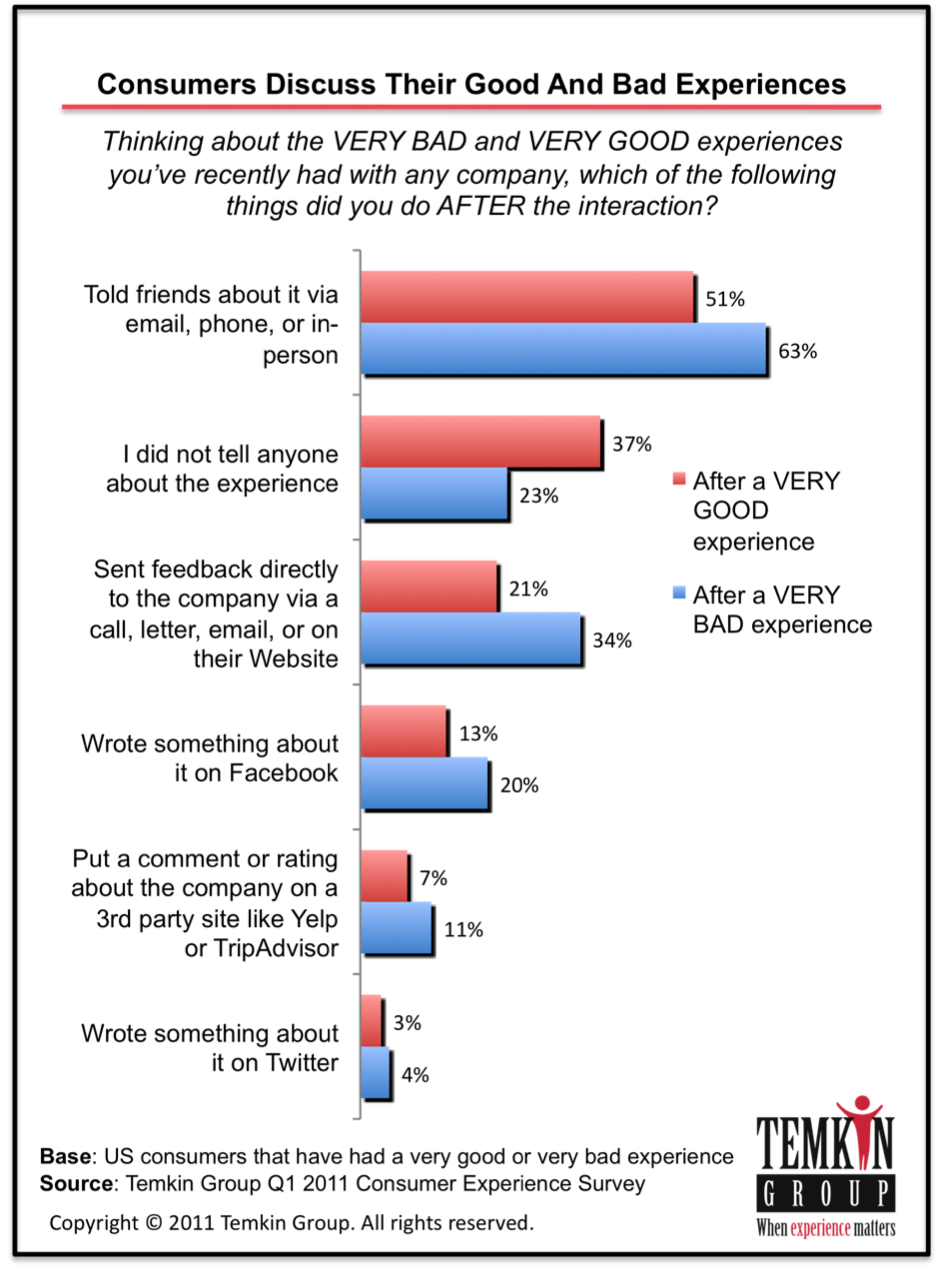
Former Forrester Research analyst Bruce Temkin (now managing partner of Temkin Group) is a guru of the Customer Experience Management (CEM) discipline…and there are some interesting insights for marketers in Temkin Group’s Q1 2011 Customer Experience Survey, including this one:

Are traditional channels the best battleground to fight brand terrorists?

It appears as though customer terrorists are most likely to inflict brand damage in direct conversations with friends; either on the phone, through email or in person (63%), and it’s tough for companies to counter those assaults. In fact, Word-of-Mouth research firm Keller Fay Group estimates that 90% of all customer conversations about brands in the US – both positive and negative – happen offline.

From a defensive standpoint, a company’s greatest opportunity to address customer grievances occurs when they appeal directly to the company through phone calls, email, letters and website comments, which according to Temkin occurs about 34% of the time.

Despite all the buzz about the power of social media as a CEM tool, most customers are not spending much time complaining on Facebook(20%); on 3rd party opinion sites such as Yelp or TripAdvisor (11%); or on the darling of social media, Twitter (4%).

Perhaps all the social media hubbub – at least in part – serves as a convenient distraction for companies that have failed to deliver on the most widely used CEM channels: phone, chat and email?  If you’re looking to convert customer terrorists into brand ambassadors, those channels still appear to be the best places to invest time and money.

Leave a comment

Filed under Uncategorized

Porno as a B2B Marketing Tactic?

Here’s an interesting insight from the Decision Dynamics survey released earlier this week. Co-sponsored by the Financial Times and Doremus, this survey of more than 500 senior-level business executives suggests that if you’re attempting to reach corporate decision-makers, you may want to want to re-consider Twitter as a marketing tactic. Fewer than 10% use Twitter at work, and only about 20% use Twitter at  home. 

Apparently there are better ways other than Twitter to leverage digital media to reach business executives;  including webcasts, podcasts, blogs and…yes, games…which is likely to be of some concern to company shareholders and laid-off employees, as it appears that nearly 40% of these senior executives spend some part of their day playing games at work.

Given the survey’s game-usage insight, here’s something that deserves additional research: if nearly 75% of senior executives frequently or sometimes “view online video” while they’re at work, what exactly are they watching?

Digital Media: % Used Frequently or Sometimes

Leave a comment

Filed under Uncategorized