Category Archives: Uncategorized

Should PRSA Sanction Public Relations Practitioners?

In his bi-weekly column on customer service, “The Haggler,” New York Times writer David Segal addressed a long-standing and well-founded gripe that many journalists have against public relations practitioners who send out press releases and other solicitations in wholesale fashion; regardless of the content’s relevance or likely interest to the journalists they’re pitching. According to Segal, hundreds of thousands of these unsolicited pitches – or “P.R. Spam,” as he calls it – “belly flop into the email systems of journalists every day.”

The relationship between journalists and PR professionals has always been contentious. Reporters claim PR people block their access to sources, and sometimes to the truth. PR counters that journalists often don’t care about facts, or twist them to suit their editorial agenda. But because the press can deliver exposure and credibility that PR craves, journalists have always been in a more powerful position. As a result, effective public relations involves pushing a company’s or client’s agenda (or products and services) without being a pest, and ideally, by being helpful to reporters who are in a position to reciprocate with media coverage. It’s a dance that both sides understand.

Over the past decade, three developments have upset the already rocky relationship between PR and the press:

  • Email, and “blast email” in particular, has become PR’s most frequently used communication device. Standard PR procedure at most firms and agencies is based on “shotgun” tactics designed to reach as many media sources as possible, relevance or interest notwithstanding.
  • Database companies, notably Cision and Vocus, empower PR people to create enormous lists of journalists in a matter of minutes. What was once a painstaking research process now involves a few keystrokes.
  • The internet and a fundamental shift in how news is reported have greatly reduced the number of journalists. Conversely, more schools are pumping out graduates with PR degrees. So there are now significantly more PR people chasing a much smaller number of journalists. And many newly minted PR people have not been taught the unwritten rules of effective media relations.

Why should serious PR practitioners care about the behavior of the growing number of people within their profession who display no regard for fundamental media relations protocol?

In his column, New York Times’ David Segal reports that he has removed his contact information from the 5 leading media database companies. Calling on other reporters who also seek fewer unsolicited intrusions in their mailboxes, Segal provides detailed instructions on how they can delete their listings from those databases.

But it matters very little whether Segal is the canary in the coal mine for this issue, foreshadowing mass defections of journalists from online databases; thereby making those tools useless. In fact, PR may also be better served without them.

What does matter is that this sloppy, lazy, abusive practice of media harassment by so many PR people increasingly harms the stature of the profession, and makes it even more difficult for serious practitioners to work effectively with the press.

Public relations has fought for decades to be recognized as a bona fide profession, similar to medicine, law or accounting. But until the profession is in a position to self-regulate – to reprimand or sanction, in transparent fashion, individual practitioners or organizations that harm the reputation and effectiveness of the discipline – PR can never be considered a legitimate profession. It will remain a business function, nothing more.

If the Public Relations Society of America (PRSA), in its role as the industry’s trade association, has serious interest in protecting the reputation and collective interests of the nation’s public relations franchise, the issue highlighted by David Segal provides an opportunity to demonstrate true leadership by reversing a troubling trend. An online “complaint box” for journalists to identify abuse, combined with a “Wall of Shame” to call out repeat offenders – both featured on the PRSA website – might be an effective first step in changing industry behavior.

Any other ideas?

Leave a comment

Filed under Uncategorized

Why Public Relations Does Not Sit at the Senior Management Table

In his keynote address two years ago at the Institute for Public Relations (IPR) 50th Annual Distinguished Lecture and Awards Dinner, Richard Edelman – President & CEO of the world’s largest independent public relations firm – echoed the PR profession’s long-standing goal: “…to elevate public relations as a management discipline that sits as a full partner aside finance, operations, legal, marketing and strategic leaders in the C-Suite.”

If the Edward Bernays era is considered the profession’s starting point, then public relations has had nearly a century to earn its seat at senior management’s table. But there are two major reasons – involving credentials and values – why PR still does not, and may never, sit there.

  1. PR Lacks Credentials: Notably, the profession has no accepted body of knowledge, and lacks professional standards of practice that are supervised or enforced. Unlike law, medicine, accounting or engineering, it’s difficult to define or validate expertise in public relations – as evidenced, for example, by the volume of information and disagreement on issues as fundamental as press release protocol. Despite PRSA’s best efforts, its APR designation does not carry the same weight as MD, JD, CPA, CFA, an MBA degree, or even a Six Sigma belt.

This credentials dilemma for PR also involves the fact that other professions such as information technology, with far less than a century of corporate membership and a similar lack of credentials, have earned a prominent place at the management table.

  1. PR Enforces Values: Ideally, public relations should function as the conscience of an organization; defining what it stands for, and working to make it accountable on that basis. Unlike any other corporate management function, the role of PR involves holding a company’s feet to the fire in terms of institutional values. Either because a particular course of action is simply the “right thing” to do (for sake of transparency, honesty or fairness), or because it may cause unwanted problems (involving morale, public opinion or legalities), it’s the job of public relations to raise its hand.

This values dilemma for PR involves the fact that many senior corporate managers who have a longstanding and secure seat at the management table and who drive most decision-making would prefer not to make their decisions with Jiminy Cricket in the same room.

Not giving PR a voice in corporate decision-making, and instead relegating its role to spinning a decided course of action or to cleaning up a related messy aftermath, appears to be the preferred approach for senior management at most corporations. At the upper end of the corporate food chain, executives whose function is listed as either Public Relations or Corporate Communications are rarely included in the Schedule 14A proxy filings as a “Named Executive Officer” by FORTUNE 500 companies. Corporate America’s NEO list clearly defines what’s meant by the “senior management table,” and the PR profession is absent by design, not oversight.

PR’s Plan to Earn a Seat at the Table

Perhaps for the first time – reflected in Richard Edelman’s stated plan to harness PR’s collective brain trust to address this issue, and the current push for inclusion of public relations in MBA school curricula – the profession appears ready to take meaningful steps to gain the corporate legitimacy it has long coveted. But these efforts will take many years to yield change, and talented PR practitioners and potential industry newcomers may consider other career paths rather than wait, thereby compounding the problem.

Regardless of size or industry, companies change direction either when they believe change will provide economic benefit, to avoid defined risks, or when they are forced to change by regulation or competitive influence. The delta between the PR function and revenue generation eliminates that rationale from consideration as a means to argue inclusion of public relations at the management table. However, both risk and regulation are strong cards PR is entitled to play in its effort to gain a seat there.

For example, to quantify the tangible value of PR, it could be beneficial for the profession to conduct research that compares the long-term stock price volatility (or beta) of public companies that include PR in its senior level decision-making process against those companies that do not. If a stock’s beta reflects market uncertainty, then a company’s track record of consistently avoiding “PR problems” as well as its ability to address those issues quickly and effectively – as a result of having a PR professional involved in operational decisions – should have a measurable effect on its stock market valuation, cost of capital and brand reputation.

Armed with objective evidence that supports the inclusion of PR as a best practice of corporate governance, the profession will have a solid platform that resonates with CXOs. Corporate America’s boards of directors may then be far more likely to require that management include PR in all strategic decisions, and issuers of Directors & Officers liability insurance might begin to factor a company’s PR discipline into pricing of its policy premiums.

To earn a seat at the management table, PR must argue its case with hard, relevant facts that will either incent or coerce companies to change. Otherwise, the keynote speaker at IPR’s 100th Distinguished Lecture and Awards Dinner in 2061 will be echoing Richard Edelman’s aspirations for the profession.

2 Comments

Filed under Uncategorized

Five Life Lessons from Doc Martin

Entertainment Craftsmanship: What Missing from American Television

Entertainment Craftsmanship: What’s Missing from American Television

Although a similar-sounding name brings footwear to mind for most Americans, “Doc Martin” is a British television series that follows the fictional life of Dr. Martin Ellingham, a brilliant but extremely grumpy (dog-hating) vascular surgeon whose medical career is sidelined after he develops a fear of blood. This unfortunate turn of events takes him to the (fictional) Cornwall seaside village of Portwenn where, as a general practitioner, his gruff, short-tempered manner conflicts with the laid-back, folksy manner of the villagers.

If you’re unfamiliar with the show, you’re missing several things that American television has long been lacking, including great scriptwriting and acting, sophisticated humor and genuinely interesting characters. Doc Martin is pure television craftsmanship and well worth your time to watch all of the episodes from the past 5 seasons on Netflix.

Worldwide followers of the series eagerly await Season 6, set to begin this fall, which is purportedly its last. Addicted fans are preparing themselves for withdrawal, as the show’s creators understand that it’s always better to leave fans hungry for more, than it is to jump the shark with sloppy scriptwriting and worn-out or ridiculous plot lines.

Because Doc Martin offers viewers simple but enduring life lessons, the show’s legacy is secure. Here are a few things this blogger will always remember:

It’s OK to say “No!”  There’s rarely any doubt regarding where Doc Martin stands on an issue. No long explanations regarding the motivation or feelings behind his decisions. No sugar-coating. The downside of this approach is that people can be put off by the lack of diplomacy. The upside is that when you do say “Yes!” people understand that your decision is genuine, and not simply intended to make them feel good.

Know Your Stuff.  Even people whose personalities clash with Doc Martin appreciate (eventually) that he’s a skilled practitioner who has their best interests at heart.  He has the observational skills of Sherlock Holmes, and encyclopedic knowledge of every disease and malady known to mankind. Importantly, despite his lowbrow patients (compared with his London practice) he continues to study his craft and works to improve it. People will forgive personality shortcomings if you can add value to their lives in meaningful ways.

Overcome Obstacles. Development of a mid-career blood phobia would have ended the professional life of most physicians, but Doc Martin simply shifted gears – moving from surgery to general practice. When he’s confronted with blood in his new role, Doc Martin pukes in a paper bag and addresses the medical crisis at hand without skipping a beat. Doc Martin is a dauntless spirit whose determination was shaped by a mother who did not want him and a father who had no time for him. “When life gives you lemons…make lemonade” is a cliché, but its underlying lesson helps to maintain one’s sanity in a world we often can’t control.

Set Clear Expectations. Although Doc Martin is not always effective in enforcement of his own rules, there’s never any question about what he expects from people. His receptionists (three of them, so far) understand what behavior he’s seeking and what will not be tolerated, which includes not serving hot tea to patients in the waiting room. Whether you’re managing an office staff, raising children (or lining up your putt on the 16th hole), it’s important to have a clear vision of the outcome you’re seeking, and to be very specific with people regarding how they can help you achieve it.

Find an Meaningful Outlet. Doc Martin is wound as tight as a clock, so perhaps the show’s creators intend for his hobby of clock repair to serve as a metaphor for self-examination.  Either way, it’s important to have an outlet for relaxation, expression or personal satisfaction; whether that activity be physical or intellectual, which is increasingly difficult in a world consisting of so many passive distractions…such as watching Doc Martin re-runs.

In advance of Season 6’s final 8 episodes, diehard Doc Martin fans can follow the latest series-related news and gossip on its official website / blog www.docmartinfan.com . In the meantime, readers of this blog post are invited to share a life lesson or two that they’ve learned from Doc Martin.

Leave a comment

Filed under Uncategorized

The Herb Schmertz Era: When Public Relations Had Some Balls

The recent passing of Rawleigh Warner, Jr., former Chairman and CEO of Mobil Oil Corp., brings to mind what many consider to be a golden age for Public Relations: the period from the mid-60s to mid-80s, when the PR profession had the mandate, the skills and the balls to stand up to criticism leveled against the organizations and people they represented.

The tip of Mobil’s public relations spear was guided by Herb Schmertz, who served as Vice President of Public Affairs under Warner (and whose credentials included a law degree from Columbia.) During Warner’s tenure, Mobil operated at ground zero of the 1970’s energy crisis, and was a primary target of the American public’s frustration over the availability and price of oil. For more than a decade, Mobil remained in the media’s crosshairs and often served as the corporate poster child for greed and unbridled capitalism.

Herb Schmertz countered public criticism against Mobil with hardball PR tactics, under the pretense that if companies don’t pro-actively participate in pertinent discussions, they deserve what they get, in terms of reputation. Under his regime of “creative confrontation,” Schmertz applied a number of innovative and controversial tactics including:

  • Introduction of modern-day advocacy advertising, or “advertorials,” which first appeared on the OpEd page of the New York Times in 1970. Mobil’s weekly commentaries, which Schmertz called “the honorable act of pamphleteering,” covered a broad range of energy related topics – the environment, oil reserves, taxation, regulation – and also took on detractors. The Mobil advertorials eventually were published weekly in several leading daily newspapers over the course of three decades, and serve as the template for what the PR profession now calls thought leadership.
  • Corporate underwriting of artistic endeavors unrelated to Mobil’s core issues, including sponsorship of the PBS television series, Masterpiece Theatre. Herb Schmertz called this “affinity-of-purpose marketing,” where audiences associate successful ventures with the companies that sponsor them.
  • Slash and burn public relations, where all communication is shut down with a media source considered to be biased or not acting in good faith. Notably, in 1984 Mobil boycotted the Wall Street Journal – refusing to provide the nation’s premier business publication with any information, to respond to its reporters, or to advertise – following what Schmertz considered to be history of inaccurate and biased reporting on Mobil. Although this over-the-top tactic was and is considered childish by many PR and media executives, it made a strong statement to the public and Wall Street Journal editors as well.

Herb Schmertz was no reckless PR cowboy. His communications philosophy was well-grounded in democratic principles, and his tactics well-reasoned and effective. In this 2-minute YouTube clip, Schmertz (who is now 84 years-old) eloquently describes how Mobil’s confrontational and sometimes abrasive public relations strategy reflected the company’s obligation, as a custodian of significant physical, human and economic resources, to maintain its role as one of the pillars of a free society.

In contrast to Schmertz-era brand management, most current PR practitioners are hamstrung by corporate legal counsel, who advocate non-confrontational PR strategies, advising CEOs to simply hunker down and wait for the storm to pass.  This enduring one-sided focus on the aversion of legal risk not only has precluded many organizations from opportunities to manage their brand reputation effectively, but has also emasculated the Public Relations profession in the process.

As the PR profession’s role is increasingly relegated to management of Tweets, Likes and unread press releases, as its practitioners continue to lose their seat at the senior management table, and as the long tail of online content extracts a heavy price for avoiding legitimate and timely confrontation, PR professionals will likely wonder why their role as architect and defender of the company’s reputation no longer belongs to them.

5 Comments

Filed under Uncategorized

Thought Leadership Merchandising: Rising Above the Noise

kjhkjhk

Thought Leadership Programs Must be Accountable for Business Outcomes

Thought Leadership is one of the most widely used terms in B2B marketing.  But there’s a range of opinion regarding what Thought Leadership is, and fuzzy expectations with respect to its tangible benefits.

Researching the term “Thought Leadership” yields everything from a sterile Wikipedia definition, to blog posts featuring marketing insights similar to this online gem:

“It doesn’t matter if you’re an entrepreneur, an employee, or a student – your ability to become a thought leader will catapult your success.  A great way to accomplish this, is on LinkedIn.” And we wonder why the marketing discipline is held in such low regard.

Broadly, if Thought Leadership is a marketing strategy that leverages intellectual capital to engage target audiences, then there are two critical components and issues:

  1. Content — What qualifies as legitimate and effective Thought Leadership?
  2. Application — How should the content be applied to drive tangible business outcomes?

A coherent and concise description of bona fide Thought Leadership content is contained within a checklist (shown below) developed by Jeff Ernst, VP of Marketing at Forrester Research, who broadly describes the strategy as “expressing a viewpoint that influences others…” as a means to “generate conversations that build trusting relationships over time.”

It’s important to note that Thought Leadership should not be limited to pushing one’s own viewpoint. True Thought Leaders are those individuals or organizations that define what topics or issues are important, and also provide opinions on those topics (other than their own) that are worth listening to. Thought Leaders seek to manage, rather than control, the conversation.

For example, rather than featuring a message from your CEO in each issue of the company’s quarterly newsletter, consider publishing guest commentaries (not promotional messages) from clients, prospects, referral sources and recognized opinion leaders in your discipline. In return, you’ll gain higher readership levels, greater credibility and top-of-mind awareness, and the likelihood that the client / prospect will distinguish your brand from competitors.

Merchandising Strategy Precedes Content Development

To the consternation of CXOs, some marketers employ Thought Leadership as though it embodied some mystical higher purpose; as a tactic that’s not held accountable for increasing leads, clients or revenue. Apparently through marketing osmosis, a brilliant OpEd piece in the Wall Street Journal or a rousing keynote presentation at an industry conference will somehow bolster a company’s balance sheet. All too often, Thought Leadership’s only benefit involves corporate egos.

Proper application of Thought Leadership-based content begins with development of a content merchandising strategy, involving two basic questions:

  • What measurable outcomes do we want our Thought Leadership to achieve (other than having people think we’re smart)?
  • How will we apply our Thought Leadership content (other than dropping it on our website) to achieve those measurable outcomes?

Creating any Thought Leadership content before fully addressing these two questions is akin to building a large sailboat in your basement. It may be a beautiful work of art, but you will never sail it around the lake.

Ultimately, the most effective merchandising of B2B Thought Leadership content yields credibility tools that:

–        support your company’s value proposition,

–        deliver an inherent 3rd party endorsement,

–        can be presented in a non-self-serving manner,

–        contain content that has a very long shelf life,

–        integrate seamlessly into your firm’s sales process,

–        engage target audiences in conversations that build relationships, and

–        drive tangible business results.

In fact, the acid test of effective Thought Leadership should not be based on your CEO’s level of satisfaction in seeing her byline in print. Instead, you’ll know that your Thought Leadership is effective when the head of sales or new business development is nipping at your heels regarding the campaign’s progress.

2 Comments

Filed under Uncategorized

Did Reader’s Digest Flunk Its Own Trust Test?

It Pays to Get a Second Opinion

…and I have a highly rated TV show.

In an effort to goose newsstand sales, the June issue of Reader’s Digest features a cover story entitled, “The 100 Most Trusted People in America Today.” Although the article’s “most trusted” claim is far from trustworthy (in fact, 1,000 people voted on 200 American “opinion shapers and headline makers” that Reader’s Digest had pre-selected), there are some quirky results worth noting.

According to the survey:

  • Americans trust doctors, especially if they’re on TV. For example, Dr. Oz (#16) and Sanjay Gupta (#17) outscored respected medical authors Andrew Weil (#75) and Deepak Chopra (#92).
  • Americans also trust TV judges, such as Judge Judy (#28) and Judge Joe Brown (#39), more than they do real-life Supreme Court judges, including Sam Alito (#60) and Elena Kagan (#62).
  • Some strange relative rankings include: Johnny Depp (#35) who outscored Oprah Winfrey (#59), Billy Graham #67) and Condoleezza Rice (#68);  and Adam Sandler (#64) who edged out Barack Obama (#65), but both were far behind Michelle Obama (#19).
  • The top four people on the list are all actors: Tom Hanks, Sandra Bullock, Denzel Washington and Meryl Streep. At the bottom of the 200 candidates were celebrities with damaged brands, including Lance Armstrong and Kim Kardashian.
  • In addition to its untrustworthy headline, Reader’s Digest fesses up in the article that its editors had removed the three highest scorers from its Top 100 list, which were “your own doctor” (77%), “your own spiritual advisor” (71%) and “your own child’s current teacher” (66%).
  • Given 15 categories, the most trusted professions were 1. Doctors, 2. Teachers, 3. Movie Stars, 4. Philanthropists, and 5. Spiritual Leaders. Not surprisingly, Business Leaders and Financial Experts were ranked 11th  and 12th, respectively, just ahead of Politicians and Political Pundits.
  • Only 6 active business leaders made the Top 100 list, and all near the tail end, led by Warren Buffett (#71), Amazon’s Jeff Bezos (#78), Alex Gorsky of J&J (#86), Ken Powell of General Mills (#93), Steve Balmer of Microsoft (#94) and Steve Forbes of Forbes Media (#97).

Celebrity publicists will likely use these ranking to justify image overhauls for their low-scoring clients. But Reader’s Digest’s “Top 100 Most Trusted People” ranking really only validates America’s low-brow pop culture, and does not fairly reflect the integrity or character of any one of the 200 people on its arbitrary list.

In addition to “integrity and character,” Reader’s Digest asked its poll takers to rank the trust levels of its 200 candidates in terms of “exceptional talent and drive, internal moral compass, message, honesty and leadership.” But it’s an impossible task to rank someone on any of those criteria, unless you have first-hand experience with that individual over a long period of time.

Here are some the criteria this writer uses to measure trustworthiness of people, regardless of their profession or position of authority:

  1. DO THEY WALK THE TALK? I trust people who make good on their promises. And if they can’t deliver, they’re pro-active about explaining why they failed to meet your expectations.
  2. ARE THEY TRANSPARENT? Trustworthy people have no hidden agendas. Yes means yes, and no means no…which translates into no unpleasant surprises.
  3. DO THEY FOLLOW THE GOLDEN RULE? I trust people who treat a waiter in a restaurant, or the person cutting their lawn, with the same level of courtesy and respect they would display with their boss, or a prospective client.
  4. ARE THEY FAIR? Trustworthy people always explain the rules of the game, don’t play favorites, and base recognition and rewards on a meritocracy.

What are some of the criteria you apply to determine if an individual (or an organization) is worthy of your trust?

Leave a comment

Filed under Uncategorized

Three Myths and Realities of Client Newsletters

Client newsletters are the most widely used, often abused and hotly debated marketing tactic for professional services firms of any size. Here are three highly subjective myths and realities to help your firm determine whether it’s a worthwhile tool, or how to improve your current newsletter.

MYTH #1:        Your B2B Firm Needs a Client Newsletter

Marketers want you to believe that your firm needs a newsletter. But traditional newsletters – containing commentary ranging from tax legislation to new technology, or who’s joined the firm – are not a marketing necessity. In fact, at many firms their client newsletter is a marketing albatross. Each issue involves a frustrating hunt for timely information of genuine interest. Some firms avoid this pain by slapping their logo on boilerplate content purchased from a 3rd party, but those firms can pay a bigger price, in terms of brand damage. It says to target audiences, “We value our relationship, but we don’t really care enough (or know enough) to produce our own newsletter.”

REALITY #1:     Your Firm Needs to Drive Top-of-Mind Awareness

The intrinsic purpose of tactics that communicate with clients, prospects and referral sources is to reinforce the perception that your firm is smart, trustworthy and prepared to help. Beyond keeping and growing existing clients, your primary marketing goal is to drive top-of-mind awareness with target audiences. That way, when a prospect is seeking assistance, there’s a greater likelihood your firm will be selected, or at least will be put on the “short list” of candidates. If that’s the goal, then consistency and quality of the contact are critical; neither of which necessarily require a newsletter format to accomplish.

___________

MYTH #2:        People Want to Learn About Your Firm’s Success

It’s nice to think that clients and prospects really care about your firm’s growth and accomplishments. The sad truth is that your success is more important to your competitors, and to current and prospective employees than it is to people who generate revenue for the firm. Blowing your own horn can also backfire. When your firm touts that a senior partner has just published a book and was a guest on CNBC, your target audiences may wonder why that partner isn’t focused on client matters, or whether the cost of his book’s publicity tour will result in higher hourly rates.

REALITY #2:     Your Clients, Prospects and Referral Sources Care about Themselves

Understanding that all people are self-interested can make you a better marketer. Rather than creating newsletter content that’s based on what you know, on what you’ve done or on what you can do, focus instead on the ideas, talents and accomplishments of your target audiences, regardless of whether your firm played any role in their success. This is a very tough concept for many B2B firms to understand and embrace: that the most powerful form of thought leadership does not involve pushing out your own ideas. Instead, it involves deciding what ideas merit the attention of your target audiences, as well as what voices are worth listening to. True thought leaders seek to manage the conversation, not to control it.

_________

MYTH #3:        A Newsletter is a Cost-Effective Marketing Tactic

The old saw, “Cheap is dear” rings true when it comes to newsletters. If it’s created in-house, few firms actually track the hours required to write, edit, approve and publish their newsletter. If it consists of cut & paste content, few firms consider the cost of producing a newsletter that very few people will read or respect. Regardless of content, only a small number of professional service firms proactively work to expand their newsletter’s reach, to maintain an adequate CRM capability, or to properly leverage readership analytics from open and click-thru rates, if their newsletter is delivered online.

REALITY #3:     Your Marketing Requires More than a One-Way Conversation

Newsletters often are one-way conversations. A fundamental marketing objective is to engage clients and prospects in a conversation regarding their specific needs and opportunities. Despite the buzz regarding social media, that channel also falls short in terms of engagement. If your firm’s traditional and social media marketing tactics do not serve as catalysts to drive Face-to-Face discussions and Word-of-Mouth referrals, then their “cost-effectiveness” can never be measured on a meaningful basis.

4 Comments

Filed under Uncategorized

Boston Strong: Mark Your Calendar for the 2014 Marathon

Make a Statement in 2014

Make a Statement in 2014

If the cowards behind the 2013 Boston Marathon bombings believed they would forever strike terror in the hearts of Americans…then they picked the wrong country, the wrong city and the wrong sport to make their point.

The wrong country? Americans don’t back down from threats. As Afghan Taliban fighters learned the hard way, America’s armed forces “run toward our bullets.”

The wrong city? Hardscrabble Boston has kept the spirit of the American Revolution alive for nearly 250 years. There’s a reason why Boston can look New York City in the eye without blinking. Boston is a seasoned street-fighter.

The wrong sport? Distance runners fear nothing. They take on cars, dogs, darkness, cold, heat, physical pain and public ridicule. And they keep coming back for more.

Here’s what we might hope to see at the 2014 Boston Marathon as a result of this terrorist’s triple miscalculation: at least half a million people from around the nation and the world, running, walking, on bikes, in baby strollers and wheelchairs – most of them unregistered to run the race officially – who will clog the streets from Hopkinton to Boston not for hours, but for days.

Those 2014 Boston Marathon participants will be there next year to make a singular statement to all those who seek to hide behind violence:

“We are not afraid. Your cowardice only makes us stronger.”

Join me in Boston in April 2014. Let’s make a statement together.

2 Comments

Filed under Uncategorized

White Papers are Not Dead. They’re on Life Support.

Have Marketers Killed This B2B Golden Goose?

Have Marketers Killed This B2B Golden Goose?

The original purpose of white papers as a B2B marketing tactic was to produce objective information, packaged as quasi-academic research, that might validate a company’s or product’s value proposition. White paper sponsors sought to educate, inform, raise comfort levels and eventually initiate sales conversations with prospective customers.

White papers gained significant adoption as a content marketing tool concurrent with the rapid growth of new technologies that often required explanation or context for non-technical buyers. Over time, however, the market education function was largely assumed by research firms such as Gartner and Forrester, whose opinions carry greater credibility than self-publishers of white papers.

Unfortunately, what began as a legitimate and sometimes helpful marketing tactic has morphed into poorly disguised sales promotion, packaged in a plain vanilla wrapper. The evolution of white papers from bona fide content into self-serving advertorials has been validated by vertical industry trade publications, in which companies, for a fee, are permitted to “feature” their white papers in a special section. White papers jumped the shark when they became paid content.

The outcome of widespread abuse of white papers – driven by marketers grasping for new ways to put lipstick on a pig, or too lazy to produce rigorous research that might empower customers to draw their own conclusions – is that the tactic has lost its franchise as an effective B2B marketing asset class. Increasingly, prospective customers do not believe white papers will be helpful or credible, and as a result, they no longer play a critical role in their decision-making process for purchasing products or services.

Some B2B publications, marketing consulting firms and other 3rd parties with a vested interest in promoting the use of white papers are capable of citing surveys, focus group results and case studies to support the tactic as an effective lead generation and lead nurturing device. And there are still many companies that produce legitimate white papers containing helpful, objective information.

But despite this quantitative evidence and the best efforts of producers of high quality content, B2B customers are avoiding white papers in greater numbers, not only because they are no longer viewed as credible, but also because marketers have erected too many registration barriers that restrict online access to content. Marketers, in turn, are finding white papers to be far less effective as a demand generation tool. Marketers may not have killed the white paper goose, but the tactic is certainly on life support, and is producing far fewer golden eggs.

So if diminished impact is the new white paper reality, then how do companies leverage whatever B2B marketing benefits this traditional tactic may still be capable of delivering? Here are few suggestions:

Repackage the Content: One of my grandmother’s favorite expressions was, “If you fly with the crows, you’ll be shot at.” If you’ve produced credible content, avoid guilt by association with self-serving white papers by publishing it with a different label. Executive Review? Research Report? Market Analysis? Blue Paper?

Scrap the Traditional Format: Regardless of the credibility issue, people simply have too much to read. Instead, produce a video or slideshare version of your white paper content. There’s a greater likelihood that interested parties will sit still for a 3-minute video production than invest 20 minutes laboring over a written white paper. Or create a visual version to serve as a “highlights” teaser that incents readership of the written version.

Grow a Set: Instead of producing the white paper in-house or hiring a freelance writer, engage a well-known, respected industry source to research and produce your white paper…and (here’s the tough part) give that writer complete editorial control. The report may take some shots that you don’t like, but the conclusions will be highly credible and your brand will gain a reputation as a company that can withstand scrutiny.

Slice and Dice Content: Rather than jamming your white paper content into a single masterpiece, allocate and publish the findings as a series of blog post installments. This method will increase readership and also produce multiple opportunities to communicate with target audiences, versus once-and-done publication of your white paper.

Kill Registration Hurdles: Your competitors will always find a way to get a copy of your white paper. Stop acting as though your white paper contains the formula for cold fusion, and use it to generate appreciation of your company’s intellectual capital by all interested parties, including competitors. As B2B internet protocol has evolved, people are far less inclined to provide contact information in exchange for what may be worthless content. Increasingly, registration barriers lose more leads than they generate.

White paper supporters need only be patient. Similar to other B2B marketing tactics that have fallen out of favor through over-use or abuse, the utility of white papers may eventually be fully restored. Even snail mail, long declared dead as a marketing channel, is now enjoying a resurgence as an effective means to cut through the clutter of email.

18 Comments

Filed under Uncategorized

An End to B2B Social Media Madness

20070805-humanLemmings

Rapid, lemming-like adoption of social media tools by small and medium-sized B2B firms – fueled by an army of self-proclaimed social media experts – has resulted in wasted dollars, missed opportunities and heightened distrust of the marketing function in the C-suite. As if CMOs needed another cause for termination.

The past decade’s social media debacle is akin to introduction of desktop publishing in the early 1980s, when personal computers arrived in the business world. New software programs enabled companies, for the first time, to design and produce their own graphic materials in-house. Every company needed desktop publishing; corporate bean counters promoted the cost savings; anyone who learned how to use the software claimed to be a graphic designer, and the trend resulted in the most unprofessional and ineffective marketing & sales collateral every produced. Over time, even the bean counters came to understand that misapplied technology can be very costly.

The impact and potential of social media is far more significant than desktop publishing, but this also means that its range of casualties and cost of misapplication are exponentially greater. Simply, there are far too many B2B companies that are either:

–  using inappropriate social media tools,

–  not using appropriate social media tools correctly, or

–  missing opportunities to use appropriate social media tools.

At the risk of generating a firestorm of debate from social marketing gurus armed with clicks, likes, re-tweets and other forms of meaningless ROI validation, and based on the social media casualties we’ve seen or treated first-hand, the following guidelines are suggested for small and medium-sized B2B firms:

  • Focus on Your Website. This is the online mother ship of your brand. Don’t bother with social media tactics unless this tool is all that it can be. If your website has not been refreshed and updated in the last 3 years (which means more than simply sticking press releases in the “News” section), then your company is due for an overhaul.
  • Blog Correctly, or Don’t Have One. A company blog is the most effective way to leverage social media. But if you are unable or unwilling to generate meaningful content on a consistent basis (at least twice a month), or to merchandise your blog content properly (which means taking specific steps to promote the content with target audiences), then do not start a blog. If you already have a blog and you’re not meeting those goals, then shut the blog down. It’s a brand liability.
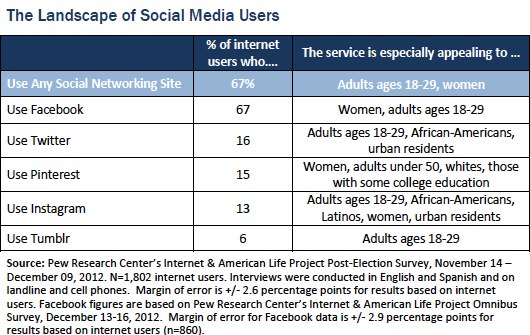
  • Forget Facebook, Twitter and Google+. These are primarily personal and B2C social media platforms, and there are few good reasons why most B2B firms should be investing any time or resources there. In terms of demographics, it’s telling that Twitter’s top 3 profiles belong to Justin Bieber, Lady GaGa and Katy Perry, but if your B2B firm needs quantitative evidence to support dropping these social media platforms, here is some recent research from Pew Research Center:

PRN_landscape_social_media_users

  • Use YouTube Selectively. YouTube can be a very effective social media channel for B2B firms. But your video products must be sophisticated, professionally produced, and no longer than 3 minutes. Resist the temptation to include sloppy, home-made productions, or hour-long webinar presentations. They reflect poorly on your brand, and few people will watch them. Ensure that you develop ways to drive consistent traffic to your YouTube channel.
  • Build Your LinkedIn Presence. LinkedIn is 3x more effective for demand generation than either Facebook or Twitter. LinkedIn has become an essential part of the business world’s due diligence process, and your company is conspicuous by its absence. Unfortunately, few companies take full advantage of LinkedIn’s social media potential. Their corporate profiles often do not contain adequate information, they do not merchandise blog-related and other relevant content, fail to connect through industry user groups, and their employees’ profiles are inconsistent and sometimes unprofessional. Most B2B companies would be well served to invest 100% of their social marketing effort through LinkedIn.

Very often, the root cause of dysfunction and disappointment related to the application of social media tools by B2B firms has less to do with the shortcomings of the various platforms, and more to do with the lack of a coherent and articulated marketing strategy. Chances are, if a B2B firm is spinning its wheels in the morass of social media, they’re having similar challenges with traditional marketing communication channels as well.

1 Comment

Filed under Uncategorized