Tag Archives: marketing craftsmanship

Is Your Own Work Worthy of Your Signature?

Craftsmanship Requires Accountability

“Artisan” was the term used before the advent of mass manufacturing to describe people who made things or provided services with a distinctive touch and flair in which they took personal pride.

Prior to the Industrial Revolution, this included just about everyone: the shoemaker, the doctor, the dressmaker, the saddler. Artisans gave a personal touch to whatever they did, and they often carved their initials into their work.

It’s a good mind-set to have for whatever job you are doing: Would you want to put your initials on it when it’s done?

That Used to Be Us: How America Fell Behind in the World It Invented and How We Can Come Back

by Thomas L. Friedman and Michael Mandelbaum

Leave a comment

Filed under Uncategorized

Brochureware Is Not a Dirty Word

Brochureware is the term used, often with derogatory marketing implications, to describe websites consisting entirely of static pages that promote a company’s products and services, people and value proposition. Most brochureware websites contain no content that requires updating, and other than perhaps a “Contact Us” form, no interactive capabilities. Brochureware simply sits online, like a printed brochure sits on a coffee table.

A big problem for many companies, from a brand marketing perspective, is that:

  1. Their well-intentioned graphic design firm has provided them with a website with functions requiring new and refreshed content. These functions might include: “News”; “In the News”; “Upcoming Events”; “Thought Leadership”; “Case Studies”; “White Papers”; “Webinars”, etc.
  2. Although they understand the potential marketing and SEO value of those website functions, companies often lack the motivation, resources or raw material to supply them with new, relevant, engaging content on a consistent basis.
  3. As a result, website visitors might see…a company blog with only 3 posts over the past year; no press releases issued since 2009; a “Coming Soon” graphic for the In the News section; an archive of quarterly newsletters with many issues skipped; a 2 year-old white paper that’s no longer relevant; and zero upcoming events scheduled.
  4. Based on these impressions, website visitors will likely conclude one or all of the following:
  • This company is out of business.
  • This company doesn’t really care what clients and prospects think of them.
  • If this company doesn’t care what I think of them, how well will they serve my needs?

Having seriously out-of-date or missing content on your website is akin to showing up to a first meeting with a prospective client wearing no shoes and the same shirt you’ve worn for the past 6 months, sporting a jacket with lapels 4 inches wide. Based on first impressions, that prospect has already crossed you off his list.

If your company’s website is incurring brand damage as a result of outdated content…and if it has no intention of building disciplines to consistently feed this online beast…then your best course of action is clear:

TELL YOUR GRAPHIC DESIGN FIRM TO REMOVE ALL WEBSITE FUNCTIONS THAT REQUIRE REGULAR UPDATING.

Your company will be better served – from a brand perspective – by having a website featuring 100% static brochureware, than by having a website that aspires to be something it’s not.

Leave a comment

Filed under Uncategorized

Are You Wasting Money on Publicity?

The Value of Publicity is Based on 3 Key Factors

Every year, companies waste time, money and opportunity generating publicity that accomplishes little or nothing in terms of tangible business outcomes.

Here are a few hard truths regarding publicity:

  • Your audiences are unlikely to notice the exposure, or do anything about it.  Even with content shelf-life driven by intelligent SEO management, there is simply too much information, too many online and offline media sources, and too little time in the day for your customers, prospects and referral sources to read, see or hear your message. And if they do get your message, there’s often little motivation for them to act on it.
  • Publicity volume does not translate into business results.  A single high-value media placement that’s properly merchandised often has greater impact than a pile of press clippings. In fact, publicity for its own sake is often unfocused, with no connection to the company’s underlying value proposition or core messages; generating confusion and apathy among target audiences.
  • Some types of publicity have significantly greater marketing value than others. The old PR adage that “There’s no such thing as bad publicity” may work for Lindsay Lohan, but it has no application for companies that care about their brand. To calculate the media placement value of various types of publicity (see chart above), Highlander Consulting uses three key criteria:
  1. BRAND RISK – If you have little control over how your company’s reputation or intellectual capital is presented – such as in a feature story where a reporter or editor will seek to produce “balanced coverage” by presenting negative items or including a competitor – then the publicity has inherent brand risk. (Value Scoring: +1 if you have total control over content; -1 if you have little or no control.)
  2. CREDIBILITY – Often called “masthead value,” this factor is based on how well the media source is recognized and respected. The potential value of the publicity is based in large measure on the underlying credibility of the source, because the exposure supplies an inherent 3rd party endorsement. (Value Scoring: +1 if the source has strong credibility; -1 if it has low credibility.)
  3. MERCHANDISING POTENTIAL – This often overlooked factor is sometimes mistakenly called “reprint value,” but Merchandising Potential encompasses far more, relating to how easily and how broadly the media exposure can be leveraged to support and drive specific marketing goals. Simply posting publicity on a website does not deliver a high ROI.  (Value Scoring: +1 if the publicity has a range of applications; -1 if it’s limited to one or two.)

Using this ranking methodology, and as reflected in the chart above , bylined articles and OpEd pieces published in credible sources typically deliver the highest marketing ROI; while inclusion (being mentioned or quoted) in a round-up news or feature story does not score well. Most home-grown efforts, such as self-published press releases, have very little value.

By using this formula, or a similar methodology, to evaluate the potential ROI of individual publicity tactics, and by building media and marketing strategies around only high-value activity,companies can consistently make the connection between publicity and tangible business results.

Leave a comment

Filed under Uncategorized

Are Your Customers Brand Terrorists?

The old marketing adage is that customers can either be brand ambassadors or brand terrorists, depending on how they’re treated.

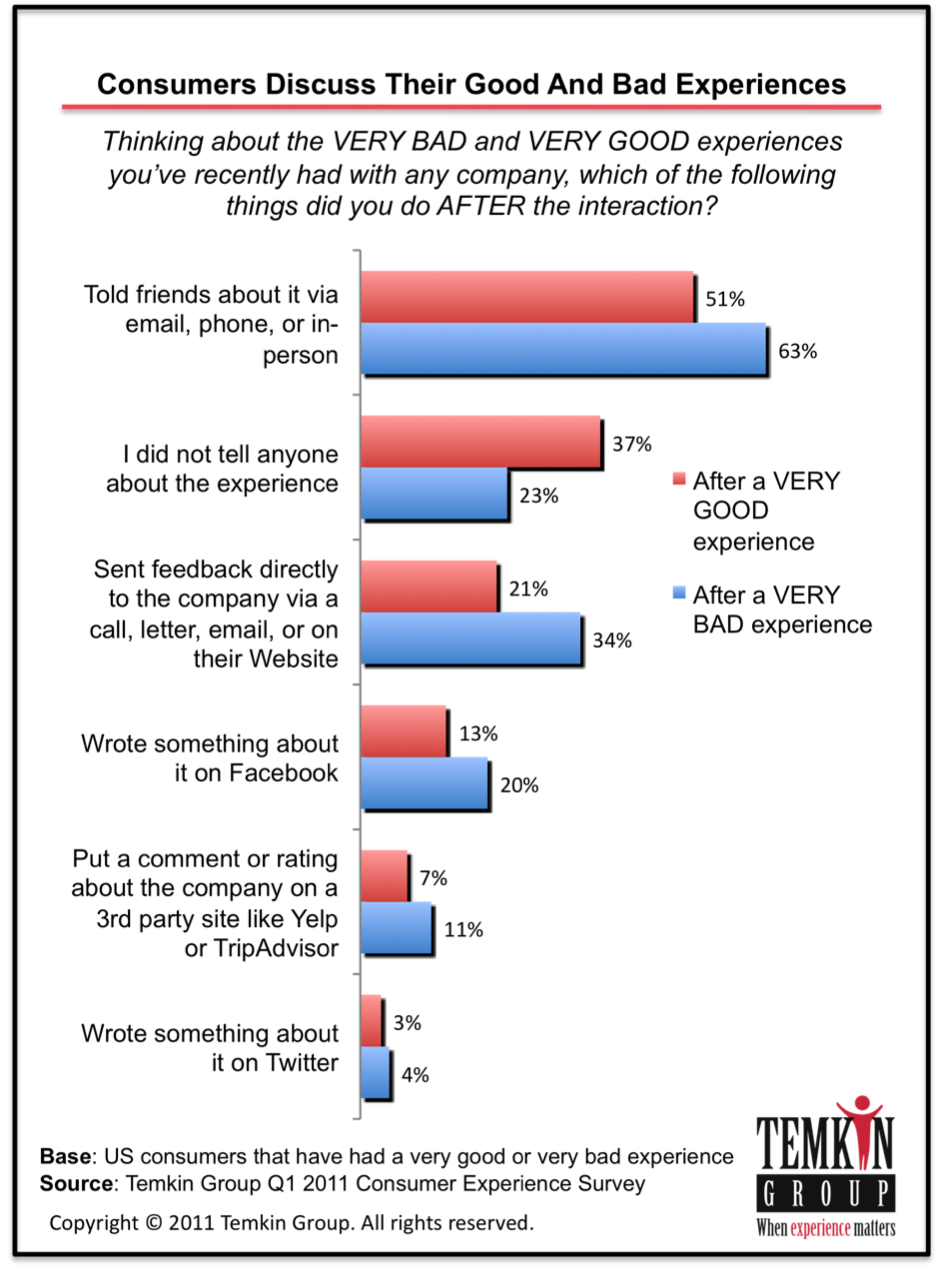
Former Forrester Research analyst Bruce Temkin (now managing partner of Temkin Group) is a guru of the Customer Experience Management (CEM) discipline…and there are some interesting insights for marketers in Temkin Group’s Q1 2011 Customer Experience Survey, including this one:

Are traditional channels the best battleground to fight brand terrorists?

It appears as though customer terrorists are most likely to inflict brand damage in direct conversations with friends; either on the phone, through email or in person (63%), and it’s tough for companies to counter those assaults. In fact, Word-of-Mouth research firm Keller Fay Group estimates that 90% of all customer conversations about brands in the US – both positive and negative – happen offline.

From a defensive standpoint, a company’s greatest opportunity to address customer grievances occurs when they appeal directly to the company through phone calls, email, letters and website comments, which according to Temkin occurs about 34% of the time.

Despite all the buzz about the power of social media as a CEM tool, most customers are not spending much time complaining on Facebook(20%); on 3rd party opinion sites such as Yelp or TripAdvisor (11%); or on the darling of social media, Twitter (4%).

Perhaps all the social media hubbub – at least in part – serves as a convenient distraction for companies that have failed to deliver on the most widely used CEM channels: phone, chat and email?  If you’re looking to convert customer terrorists into brand ambassadors, those channels still appear to be the best places to invest time and money.

Leave a comment

Filed under Uncategorized

Will Internet Transparency Devalue Craftsmanship?

As online access to information and insight into a broad range of professional and technical skills becomes more widely available, will “knowledge worker” craftsmanship become an anachronism?

For decades, medical schools have told students that patients want the Three As: Accessibility, Affability and Ability…in that order. Med students are taught that “patients don’t care how much you know, until they know how much you care.” With the exception of Dr. Gregory House, most physicians understand that bedside manner often trumps a correct diagnosis or successful procedure. And insurance company research shows that physicians who apologize to patients for their errors are sued for malpractice far less often than those physicians who “lawyer up.”

Increasingly, online search and social media transparency will enable us to understand, manipulate, second-guess and validate the counsel of every professional discipline. If motivated, you can learn as much as your CPA knows about arcane tax laws, as much as your lawyer knows about divorce agreements, or as much as your real estate broker knows about mortgage lending.

With this level of virtual transparency, what’s the motivation for any knowledge worker to excel in their profession? If knowing only what’s necessary becomes sufficient – to avoid embarrassment and lawsuits – then why should any professional seek excellence? Rather than studying IRS rulings, is your accountant better served, in terms of business development and retention, by inviting clients and prospects out for a round of golf, dinner and drinks? As the client, would you prefer to be schmoozed by your CPA, or to have him increase your tax refund by $1,500? Would you even know if he’s capable of doing a better job for you? Maybe that’s why you’ve already replaced him withTurboTax.

Google, Twitter and TurboTax notwithstanding, as a knowledge worker, I take some solace in having seen that information and tools are often no substitute for experience. Several years ago, I was asked by a new client to create an integrated marketing strategy to serve as that company’s detailed blueprint to be implemented entirely by the CEO and his young, in-house marketing director. Two months later, the CEO engaged me again, to help his marketing director make the plan actually work.

So keep your former CPA’s phone number, because your TurboTax customer service rep will not be helpful at a tax audit with the IRS.

My guess is that true craftsmen in any profession will leverage online transparency to enhance their skills, rather than to use it as an excuse to join the status quo.

2 Comments

Filed under Uncategorized

Is Your Website Content a Brand Liability?

Either Feed the Content Beast or Don't Create One

Either Feed the Content Beast or Don’t Create One

Distracted by all the social media buzz, it’s easy for a company to lose sight of the fact that their website remains the mother ship of brand expression and commerce. The standard marketing approach – particularly among B2B firms – is to create a brochureware-esque “Who We Are / What We Do / Why You Should Select Us” web presence, which forever serves as a handy repository for press releases, case studies, white papers and other expressions of thought leadership. For many firms, “build it once & fill it with stuff” is considered effective website management.

What often happens – soon after LAUNCH COMPANY WEBSITE is crossed off the corporate to-do list – is that companies don’t apply the same standards of excellence or levels of scrutiny to the content generated post-launch that were applied during development of the website’s original core content.

For a host of political and practical reasons, inappropriate and ineffective web content gets posted; sorely outdated content is granted lifetime tenure; and assorted layers of information…in WORD documents, PDFs, YouTube videos, podcasts, webinars…all obscure the company’s core messages and brand positioning.  When it comes to website content, less is absolutely more.

If the brand police were to issue citations for website content-related abuse, some of the most common violations might include:

Vagrancy – If your most recent press release, example of news pickup, or last blog posting is more than two months old…website visitors will wonder “Are these guys still is business?” or “Is this how they will keep up with my needs as a client?” If a company can’t produce and maintain a fresh inventory of content, then from a brand perspective it’s better off without having any content at all. Dump the dated material and put a bullet in the blog with few posts.  If you’re unable to trash the old content, at least bury it in an archive tab so it’s not as visible.

Prostitution – If your white papers, case studies, newsletters, webinars and other tools are nothing more than re-labeled sales pitches…website visitors will classify you a self-promoter and discount the credibility of all the information on your website.  Admittedly, it’s often a battle for marketers to convince a CEO or Sales VP that their company needs to produce content that empowers prospects to draw their own conclusions…but pursuit of that cause is well worth the effort, if only in terms of professional self-respect.

Hoarding – If your company believes its content is so proprietary that visitors must be registered and approved to gain access to it, then you’re a prisoner of Web World 1.0, and here’s a news flash from 2014: Online content that requires registration is no longer an effective carrot to generate leads.  Your company’s intellectual capital – showcased in website content – is its most valuable asset. If you restrict access, potential customers are more likely to move on to a competitor than they are to request permission to see it.

B2B companies will increasingly be tasked with having to feed new, relevant content to the online beasts that now rule our world. But rather than approach this as an endless, thankless chore, they need to embrace the opportunity to promote their expertise. A company that’s unwilling or unable to invest the resources necessary to keep their website current and vibrant needs to re-think how it presents its brand online.

[Previously published at http://prbreakfastclub.com/2011/04/08/content-marketing-liability/]

Leave a comment

Filed under Uncategorized