
Tag Archives: #marketing

An End to B2B Social Media Madness

20070805-humanLemmings

Rapid, lemming-like adoption of social media tools by small and medium-sized B2B firms – fueled by an army of self-proclaimed social media experts – has resulted in wasted dollars, missed opportunities and heightened distrust of the marketing function in the C-suite. As if CMOs needed another cause for termination.

The past decade’s social media debacle is akin to introduction of desktop publishing in the early 1980s, when personal computers arrived in the business world. New software programs enabled companies, for the first time, to design and produce their own graphic materials in-house. Every company needed desktop publishing; corporate bean counters promoted the cost savings; anyone who learned how to use the software claimed to be a graphic designer, and the trend resulted in the most unprofessional and ineffective marketing & sales collateral every produced. Over time, even the bean counters came to understand that misapplied technology can be very costly.

The impact and potential of social media is far more significant than desktop publishing, but this also means that its range of casualties and cost of misapplication are exponentially greater. Simply, there are far too many B2B companies that are either:

–  using inappropriate social media tools,

–  not using appropriate social media tools correctly, or

–  missing opportunities to use appropriate social media tools.

At the risk of generating a firestorm of debate from social marketing gurus armed with clicks, likes, re-tweets and other forms of meaningless ROI validation, and based on the social media casualties we’ve seen or treated first-hand, the following guidelines are suggested for small and medium-sized B2B firms:

  • Focus on Your Website. This is the online mother ship of your brand. Don’t bother with social media tactics unless this tool is all that it can be. If your website has not been refreshed and updated in the last 3 years (which means more than simply sticking press releases in the “News” section), then your company is due for an overhaul.
  • Blog Correctly, or Don’t Have One. A company blog is the most effective way to leverage social media. But if you are unable or unwilling to generate meaningful content on a consistent basis (at least twice a month), or to merchandise your blog content properly (which means taking specific steps to promote the content with target audiences), then do not start a blog. If you already have a blog and you’re not meeting those goals, then shut the blog down. It’s a brand liability.
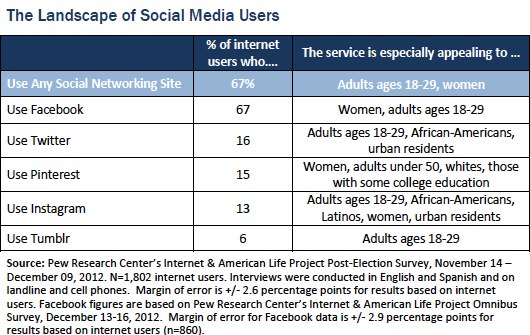
  • Forget Facebook, Twitter and Google+. These are primarily personal and B2C social media platforms, and there are few good reasons why most B2B firms should be investing any time or resources there. In terms of demographics, it’s telling that Twitter’s top 3 profiles belong to Justin Bieber, Lady GaGa and Katy Perry, but if your B2B firm needs quantitative evidence to support dropping these social media platforms, here is some recent research from Pew Research Center:
PRN_landscape_social_media_users

  • Use YouTube Selectively. YouTube can be a very effective social media channel for B2B firms. But your video products must be sophisticated, professionally produced, and no longer than 3 minutes. Resist the temptation to include sloppy, home-made productions, or hour-long webinar presentations. They reflect poorly on your brand, and few people will watch them. Ensure that you develop ways to drive consistent traffic to your YouTube channel.
  • Build Your LinkedIn Presence. LinkedIn is 3x more effective for demand generation than either Facebook or Twitter. LinkedIn has become an essential part of the business world’s due diligence process, and your company is conspicuous by its absence. Unfortunately, few companies take full advantage of LinkedIn’s social media potential. Their corporate profiles often do not contain adequate information, they do not merchandise blog-related and other relevant content, fail to connect through industry user groups, and their employees’ profiles are inconsistent and sometimes unprofessional. Most B2B companies would be well served to invest 100% of their social marketing effort through LinkedIn.

Very often, the root cause of dysfunction and disappointment related to the application of social media tools by B2B firms has less to do with the shortcomings of the various platforms, and more to do with the lack of a coherent and articulated marketing strategy. Chances are, if a B2B firm is spinning its wheels in the morass of social media, they’re having similar challenges with traditional marketing communication channels as well.

1 Comment

Filed under Uncategorized

5 Ways to Merchandise the “Masthead Value” of Publicity

Not to be confused with "The Wall Street Transcript"

Not to be confused with “The Wall Street Transcript”

Many companies will invest considerable effort seeking positive publicity in influential media sources, and then fail to benefit from the masthead value of that exposure.

Originally a seafaring term relating to the brass plate attached to a ship’s mainmast that memorialized its owners and builders, a publication’s masthead lists the members of its current editorial and production staff. The industry term “masthead value” can be defined broadly as the level of stature, credibility and influence associated with a specific media source. The Wall Street Journal, for example, has high masthead value; the Wall Street Transcript…not so much.

Masthead value can be relative. A respected trade or professional publication in a particular industry may have greater masthead value – in terms of its influence with a particular audience – than well known publications such as the Wall Street Journal or New York Times. For example, physicians are likely to assign the New England Journal of Medicine greater masthead value than the Journal or Times on topics relating to clinical care of patients.

Masthead value should drive your publicity strategy. A placement from a single highly respected source can be far more valuable, in terms of influence, than a dozen hits with low masthead value. Because gaining inherent 3rd party endorsement is the end goal, in the publicity game quality always trumps quantity.

Here are 5 ways to leverage media placements with strong masthead value:

  • Put high value placements directly in front of your target audiences – Even if your coverage appears on the front page of the Wall Street Journal or makes the cover of Fortune magazine, don’t assume it will be read by clients, prospects, referral sources…or even by your employees. There’s simply too much offline and online noise to ensure that any media exposure on its own will gain the attention you’re seeking. If you’ve developed an internal CRM-driven discipline to communicate directly and regularly with target audiences, then you’re well prepared to apply that distribution capability to increase the chances that decision makers will notice, remember, and respond to your high value exposure. (Lacking that discipline, your time may be best spent building an effective distribution capability, in advance of seeking additional publicity.)
  • Avoid “Hey, look at me!” self-promotion – Pickup in a media source with high masthead value provides some reason for high-fives internally, but it should not serve as a platform for self-promotion. Extreme examples of this error include companies that issue a press release, or generate Twitter and Facebook postings to announce, for example, that their CEO has been profiled in Inc. magazine. This type of over-reaction to high value publicity suggests to target audiences that you were surprised to receive the media endorsement, and therefore may not have really deserved it. The key is to showcase the media exposure in a relevant context (you may need to create this), to make the media placement secondary to the underlying content (such as the reasons why your CEO was profiled in Inc.) and to pull off these tasks with a matter-of-fact level of self-confidence.
  • Rank graphics over content, in terms of impact – Most people are surface readers. Online visitors are more likely to scan images, heads, subheads and captions, than they are to read body copy. (Long blocks of copy on websites that require scrolling are rarely read.) If you’ve earned a placement with high masthead value, you can increase the likelihood of your company being associated with the “endorsing” publication by displaying its logo with the capsule description and link to the placement. To be clear: the critical element is the logo. If your placement is from the New York Times, for example, you should replicate the logo – as it appears on the front page of that publication. Based on how people gather information, simply typing, “from The New York Times,” or a similar attribution, is about 75% less effective than actually depicting the New York Times logo.
  • Prominently showcase high value placements – If you’ve invested and succeeded in generating media placements with high masthead value, why make it difficult for target audiences to find them on your website? Rather than burying influential publicity in an obscure “In the News” section that requires multiple clicks for visitors to locate, you can amortize your investment in publicity (and perhaps improve your website’s bounce rate in the process) if you create a location for these high value items on your home page. This can be accomplished by applying a design format in which the content either remains fixed or is refreshed regularly. For formats that supply current information, extend the shelf-life of each placement by not including its publication date.
  • Cite a relevant endorsement on your home page – One of the most effective  ways to  merchandise high-value media exposure is to select a very brief, relevant phrase from the coverage, for placement in a prominent position on your home page. Here’s a hypothetical example:

“…a recognized authority in Big Data technology.”

                                                       –Wired Magazine

By limiting your publicity efforts to media placements with high masthead value, and by ensuring that those placements are effectively merchandised through direct communication, social media tools and proper website visibility, PR practitioners will spend far less time worry about the ROI of public relations. The fruits of their labors will be self-evident in tangible business metrics, ranging from lead generation to high search engine page rankings.

Leave a comment

Filed under Uncategorized

Should I Rekindle My Blog Love Affair…Or End It?

Can This Blog Affair Be Saved?

Can This Blog Affair Be Saved?

Here’s a sad letter from the Marketing Craftsmanship mailbag:

Dear Marketing Guy,

I’ve fallen out of love with my Blog and I need your advice. My sad story:

It was love at first sight. A company Blog had everything I was looking for in social media. It would drive SEO. Establish thought leadership. Engage clients and prospects. Create two-way communication. Build long-term relationships.

My competitors all had Blogs, and I needed one. It would complete my marketing.

Falling in love with my Blog was so easy. WordPress.com was the perfect matchmaker, and my Blog didn’t cost me a penny to build. I had big plans for my Blog. Topics we would cover together. Discussions I would moderate. I made a personal commitment to post regularly. My Blog and I would create beautiful leads together.

It was a great love affair…at least for a while.

After a few months, my Blog started demanding more of my time. But my Blog wasn’t living up to expectations. Few people visited, only employees commented on posts, and there were no leads in sight. My disappointment grew, but my Blog demanded even more content. “I need interesting ideas, not sales promotion,” my Blog would scream. We grew further apart. Weeks, and sometimes months, passed between posts.

Now, my blog and I are the office joke. Blog visitors wonder if my company has a pulse. My Blog has become a brand liability. I can’t look at the company’s website anymore, because my Blog is always there, reminding me of our failed relationship.

Does my Blog deserve a second chance? Or should I simply move on? Help!!!

Yours Truly, Blog Gone Wrong

Dear Blog Gone Wrong,

Lots of companies fall out of love with their Blogs. I feel your pain, but you’ll get little sympathy from me. Here are  a few questions to start you thinking about why your Blog relationship fell apart so quickly:

  • Was your Blog part of an integrated marketing strategy…or just a temporary infatuation?
  • Did you create an editorial calendar to provide content focus…or made promises you could never keep?
  • Did you assign sufficient resources to ensure your Blog’s long-term success…or were you just looking for a cheap date?
  • Was there a strategy to promote your Blog and to merchandise its posts…or did you think that would just “happen”?
  • Were there tangible and realistic business metrics to measure your Blog’s ROI…or did you think pre-nuptuals would kill the relationship?

My guess is that you were attracted to your Blog’s many fine features and benefits, but were unwilling to invest the time and resources necessary to build a meaningful, long-term relationship. If that’s the case, you really don’t deserve a Blog.

You might be better suited for a relationship with a Twitter account.

The Marketing Guy

2 Comments

Filed under Uncategorized

What the US Marines Can Teach Your B2B Firm about Marketing and Sales

Every Marine a Rifleman

Every Marine a Rifleman

“Every Marine a Rifleman” is a basic tenet of the US Marine Corps.  At boot camp, every marine receives training in marksmanship, hand-to-hand combat and teamwork. Regardless of how (s)he ends up serving in the Corps – as a mechanic, lawyer, clerk, pilot, dentist or pastry chef – every marine is prepared and expected to apply their combat training whenever it’s required. That rifleman commitment serves as a tactical cornerstone of the Marine Corps’ Semper Fi (“Always Loyal”) motto.

B2B companies – professional service firms in particular – can benefit by creating a culture similar to the Marine Corps; training all employees with basic marketing & sales skills that can help the firm to grow and succeed. “Every Employee a Sales Rep” should be fully ingrained across a company’s work force, from the front desk to the corner office.

Many B2B firms – in legal, accounting, financial services and consulting disciplines – employ at least one rainmaker, typically a founding member, who brings in the lion’s share of new business. But that “outside / inside guy” dynamic puts a company at risk, because rainmakers can depart unexpectedly (by choice or by ambulance), and the firm’s growth rate is always limited by their energy, motivation and availability.  More importantly, this business model fails to leverage a firm’s “inside guys,” whose individual and collective business relationships, skills, experience and credibility should be harnessed to drive consistent revenue growth and to scale the operation.

Regardless of their title, job description or capacity to work the room at a social event, every B2B executive should be given training, tools and ongoing support that empowers them to:

  • Manage Their Personal Brand – Clients hire individuals, rather than a firm, to help them. To showcase their credentials, every account practitioner should maintain a complete and up-to-date biographical profile on the company’s website and on LinkedIn. To expand their visibility, they should also participate in at least one activity unrelated to employment, whether  that’s membership in the local chapter of a professional trade association, their daughter’s soccer team, or a fly fishing club.
  • Articulate the Firm’s Value Proposition – Many employees, even at the senior level, do not have a clear understanding of what makes their firm different from the competition, and are at a loss to provide a compelling      reason why someone should engage them. Like a good marine, every employee should know their firm’s “elevator pitch,” and be prepared to recite it whenever someone asks, “So…who do you work for?”
  • Nurture Their Professional Network – Every practitioner has a network of current and former clients, associates in other disciplines, friends, relatives, neighbors and individuals they’ve met at conferences or social events.  Business contacts are often included in the firm’s CRM system, and may receive quarterly newsletters or other communications issued by the company. But account practitioners should also maintain direct and regular contact with their entire personal network in order to nurture and expand those relationships, because referrals are driven by casting a wide net.
  • Drive Top-of-Mind Awareness – The marketing challenge for most B2B firms is making the short list of candidates called in for an assignment. To increase their odds of getting that call, firms must constantly sow seeds with clients, prospects and referral sources, driving top-of-mind awareness regarding the firm’s capabilities and credentials. Every practitioner should play an active role in that process by generating relevant content – in the form of blog posts, bylined articles, case studies, industry updates, slide presentations, etc. – that can be merchandised by the firm to keep the firm in play.
  • Sell Intrinsically – Because “inside guys” embody the firm’s intellectual capital and deliver its services and solutions, they are best prepared to demonstrate to prospects and clients the firm’s capacity to add value, which is its most powerful sales tactic. Intrinsic (or “consultative”) selling is what converts prospects to clients, and not including account practitioners in the sales presentation process can handicap a firm’s growth potential.
  • Seek Cross-Selling Opportunities – The professional practitioner assigned to an account is the steward of that relationship. As a trusted advisor, the practitioner has an in-depth understanding of each client’s current needs, as well as insight into what additional services might be of value. Based on that 360° perspective, the account practitioner is in the strongest position to recommend new services or an expansion of existing work. But many practitioners fear this solicitation will compromise their professionalism, or put the client relationship at risk. Both of those obstacles to increasing account penetration can be addressed with proper tools and training.
  • Ask for Referrals – This is a tough task for most account practitioners.  However, if they’ve nurtured their network, gained confidence by learning how to cross-sell to existing clients, and have rehearsed the referral request process, then practitioners can make this a painless routine.

“Every Employee a Sales Rep” will not be achieved simply by establishing firm-wide mandates. The program must be driven by internal disciplines – consisting of written guidelines, worksheets and in-house training – that provide employees with proper guidance, support, feedback and motivation. Combined with a senior-level commitment to change the culture, and firm-wide acknowledgement that the transformation will be difficult, your B2B company can greatly enhance its sales and marketing capability. Semper Fi.

1 Comment

Filed under Uncategorized

4 ½ Reasons To Avoid Using Celebrity Endorsements

With those big guns, can we be sure that Tony's not using HGH?

With those big guns, can we be sure that Tony’s not using HGH?

Here are 4 ½ good reasons to avoid celebrity endorsements:

  1. OJ Simpson
  2. Tiger Woods
  3. Lance Armstrong
  4. Oscar Pistorius

4.5  Elmo the Muppet

The marketing world is littered with celebrity endorsements similar to these train wrecks. Yet companies will continue to dole out lucrative contracts to sports heroes, actors, politicians and other personalities du jour…in hopes of leveraging their popularity or notoriety.

Why do marketers continue to roll the dice with their company’s brand reputation?

One reason: celebrity endorsements require no creativity and very little effort. Nike’s ad agency simply shoots some footage of Tiger bouncing a golf ball 25 times off the face of a pitching wedge, and voila…there’s a 30-second commercial.

Companies rationalize this brand risk by assuming that the public will assign them some sympathy for having been duped by the murdering, philandering or drug abusing ways of their fallen celebrity. Marketers also may believe a celebrity’s fall from grace will provide their company with an opportunity to publicly cancel the contract, express sorrow or indignation, and gain additional time for their brand in the public spotlight.

But in terms of long-term brand management, association with a celebrity who’s fallen from grace is a losing proposition. For starters, it demonstrates poor judgment. So ignore the assurances from your ad agency, even if the celebrity they’re proposing is Mother Teresa.

But if you’re determined to use a celebrity, it may be a safer bet to hire an animal than a human. To my knowledge, RinTinTin never bit anyone, but Orca whales have a very poor track record.

Better yet…create your own celebrity. The Geico Gecko, Kellogg’s Tony the Tiger, and StarKist’s Charlie the Tuna all have clean rap sheets. So far.

Leave a comment

Filed under Uncategorized

The Lost Marketing Art of Ink on Paper

Time to temper our love affair with pixels on a screen?

In a pre-pixilated world in the not too distant past, Ink on Paper ruled the world of marketing.

Capabilities brochures, annual reports and other print collateral – complete with blind-embossing, foil-stamping, perfect binding, die-cutting and spot-varnished photos – served to explain, sell and educate. Graphic designers used drafting boards, rulers and glue. They understood the difference between a sheet-fed and web offset printing press, could distinguish between thermography and engraving, and spent hours studying paper stock samples, typefaces and PMS color charts.

In the days of Ink on Paper, marketers reviewed press proofs; they hand-delivered advance copies of newly printed materials to their CEOs, and measured ROI based on Business Reply Card volume. Printed words and images did not move on the page. Content stood on its own, linked to nothing. And the US Postal Service was profitable.

There’s no denying the time and cost efficiencies of our online world. We now communicate more broadly, more precisely, more rapidly and with greater marketing insight than we could ever have imagined 20 years ago.

But we’ve lost a few things in our exodus from Ink on Paper:

Visceral Impact – Pixels on a screen have no weight, no dimension, no texture, no smell. Ink on Paper places something physical into a person’s hands. They open the cover and turn its pages. They can scribble notes in the margin, or rip out a photo. It’s a sensory experience that communicates on human terms, and that cannot be replicated by a PDF downloaded and created on a laser copier.

Personality – The range of creative expression using pixels is limited by the fixed dimensions of a flat glass screen. Ink on Paper lives on a canvas of unlimited graphic possibilities, in terms of size, shape, color and physical features. No scrolling is required to appreciate the design. It provides an opportunity to stand out from the crowd, to express yourself more effectively, and to make an impression that’s likely to be remembered.

Permanence – People scroll through computer screens at hyper-speed. The volume of information is unlimited, and no intellectual commitment is required of viewers. Ink on Paper moves in slow motion, forcing readers to pay closer attention to its content. Print materials possess presence and permanence, suggesting that the people and company who produced them actually exist, have nothing to hide and can be trusted.

Craftsmen in any field are quick to embrace new tools and methods that enhance their results and professional satisfaction. They also understand the importance of sticking with tactics that work well. Seasoned marketers who have thrown the baby out with the bathwater in their rush to digital communications, as well as more recent arrivals to the marketing profession who have always lived in a paperless world, would be well served to reconsider Ink on Paper as a medium.

No marketing communications program is truly integrated without that capability.

27 Comments

Filed under Uncategorized

The Harvard Cheating Scandal: Do Administrators Need “Public Relations 101”?

Harvard University announced last week that the school is investigating 125 students for possibly cheating on a take-home final exam for “Government 1310: Introduction to Congress.” After reviewing more than 250 take-home exams turned in last Spring, the Harvard College Administrative Board has opened cases involving nearly half the 279 students enrolled in the class. The school has contacted every student whose work is under review, who now face sanctions that include suspension for up to a year.

In considering whether Harvard may have caused significant long-term damage to its own reputation unnecessarily, let’s ignore some fuzzy facts and conjecture:

  • The course, as measured by the professor’s own words and behavior, did not reflect a level of academic rigor one might associate with a prestigious university.
  • Take home exams, by their very nature, are generally considered a joke by most students.
  • Apparent confusion over at least one of the exam’s questions was exacerbated by the unavailability of the professor during the exam period, causing students to seek clarification from fellow classmates.
  • It’s unlikely that such a large proportion of the class would purposely cheat on what appears to be a gut course.

In examining whether Harvard may have caused significant long-term damage to its own reputation by acting in a hasty and imprudent manner, let’s speculate on a few likely catalysts:

  • After discovering similarities in the exams, and in advance of sending out letters to the 125 students suspected of cheating, Harvard failed to consider the high likelihood that this issue would quickly become a news item. If the school had acknowledged that risk, Harvard would (or should) have announced the scandal in advance of sending out letters to students.
  • Harvard likely became aware of the possibility of negative media coverage either after a call from a reporter, or in reaction to a threat from a student (or their lawyer) to make this a public issue.
  • Regardless of when and how Harvard began to think about negative media exposure, the most significant catalyst that caused administrators to blow the whistle on the affair was a post-Penn State fear that Harvard might be accused of hiding or covering up an incident related to institutional integrity.

If this speculation is correct: that Harvard overlooked the potential media impact of its cheating inquiry, and then blew the whistle on itself mainly as a knee-jerk defensive strategy….here are two fundamental PR lessons from this brand debacle:

  1. Assume the press will always learn about a problem, and plan an offensive strategy (well ahead of time) to minimize the damage. Because Harvard has long enjoyed a pristine reputation, it’s likely that their PR professional was not involved in this issue from the outset, or they had little input.
  2. If the press is on your damaging story, or is likely to be very soon, sometimes it’s better to keep your powder dry if you haven’t planned ahead. Harvard would have been better served if the school had completed its inquiry of the 125 “cheaters” in advance of its public announcement. Even with the media pounding on its doors, Harvard would have provided those 125 students and the school’s reputation with greater justice by responding publicly that “the issue is under investigation and a public statement will be issued only after all the facts and opinions are considered.”

Ham-fisted, panic motivated PR – even when it’s disguised as a self-righteous effort to maintain academic integrity – is not behavior you’d expect from one of the nation’s smartest institutions.

Leave a comment

Filed under Uncategorized

Do Most CEOs Lack Social Skills?

Do CEOs need charm school, rather than business school?

According to a new study sponsored by Domo and CEO.com, CEOs at Fortune 500 companies are participating in social media channels significantly less than the general public. The study claims that 70% of them have absolutely no presence on social media.

On the major social networks, including Facebook, Twitter and Google+, the participation of Fortune 500 CEOs was minimal, with only 7.6% on Facebook, 4% on Twitter, and less than 1% on Google+. In comparison, more than 50% of the U.S. population uses Facebook and 34% uses Twitter.   No Fortune 500 CEOs are on Pinterest.

LinkedIn is the most popular social media site among Fortune 500 CEOs, with 26% on the network, compared to just 20.15% of the U.S. general public. Of that group, ten Fortune 500 CEOs have more than 500 LinkedIn connections, while 36 CEOs have 1 LinkedIn connection or none.

Six Fortune 500 CEOs (or more likely, their PR departments) contribute to blogs, and only one of the six CEOs, John Mackey of Whole Foods, maintains his own blog.

Given the demographics of Fortune 500 CEOs, none of this news is jaw-dropping. Older, well-established corporate guys (and gals) in the business world’s stratosphere are not wired for social media.

But here are some potential take-aways from the research:

  • The propensity of C-level executives at companies of all sizes – well below the Fortune 1000 level – to invest time on social media outlets is extremely low. Top decision-makers spend most of their day dealing directly with people within their own sphere of influence. And most C-level execs still are not convinced that social media is anything more than a technology hula-hoop that will eventually run out of steam.
  • Marketers attempting to reach and influence C-level decision-makers are still best-served by leveraging the channels that are used and respected by that target audience…including traditional business media sources and professional forums; and by seeking to influence the 2nd and 3rd tier corporate executives who provide insight and guidance for  C-level decision-makers…which may involve selective use of social media tools.
  • Aspiring CEOs may still be more likely to reach the top of the corporate ladder by joining the right country club, rather than by having 500 connections on LinkedIn.

Leave a comment

Filed under Uncategorized

The Dirty Secret Behind Sir Richard Branson’s Attack on the Suit and Tie

Joseph Stalin Refused to Wear a Tie

For Sir Richard Charles Nicholas Branson – the English business magnate known for his Virgin Group of more than 400 companies, his daredevil exploits, his humanitarian deeds, and his estimated net worth of $4.2 billion – nothing is more important than brand image.

Largely because Virgins are always in short supply, Branson serves as the personification of his brand, and works hard to nurture the image of a counter-culture, free-spirited, creative thinker who’s always ready with new solutions to old problems, eager to challenge the status quo. The public’s role is simply to accept the underlying notion that Branson’s companies all embody the same sort of energy and positive thinking that he exhibits, and to ignore the fact that several of his ventures have gone belly-up over the years.

So it’s no great surprise for Branson watchers to see him crank up his PR machine to attack formal business attire – specifically the suit & tie – as the greatest threat to capitalism since Joseph Stalin (who, ironically, was never photographed wearing a business suit.)

Evidence of Branson’s well-managed crusade to disparage the defenseless suit & tie can be seen everywhere. He’s in London snipping off $125 silk ties from people he meets. He’s in Entrepreneur Magazine extolling the virtues of the open collar workplace. He’s on CNN, with his toothy smile, explaining why it’s impossible to be creative while wearing a business suit. Here’s a sampling of the Branson propaganda:

“Suits and ties in an office are just another type of uniform, but in an arena where uniforms no longer serve any useful purpose. At one time they probably showed that the wearer was, at the very least, able to purchase and maintain a fairly expensive piece of fabric. Now, however, in an individualized, interconnected culture, your achievements speak for themselves. The suit and tie is an anachronism.”

If businessmen believed that not wearing a suit & tie would make them more creative, move them up the corporate ladder faster, or get them closer to earning their first billion dollars, they’d all be on the Branson bandwagon. If casual wear was the proven secret to success, they’d all wear pajama bottoms, tank tops and Crocs to work (which happens to be the official uniform of everyone who works from home.)

But suit & tie wearing business professionals all know two important things that Richard Branson is never likely to understand or to acknowledge:

  • Throwing on a suit and tie at 6 o’clock in the morning requires very little time or effort, and involves zero concern that what you’re wearing will be the butt of jokes at lunchtime, and…
  • Rumor has it that Virgin Menswear LLC – a new concept in men’s fashion – is currently under development by Sir Richard.

Leave a comment

Filed under Uncategorized