Tag Archives: #marketing

Marketing to Multi-Media Multitaskers?

Death of the Mono-Media Environment?

A new study from Boston College’s Carroll School of Management on the impact of multi-media multitasking has some significant implications for marketers using TV or online channels.

In a forthcoming edition of the journal Cyberpsychology, Behavior, and Social Networking, Professors S. Adam Brasel and James Gips demonstrate that, in a side-by-side challenge for multitasker attention, the computer dominates TV, but neither device holds attention for long periods.

Prior surveys have shown that 59% of Americans use their computer and television at the same time, and for those who do:

  • the computer draws the viewer’s attention nearly 69% of the time
  • neither device holds their length of gaze for long periods (< 2 seconds for TV, < 6 seconds for computer)
  • just 7.5% of all computer gazes, and 2.9% of all TV glances last for longer than 60 seconds

For companies that rely on TV or the Internet to communicate with consumers, these findings regarding the physical behavior of multi-media multitaskers raise questions about the effectiveness of both channels as a means to garner the attention of potential customers.

The researchers noted that the study did not take into account the impact of a multi-media distraction that may eventually push both TV and computers to the side, in terms of multitasker dominance: the mobile phone. According to Professor Brasel, “Assumptions about how people are using media need to be updated. The era of the mono-media environment is over.”

Marshall McLuhan has been dead for 31 years, but I’m confident he would have had something clever to say about the death of the mono-media environment.

Leave a comment

Filed under Uncategorized

Survey of 550 Ferrari-Driving Marketers

Would you please re-paint mine to match my tartan?

According to research released by Unisfair, which calls itself a “leading global provider of virtual events and business environments,” 60 percent of the 550 US marketers who participated in its online survey “plan to increase spending on virtual events and environments this year… and if budgets were not an issue, 67 percent would host 10 or more virtual events in the next 12 months.”

If “budgets were not an issue,” I suspect those 550 marketers would likely all be driving Ferrari Testatrossas. Whatever.

The survey also noted that “42 percent of marketers plan to decrease spending on physical conferences and trade shows over the next year.” Although I don’t dispute the veracity of Unisfair’s survey results, this does not square with the first-hand reports from folks at World Congress and other sponsors of live events, who claim companies are increasing spending on conferences, seminars and trade shows.

Survey results notwithstanding, whether it’s conducted live or virtually, the most significant shortcoming of event sponsorship is the failure of companies to conduct adequate pre- and post-event merchandising of the related content. An event is an opportunity to communicate with target audiences for a legitimate purpose; a way to showcase thought leadership; and (if the forum is prestigious) to leverage the inherent 3rd party endorsement of the program sponsor.

Most importantly, pre- and post-event merchandising is a great way to reach a significantly larger audience than those sitting in seats or listening in over their laptops. In fact, many events can be viewed simply as a necessary excuse to communicate with important decision makers who don’t waste time attending events of any kind.

If you’re looking for business results-driven ROI on event sponsorship, you’ll need to focus more on the content and less on the venue.

Leave a comment

Filed under Uncategorized

Quick Fix for Sales and Marketing Alignment?

Blame the CFO

According to BtoB magazine’s coverage of last week’s SiriusDecisions Summit 2011 held in Scottsdale, sales must be “pulled into the fold” by marketing, to better understand alignment and sales enablement. That was the overriding theme delivered throughout the event and reiterated on its final day.

“It’s not a question of adding systems to fix sales and marketing alignment, but rather a challenge of leadership,” according to John Neeson, SiriusDecisions’ managing director, at a wrapup session Friday. “It’s about two leaders—the heads of marketing and sales—fixing things together.”

Another common thread at this year’s summit was the need to gain C-suite buy-in for these evolving sales-marketing initiatives. Several case studies presented during the week detailed resistance to proactive sales-marketing alignment.

“One major theme here is how CFOs must begin to think about marketing, not so much as an expense but rather as an investment,” Neeson said.

Leave a comment

Filed under Uncategorized

Are Your Customers Brand Terrorists?

The old marketing adage is that customers can either be brand ambassadors or brand terrorists, depending on how they’re treated.

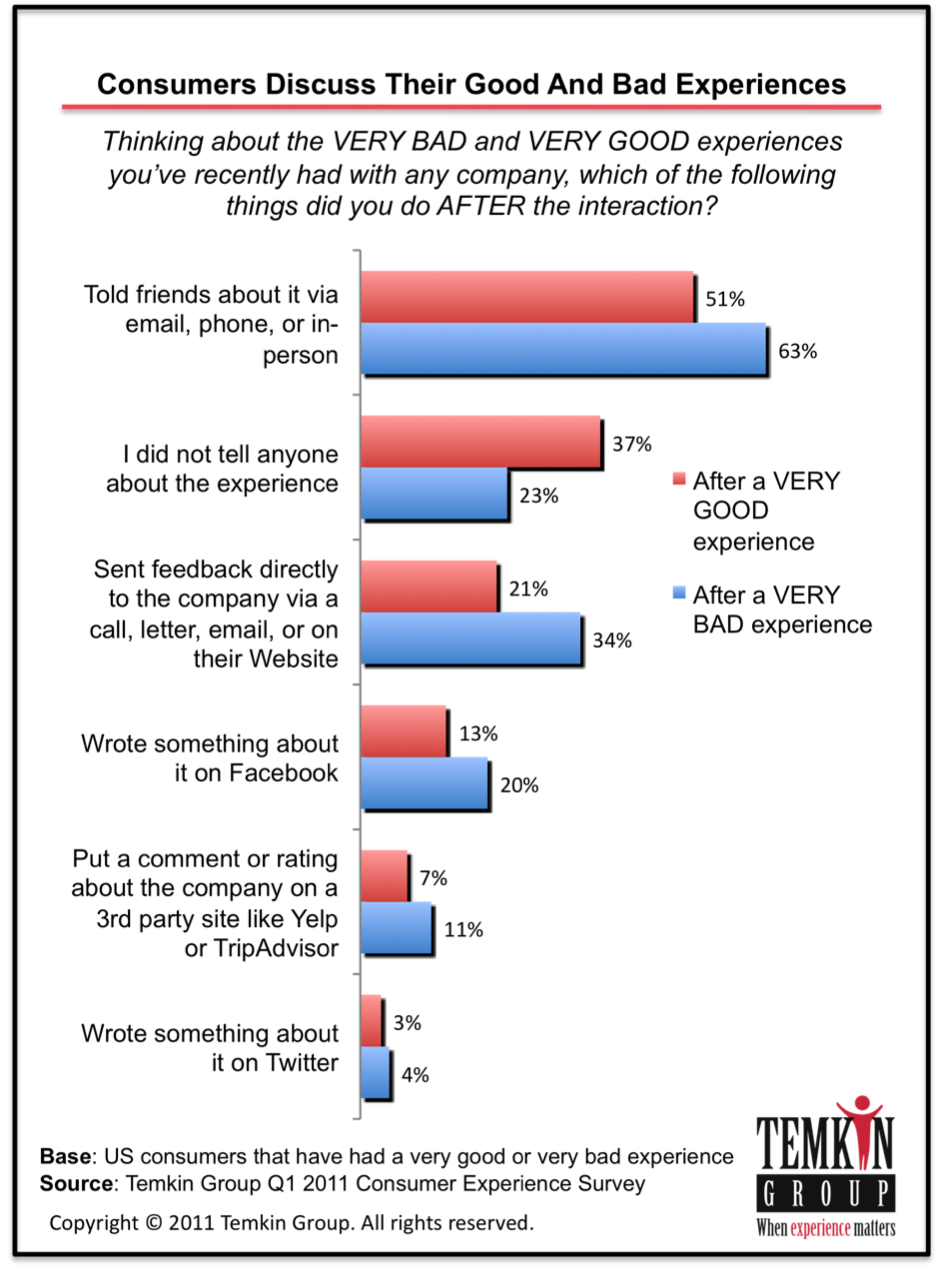
Former Forrester Research analyst Bruce Temkin (now managing partner of Temkin Group) is a guru of the Customer Experience Management (CEM) discipline…and there are some interesting insights for marketers in Temkin Group’s Q1 2011 Customer Experience Survey, including this one:

Are traditional channels the best battleground to fight brand terrorists?

It appears as though customer terrorists are most likely to inflict brand damage in direct conversations with friends; either on the phone, through email or in person (63%), and it’s tough for companies to counter those assaults. In fact, Word-of-Mouth research firm Keller Fay Group estimates that 90% of all customer conversations about brands in the US – both positive and negative – happen offline.

From a defensive standpoint, a company’s greatest opportunity to address customer grievances occurs when they appeal directly to the company through phone calls, email, letters and website comments, which according to Temkin occurs about 34% of the time.

Despite all the buzz about the power of social media as a CEM tool, most customers are not spending much time complaining on Facebook(20%); on 3rd party opinion sites such as Yelp or TripAdvisor (11%); or on the darling of social media, Twitter (4%).

Perhaps all the social media hubbub – at least in part – serves as a convenient distraction for companies that have failed to deliver on the most widely used CEM channels: phone, chat and email?  If you’re looking to convert customer terrorists into brand ambassadors, those channels still appear to be the best places to invest time and money.

Leave a comment

Filed under Uncategorized

Porno as a B2B Marketing Tactic?

Here’s an interesting insight from the Decision Dynamics survey released earlier this week. Co-sponsored by the Financial Times and Doremus, this survey of more than 500 senior-level business executives suggests that if you’re attempting to reach corporate decision-makers, you may want to want to re-consider Twitter as a marketing tactic. Fewer than 10% use Twitter at work, and only about 20% use Twitter at  home. 

Apparently there are better ways other than Twitter to leverage digital media to reach business executives;  including webcasts, podcasts, blogs and…yes, games…which is likely to be of some concern to company shareholders and laid-off employees, as it appears that nearly 40% of these senior executives spend some part of their day playing games at work.

Given the survey’s game-usage insight, here’s something that deserves additional research: if nearly 75% of senior executives frequently or sometimes “view online video” while they’re at work, what exactly are they watching?

Digital Media: % Used Frequently or Sometimes

Leave a comment

Filed under Uncategorized

Will Internet Transparency Devalue Craftsmanship?

As online access to information and insight into a broad range of professional and technical skills becomes more widely available, will “knowledge worker” craftsmanship become an anachronism?

For decades, medical schools have told students that patients want the Three As: Accessibility, Affability and Ability…in that order. Med students are taught that “patients don’t care how much you know, until they know how much you care.” With the exception of Dr. Gregory House, most physicians understand that bedside manner often trumps a correct diagnosis or successful procedure. And insurance company research shows that physicians who apologize to patients for their errors are sued for malpractice far less often than those physicians who “lawyer up.”

Increasingly, online search and social media transparency will enable us to understand, manipulate, second-guess and validate the counsel of every professional discipline. If motivated, you can learn as much as your CPA knows about arcane tax laws, as much as your lawyer knows about divorce agreements, or as much as your real estate broker knows about mortgage lending.

With this level of virtual transparency, what’s the motivation for any knowledge worker to excel in their profession? If knowing only what’s necessary becomes sufficient – to avoid embarrassment and lawsuits – then why should any professional seek excellence? Rather than studying IRS rulings, is your accountant better served, in terms of business development and retention, by inviting clients and prospects out for a round of golf, dinner and drinks? As the client, would you prefer to be schmoozed by your CPA, or to have him increase your tax refund by $1,500? Would you even know if he’s capable of doing a better job for you? Maybe that’s why you’ve already replaced him withTurboTax.

Google, Twitter and TurboTax notwithstanding, as a knowledge worker, I take some solace in having seen that information and tools are often no substitute for experience. Several years ago, I was asked by a new client to create an integrated marketing strategy to serve as that company’s detailed blueprint to be implemented entirely by the CEO and his young, in-house marketing director. Two months later, the CEO engaged me again, to help his marketing director make the plan actually work.

So keep your former CPA’s phone number, because your TurboTax customer service rep will not be helpful at a tax audit with the IRS.

My guess is that true craftsmen in any profession will leverage online transparency to enhance their skills, rather than to use it as an excuse to join the status quo.

2 Comments

Filed under Uncategorized

Is Your Website Content a Brand Liability?

Either Feed the Content Beast or Don't Create One

Either Feed the Content Beast or Don’t Create One

Distracted by all the social media buzz, it’s easy for a company to lose sight of the fact that their website remains the mother ship of brand expression and commerce. The standard marketing approach – particularly among B2B firms – is to create a brochureware-esque “Who We Are / What We Do / Why You Should Select Us” web presence, which forever serves as a handy repository for press releases, case studies, white papers and other expressions of thought leadership. For many firms, “build it once & fill it with stuff” is considered effective website management.

What often happens – soon after LAUNCH COMPANY WEBSITE is crossed off the corporate to-do list – is that companies don’t apply the same standards of excellence or levels of scrutiny to the content generated post-launch that were applied during development of the website’s original core content.

For a host of political and practical reasons, inappropriate and ineffective web content gets posted; sorely outdated content is granted lifetime tenure; and assorted layers of information…in WORD documents, PDFs, YouTube videos, podcasts, webinars…all obscure the company’s core messages and brand positioning.  When it comes to website content, less is absolutely more.

If the brand police were to issue citations for website content-related abuse, some of the most common violations might include:

Vagrancy – If your most recent press release, example of news pickup, or last blog posting is more than two months old…website visitors will wonder “Are these guys still is business?” or “Is this how they will keep up with my needs as a client?” If a company can’t produce and maintain a fresh inventory of content, then from a brand perspective it’s better off without having any content at all. Dump the dated material and put a bullet in the blog with few posts.  If you’re unable to trash the old content, at least bury it in an archive tab so it’s not as visible.

Prostitution – If your white papers, case studies, newsletters, webinars and other tools are nothing more than re-labeled sales pitches…website visitors will classify you a self-promoter and discount the credibility of all the information on your website.  Admittedly, it’s often a battle for marketers to convince a CEO or Sales VP that their company needs to produce content that empowers prospects to draw their own conclusions…but pursuit of that cause is well worth the effort, if only in terms of professional self-respect.

Hoarding – If your company believes its content is so proprietary that visitors must be registered and approved to gain access to it, then you’re a prisoner of Web World 1.0, and here’s a news flash from 2014: Online content that requires registration is no longer an effective carrot to generate leads.  Your company’s intellectual capital – showcased in website content – is its most valuable asset. If you restrict access, potential customers are more likely to move on to a competitor than they are to request permission to see it.

B2B companies will increasingly be tasked with having to feed new, relevant content to the online beasts that now rule our world. But rather than approach this as an endless, thankless chore, they need to embrace the opportunity to promote their expertise. A company that’s unwilling or unable to invest the resources necessary to keep their website current and vibrant needs to re-think how it presents its brand online.

[Previously published at http://prbreakfastclub.com/2011/04/08/content-marketing-liability/]

Leave a comment

Filed under Uncategorized

Jerry Maguire’s Mission Statement…

…Revisited

“If the tapdancing becomes less constant, less furious, less necessary, what will the result be? The result will be more honesty, more focus, fewer clients, but eventually the revenues will be the same. Because the new day of honesty will create a machine more personalized, more truthful, and the client that wasn’t bullshitted this year, has a greater chance of greatness next year.

The answer is fewer clients. Less dancing. More truth. We must crack open the tightly clenched fist of commerce and give a little back for the greater good. Eventually revenues will be the same, and that goodness will be infectious. We will have taken our number oneness and turned it into something greater. And eventually smaller will become bigger, in every way, and especially in our hearts…

Forget the dance. Focus…Love the job. Be the job.”

Jerry Maguire’s Mission Statement

  • Hikers wait for 3 years, pay $700 and travel to New Hampshire for boots made by Peter Limmer.
  • Musicians wait for 5 years, and pay more than $100,000 for a violin made by Sam Zygmuntowicz in Brooklyn.
  • Hunters and dog lovers wait years, and pay $15,000 to $20,000 for a “finished” Labrador Retriever raised by Mike Stewart in Mississippi.
  • Fly fishermen waited years, and paid up to $2,500 for reels made by Stanley Bogdan, who passed away last month at 92.
  • There’s a wait of more than 5 years for bikes built by Sacha White in Portland, at an average price of $10,000.

Leave a comment

Filed under Uncategorized